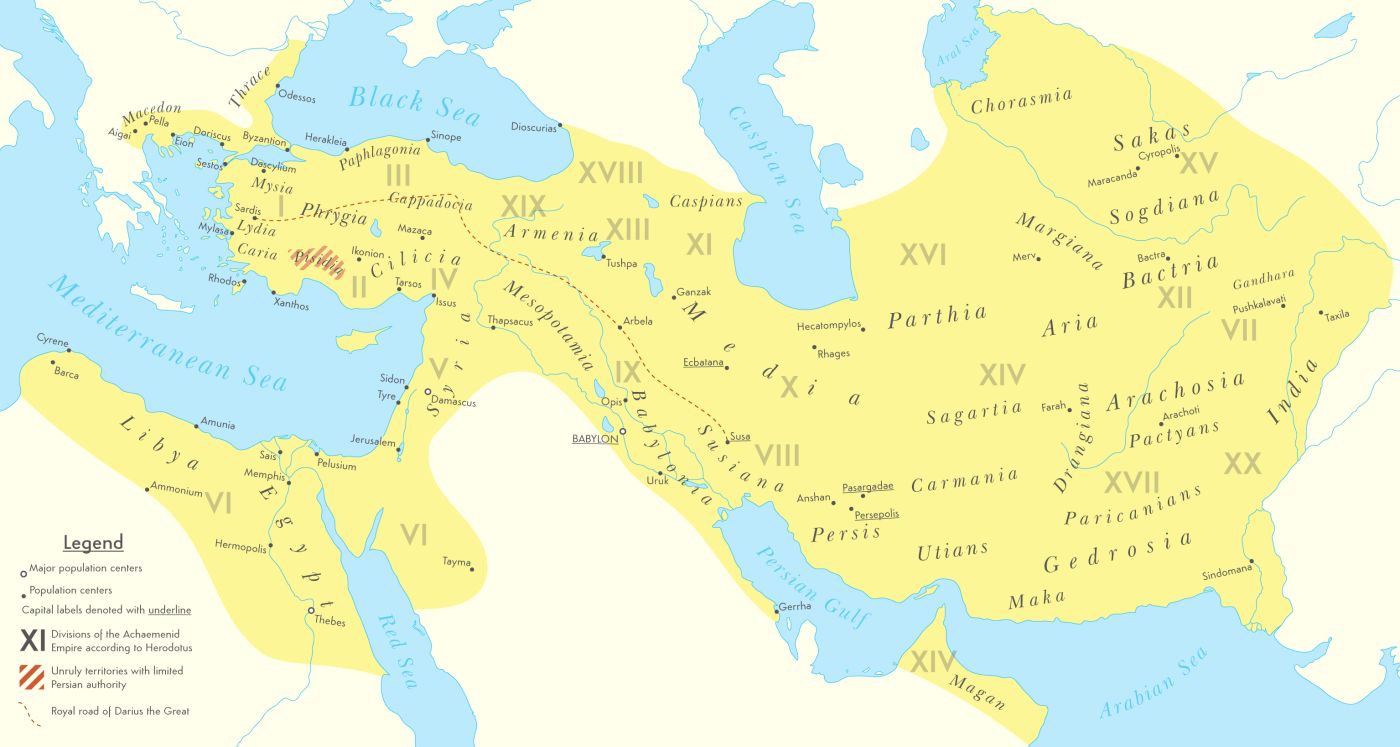
The Achaemenid Empire
The Achaemenid Empire, founded by Cyrus the Great in the 6th century BCE, was the first Persian Empire and the largest empire the ancient world had yet seen, stretching from the Balkans to the Indus Valley and renowned for its administrative innovation and policy of religious tolerance.
At its height, it was an empire so vast that its king could truthfully call himself ruler of four corners of the earth — an empire that absorbed Babylon, Egypt, Anatolia, and the fringes of India into a single, astonishingly well-administered political system. Rising from the Iranian plateau in a matter of decades, the first great Persian empire redefined what imperial governance could look like and left an indelible mark on every civilization it touched. Its story begins with one of antiquity's most admired conquerors.
Cyrus the Great and the Founding
The empire was founded by Cyrus the Great, who overthrew the Median king Astyages around 550 BCE and rapidly expanded his domain to include Lydia and then the mighty Neo-Babylonian Empire. His approach to conquered peoples was revolutionary: rather than imposing his own religion or deporting populations, he famously allowed the Jewish exiles in Babylon to return to their homeland, an act recorded in the Hebrew Bible. This Cyrus Cylinder, a clay proclamation of his tolerance, is often described as an early charter of human rights.
Administration and the Satrapy System
The empire's genius lay in its administrative structure, dividing its enormous territory into provinces governed by officials called satraps, who collected taxes and maintained order while remaining accountable to the central court. A system of royal roads — including the famous Royal Road stretching nearly 2,700 kilometers from Sardis to Susa — enabled rapid communication and troop movement across the empire. Darius I further standardized coinage, weights, and a postal relay system that made the Achaemenid state remarkably coherent for its era.
Conflict with Greece
The empire's westward ambitions brought it into repeated conflict with the city-states of Greece, producing some of antiquity's most celebrated battles. The Greco-Persian Wars (499–449 BCE) saw Persian armies suffer unexpected defeats at Marathon, Thermopylae, and Salamis, reverses that halted Achaemenid expansion into Europe and burnished Greek martial reputation for posterity. Though the empire was not fatally weakened by these conflicts, they created a lasting cultural antagonism that would define Mediterranean geopolitics for generations.
Fall and Legacy
The Achaemenid Empire collapsed with startling speed when Alexander the Great of Macedon launched his eastern campaigns beginning in 334 BCE, defeating the last Achaemenid king Darius III and burning the imperial capital of Persepolis in 330 BCE. Yet the empire's administrative frameworks, its model of multicultural governance, and its monumental art and architecture profoundly influenced the successor kingdoms that replaced it, from the Seleucids to the later Parthian and Sasanian Persian empires that consciously invoked its legacy.