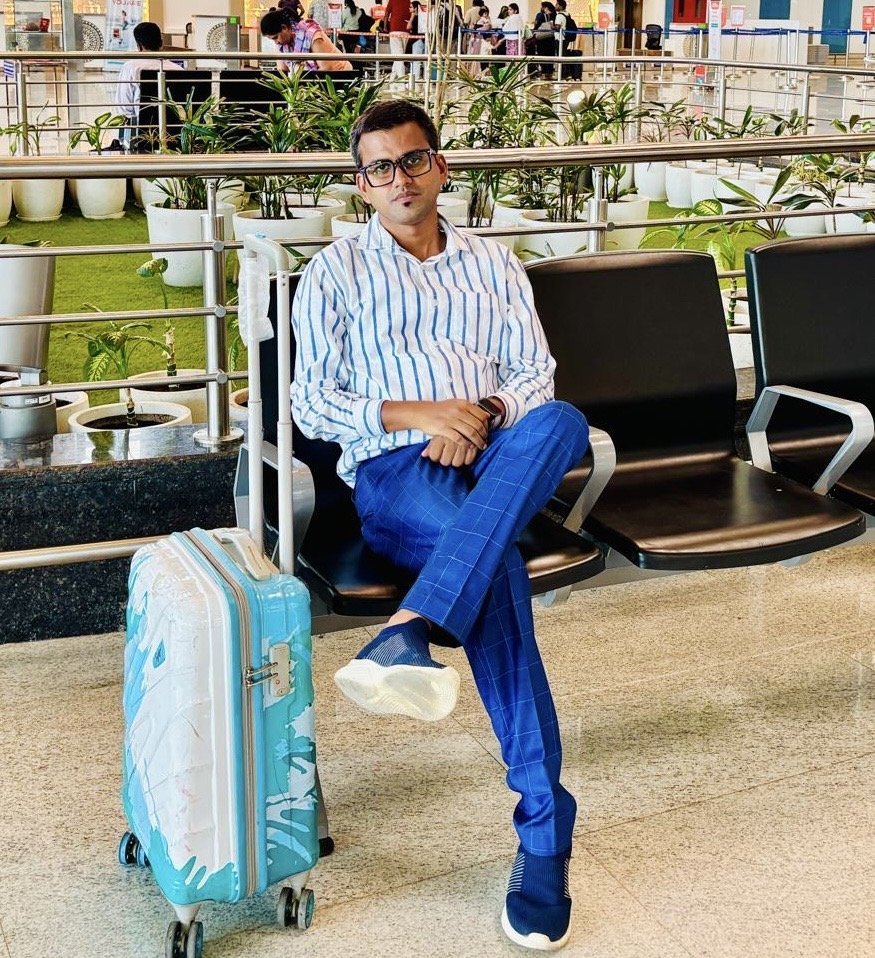
Rakesh Deb: Inspiring Journeys
Born with hemophilia and told again and again it was a curse, Rakesh Deb refused to accept it as fate. Today he runs Ridvan Academy, a school built on the belief that no one is a burden.

Rakesh Deb, Founder, Ridvan Academy
The Backstory
I was born with a rare bleeding disorder called Hemophilia, also known as the "Royal Disease", rare partly because of how expensive its only effective medicine, AHF (Anti-Hemophilic Factor), is. This was difficult for my family, but even more difficult for me was living with the disease every day, never knowing whether I'd be able to do even simple, everyday things.
Beyond the physical challenges, I faced a lot of mental and emotional stress. Neighbors, relatives, and even friends would say things like I must have committed some sin in a past life, or that my parents were being punished, and that's why I was born with this disease. Even doctors would sometimes tell my parents, with a kind of pity, that it was their "bad luck" to have a child with such a rare condition.
I wasn't satisfied with any of this, and I refused to simply accept it as my fate. I wanted a real answer: why me? Slowly, I started distancing myself from people who spoke negatively about me. At one point, I stopped attending family functions and gatherings altogether, because I knew my illness would inevitably become the topic of conversation.
Instead, I started making friends from other places, people who didn't know about my disease or the restrictions it placed on my life. I couldn't run, play sports, or lift heavy things; if I did, I'd often end up in the hospital for a week or two the very next day. But I did it anyway. I played cricket and similar games, even knowing it was dangerous, because I loved it, and my friends treated me like any other boy. I knew the risk, but I didn't care, until one day I was seriously injured during a game, and everyone found out about my condition. Somehow, I recovered.
After that, I didn't want to spend as much time with those friends, since I was often left out of games, and both my elbow and knee joints had been damaged by repeated internal bleeding.
By the time I was around 15, I started building friendships with people from farther away, again because they didn't know much about my condition. I also developed a habit of teaching young children in nearby villages through a community group.
But the question never left me: why me? I wanted a real answer, so I began attending satsangs (spiritual gatherings), but I kept hearing the same explanation, that I must have done something wrong in a past life.
I told myself: God cannot be so unjust as to punish someone for something they don't even remember. So I let that explanation go. Around that time, I met a saint who told me, "You need to search for the answer yourself, and don't stop until you find it."
God showed me the path. I loved teaching young children, so I began teaching them at home. One day, a person came to my house along with my elder brother and invited me to join a moral class. I completed the first Ruhi Book 1, and I was overjoyed. Most of my questions were finally being answered. It changed my life.
Even though I had been through many painful, sleepless nights, I finally felt at peace knowing that God had not been unjust to me. I felt as though everyone was my family, and I found love for everyone who crossed my path.
Whenever I was in good health, I found the courage to go out into the world. I remember leaving home once, traveling to another state with no money in my pocket and no medicine, thinking that even if I lost my life on the road, it wouldn't matter, but if I lived, I had to do something for society and become self-reliant.
I believe God never once left my side, from that first day until now, sending different people along the way, at just the right moments, to guide me. I know there's always uncertainty in my life, but I will try my best, up to my very last breath, to prove that I am not a burden, not to society, and not to the Hemophilia community either. We, too, can contribute to society and help build something better.
Today, I run a small school with a dream of making it one of the best schools for children in the area. I named it Ridvan Academy, "a garden of heaven."
Was the Road Smooth?
It was far from smooth. Every step came with its own challenge.
The first challenge was a lack of awareness. We lived in a rural village where illness was often seen as a curse, and it was easy to feel abandoned or lesser because of it.
Second, my family's financial situation made it hard to afford my medical expenses.
Third, I was physically limited in ways other boys my age weren't: I couldn't ride a bicycle or run like they could.
And finally, I spent much of my childhood admitted in government hospitals. My medication costs were far beyond what my parents earned, so staying in government hospitals, where I could receive alternative treatments like fresh blood transfusions instead of AHF (Anti-Hemophilic Factor VIII), became our best option for relief.
At one point, I was injured so badly that I couldn't walk for a year and a half, and I had accepted that I'd spend the rest of my life in a wheelchair. Doctors recommended surgery that would cost 12 to 16 lakh rupees, an impossible amount for my family at the time. I had resigned myself to the wheelchair until two physiotherapists from Vellore CMC (a medical college) offered to work with me using everything they knew. That gave me back my courage, and within a month of their care, I was walking again. They still call it a miracle. I felt God's presence with me through it all, and my faith gave me a new life.
The next major challenge came at the start of my career. In interview after interview, I was judged by my appearance, and once people learned about my condition, they simply turned me away. There were a few kind-hearted exceptions, people who gave me a chance to work in their schools and organizations, but often with real limitations, like unpaid leave or lower wages than other employees. I didn't let that stop me. I accepted those terms and gave my very best. Eventually, I became the Principal of a private school.
I had always dreamed of starting my own school. After two years as Principal, I left that position to open a preschool in the state. Establishing it brought a whole new set of challenges, and I worked hard to overcome each one. If I'm still here, it means I still have a purpose left to fulfill.
The Work Today
I have two goals.
First, to be an example for the Hemophilia community, to show that we are not a burden and don't have to depend entirely on others. We can live self-reliant lives, and even help others who are in need. I want to give people that same small push toward their dreams that others once gave me, because without the selfless people who helped me along the way, I wouldn't be who I am today.
Second, to build a school where moral education is valued just as much as academic education, a place that shapes people with genuine love, respect, and kindness for everyone, without difference, rooted simply in our shared humanity.
A Proud Moment
Becoming self-reliant, and being able to provide jobs to others who now support their own families through the school, that's my first success.
Second, being able to help people who otherwise couldn't meet their basic needs, especially by providing their children with a better education.
Third, watching my students grow. Despite all the mischief that comes with childhood, I see them becoming genuinely thoughtful: kind, helpful, respectful, and increasingly responsible for their own actions. That, to me, is success.
A Lesson Learned
Stay faithful, honest, and hardworking. Don't let negativity take root in your mind. Believe in yourself, and stay determined to do something that benefits not just you, but society and humanity as a whole.
What's Next
I want to keep developing the school and its infrastructure, so we can offer a better education to our students, and continue helping families who can't afford to send their children to school because of financial hardship.
How You Can Help
People can support us by sponsoring the education costs for one or more children, or by contributing funds toward developing the school's infrastructure.
Who Inspires Them
The Bahá’í Faith, and my belief in it.
Something Surprising
People are often surprised that someone who isn't able to walk properly can work so hard and take on so much, that I don't shy away from responsibility, and that the more responsibility I'm given, the more willing I am to serve.
In One Word
I am nothing, just someone trying to do what God sent me here to do.


Comments 0
Sign in to commentJoin the conversation — no account needed
No comments yet
Be the first to share your thoughts!