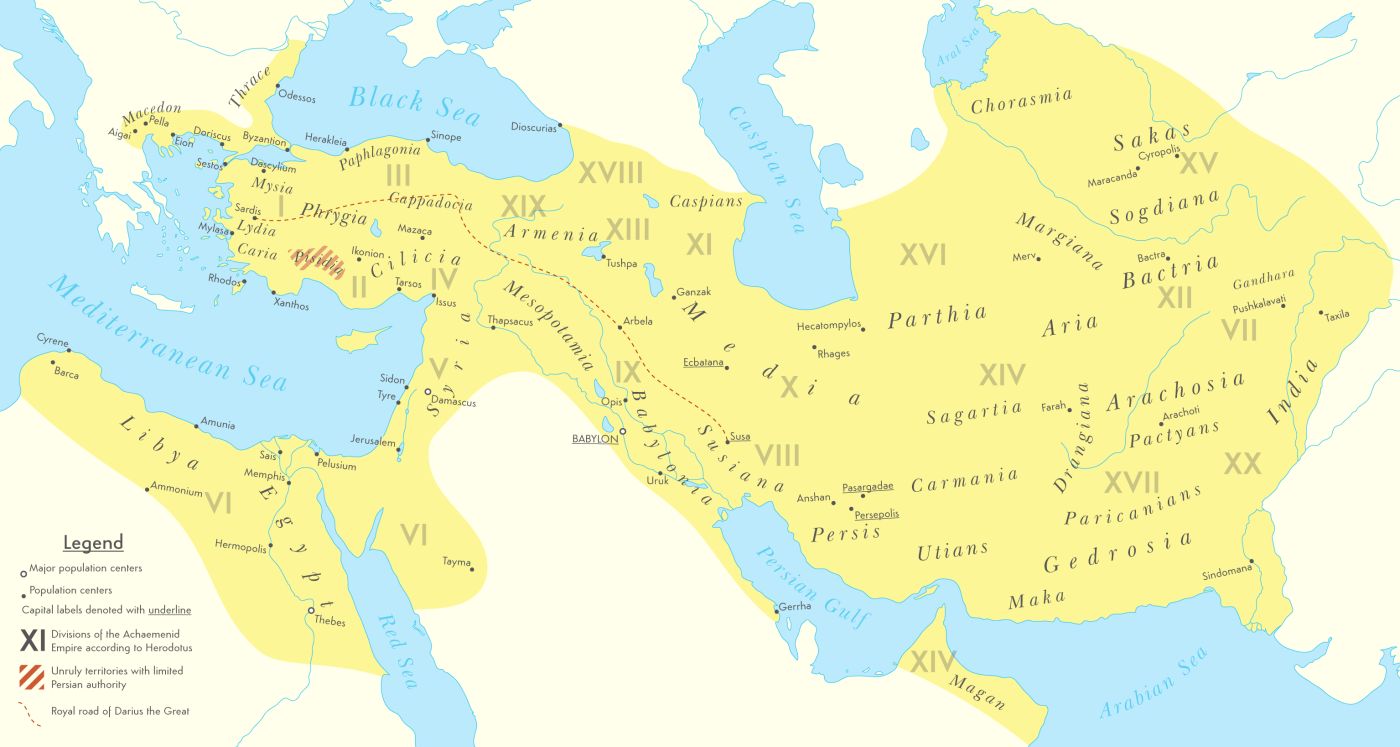
The Persian Empire
The Persian Empire, at its height under the Achaemenid dynasty, was the largest empire the ancient world had ever seen, known for its administrative innovation and relative religious tolerance.
Stretching from the Balkans to the Indus Valley at its peak, this empire governed an extraordinarily diverse population through a surprisingly tolerant and administratively sophisticated system for its era.
Founded by Cyrus the Great
The Persian Empire was founded by Cyrus the Great around 550 BCE, who rapidly expanded Persian territory through conquest while notably allowing conquered peoples to retain their own customs and religions.
An Empire of Unprecedented Scale
At its height, the Achaemenid Persian Empire was the largest empire the ancient world had yet seen, stretching from modern-day Greece and Egypt to Pakistan.
Administrative Innovation
Persian rulers developed sophisticated administrative systems, including a network of royal roads and a standardized system of provincial governance known as satrapies, that influenced later empires.
Conflict with Greece
Persian attempts to conquer Greece led to the famous Greco-Persian Wars, including the Battle of Marathon and the Battle of Thermopylae, conflicts that became foundational to later Western historical memory.
Conquest by Alexander
The Achaemenid Persian Empire was ultimately conquered by Alexander the Great in the 4th century BCE, though Persian cultural and administrative influence persisted across the region for centuries afterward.