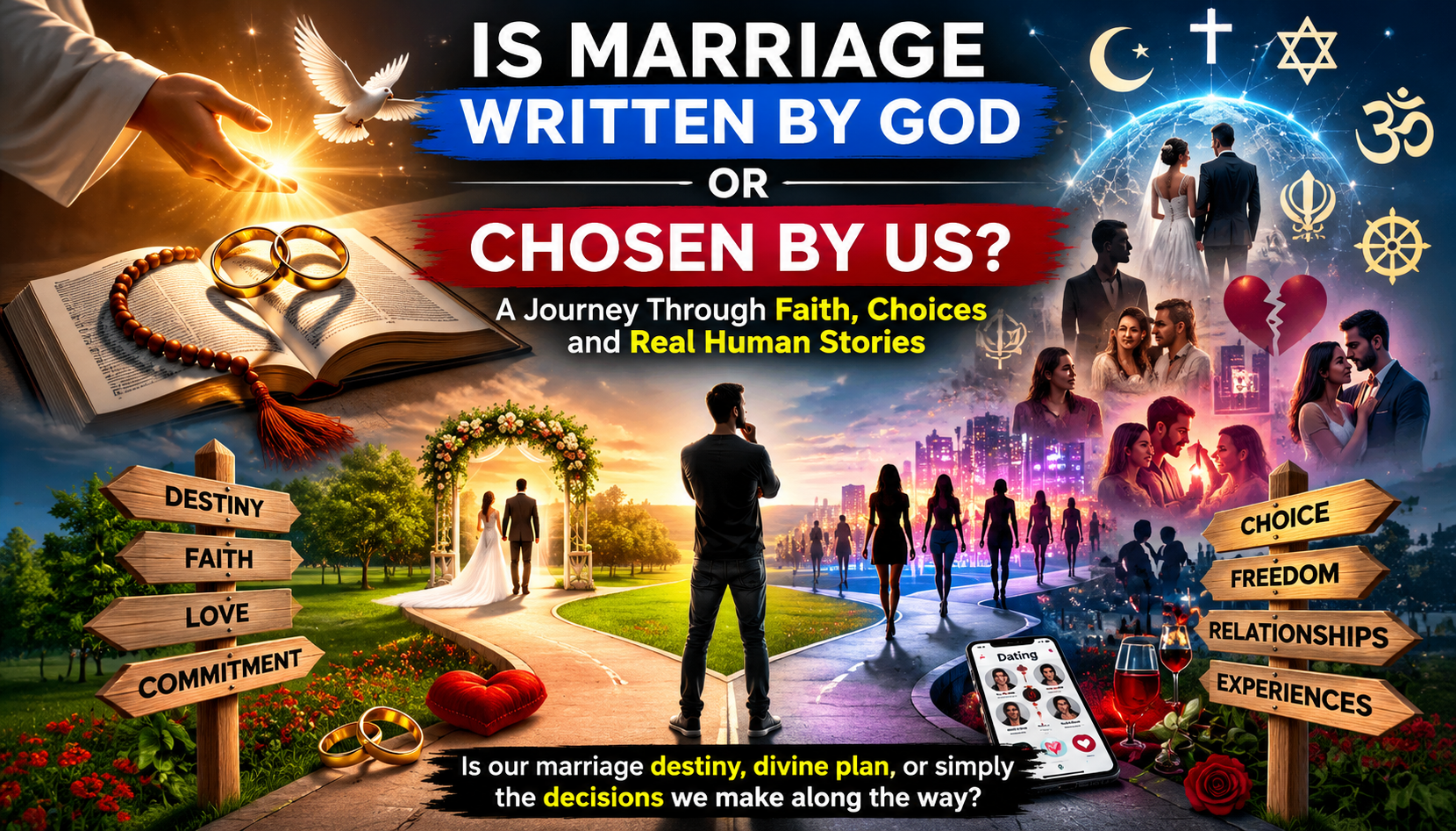
Marriage: Divine Plan or Human Decision?
For years, I believed God had already chosen my future spouse. Then I interviewed dozens of people and heard stories that completely changed my perspective. From lifelong commitment to multiple marriages, from faith to heartbreak, their experiences revealed how complex human relationships truly are. Is marriage destiny, choice, or something in between? This article explores one of life’s most fascinating questions.

Growing up, I was taught to believe that three things in life were already decided by God: our birth, our death, and our marriage. I accepted this idea with my whole heart. I believed that somewhere, long before I was born, God had already determined who I would marry. My role was simply to wait for that person to enter my life.
As I grew older, however, I began asking questions.
Marriage has existed throughout human history, but its meaning has varied across cultures, religions, and societies. In many traditions, marriage is considered a sacred bond established by God. In others, it is viewed primarily as a social contract between two people. Governments issue marriage licenses, religious institutions perform ceremonies, and families celebrate the union.
One way to look at marriage is that it grants social and legal recognition to a sexual relationship. In many societies throughout history, sexual relationships outside of marriage were forbidden and sometimes punished severely. In other societies, premarital or non-marital sexual relationships were accepted. Today, cultures around the world continue to hold very different views on sex, marriage, and commitment.
This raised an important question for me:
If marriage is truly determined by God, why do human relationships appear to be so strongly influenced by personal choices, circumstances, opportunities, and individual decisions?
To better understand this question, I began talking to people. Over time, I interviewed more than thirty individuals from different backgrounds, ages, cultures, and relationship histories. What I learned challenged many of my assumptions.
To protect their privacy, I will use fictional names.
James, a 21-year-old single man, told me he had been involved with approximately twelve partners since becoming sexually active at age thirteen.
Lylia, a 30-year-old woman who has never married, estimated that she had relationships with around thirty men and twenty women. She identifies as bisexual.
Ava, now 35, married at eighteen and later divorced. She estimated that she had been involved with more than fifty partners throughout her life. She described her marriage as wonderful at first but increasingly toxic over time. Today, she feels happier living independently.
Michael, a 45-year-old man, experienced multiple marriages. He struggled with depression during some of those relationships and worked hard to maintain his commitment to marriage. After several failed marriages, he now chooses to date without seeking another long-term commitment.
Misha, a 68-year-old woman, was married four times. Each of her husbands passed away. Throughout her life, she experienced relationships both within and outside marriage.
Peter, a 30-year-old man, described himself as someone who naturally attracts attention from women. By his own estimate, he has been involved with more than sixty partners and has never married.
While their stories were very different, a common theme emerged. Most people did not describe their relationships as predetermined events that unfolded according to a fixed script. Instead, they described choices, opportunities, mistakes, attractions, heartbreaks, personal growth, and changing circumstances.
Among all the people I interviewed, only two reported having a single romantic or sexual partner throughout their lives.
These conversations forced me to reconsider what I had believed for so many years.
Perhaps one of the greatest differences between humans and other animals is our ability to create stories, rules, traditions, and secrets around our relationships. Human beings form complex social structures. We create laws, religions, customs, expectations, and moral systems that influence how we connect with one another.
At the same time, human beings possess free will.
Every day, people choose whether to commit, separate, remain faithful, seek new partners, marry, remarry, or remain single. These choices often have profound consequences for themselves and others.
This does not necessarily prove that God has no role in marriage. It simply suggests that human choice plays a significant role.
Religious traditions offer different perspectives on this question.
In Islam, the Qur’an teaches:
“And among His signs is that He created for you from yourselves mates that you may find tranquility in them; and He placed between you affection and mercy.”
(Qur’an 30:21)
In Christianity, marriage is often viewed as a sacred union:
“Therefore a man shall leave his father and his mother and hold fast to his wife, and they shall become one flesh.”
(Genesis 2:24)
Jesus later taught:
“Therefore what God has joined together, let no one separate.”
(Matthew 19:6)
In Judaism, scripture states:
“It is not good for the man to be alone.”
(Genesis 2:18)
In Hindu tradition, marriage is viewed as a spiritual partnership:
“May you two be of one mind; may you be united in thought.”
(Rig Veda 10.191)
The Baháʼí Faith teaches that marriage should unite both body and spirit. Abdu’l-Bahá wrote:
“Marriage must be a union of the body and of the spirit as well.”
These teachings demonstrate that many religions view marriage as something meaningful, sacred, and spiritually significant.
Yet the reality of human behavior remains incredibly diverse.
Some people remain with one partner for life. Others experience multiple marriages. Some never marry. Some choose celibacy. Others have many partners. Human experiences rarely fit neatly into a single model.
Modern society provides countless examples of this diversity. Dating apps connect millions of people every day. Cohabitation without marriage is common in many countries. Divorce and remarriage are widely accepted in many cultures. At the same time, millions of people continue to seek lifelong committed marriages rooted in religious values.
The more people I interviewed, the more I realized that relationships are shaped by a combination of factors: culture, family, religion, personal values, opportunities, biology, emotions, and individual choices.
Perhaps the most honest conclusion I can reach is this:
I do not know exactly how God interacts with human relationships.
What I do know is that human beings possess the ability to choose. Every relationship begins with choices. Every commitment requires choices. Every betrayal, reconciliation, marriage, divorce, and new beginning involves choices.
Maybe God provides guidance. Maybe God creates opportunities. Maybe God places people in our path.
But ultimately, human beings still decide what to do with those opportunities.
After listening to the stories of many people from many walks of life, I have come to believe that marriage is not simply something that happens to us. It is something we actively participate in creating through our decisions, actions, commitments, and responsibilities.
Whether one views marriage as God’s plan, human choice, or a combination of both, one truth remains clear:
Relationships are among the most powerful forces shaping human life, and every person must ultimately decide how they will navigate them.
What do you think?
Is marriage primarily God’s plan, a human choice, or a combination of both? Have your own experiences changed what you believe about love, commitment, and destiny?
I would love to hear your thoughts and personal stories.

Comments 0
Sign in to commentJoin the conversation — no account needed
No comments yet
Be the first to share your thoughts!