“To forget one’s mother tongue is to drift away from the roots that first gave us voice.”
There is something sacred about the language we first learn. It comes before school, before rules, before we understand religion or identity. It is the sound of our mother calling our name. It is the voice that comforts us when we are sick. It is the first language in which we feel love.
I was born in a small village called Dhajanagar in Tripura, in the northeastern part of India. Tripura is surrounded by Bangladesh on three sides and connected to the rest of India through Assam. Borders shape life there. They shape culture, history, and language.
Our town, Bishalgarh, lies by the river Bijoy. I do not remember learning my mother tongue. It simply existed around me. My parents spoke it. My relatives spoke it. My neighbors spoke it. It was as natural as breathing.
I remember learning the alphabet from our neighbor, Anu Pishi. Pishi means aunt in Bengali. She was not related to me by blood, but she was family in every other way. She became my second teacher after my mother.
And then I learned something I did not understand at the time.
Even water had two names.
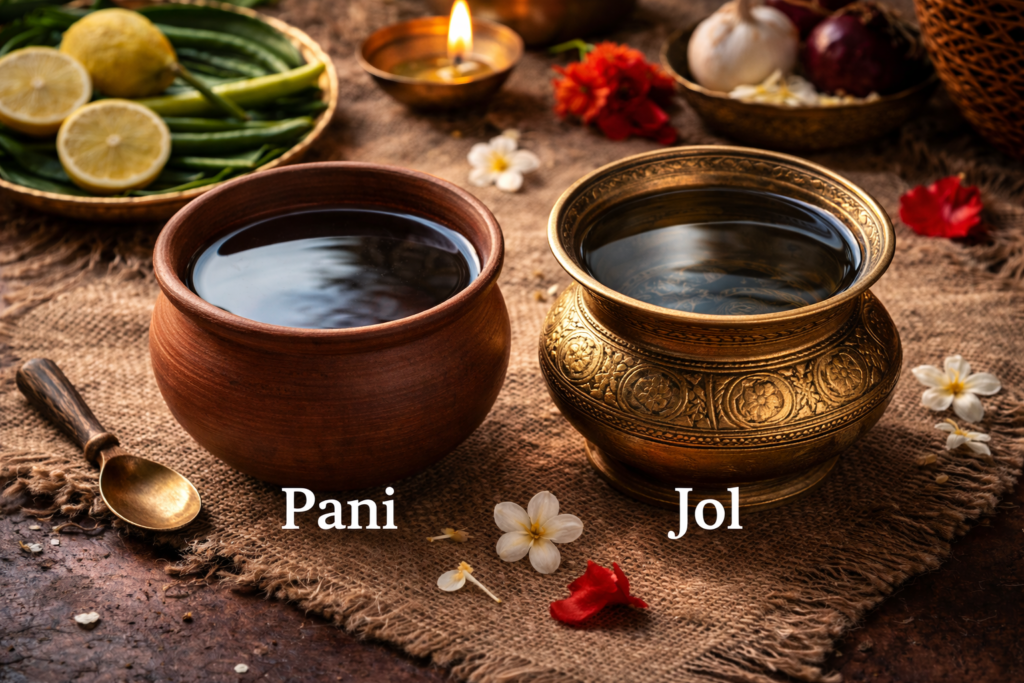
At home, I called water pani. From Anu Pishi and some neighbors, I learned jol. When I asked why I needed two words for the same thing, the answer was simple.
Muslims say pani. Hindus say jol.
I was a child. I did not understand why water needed religion. In many parts of India, pani is common and neutral. In West Bengal and Bangladesh, jol is widely used. But in my town, the word you used could quietly label you.
Then in school, we learned that jol or pani becomes water in English. And somehow, water was said to belong to Christians. Imagine being a child and having to think twice before saying the word that keeps you alive. In English class, you did not want to say jol. If you said pani, the whole class might laugh or stare at you. A simple word suddenly carried so much weight.
Later, I realized something even bigger. There are hundreds of names for water in different languages. Kokborok speakers say toi. In Manipuri, it is ising. In Oriya, it is nir. And there are many more. Different sounds. Same meaning.
If you said the wrong word in the wrong place, you were corrected. I was corrected many times. I was even slapped a few times. But I never stopped mixing them. I could not understand why something so simple should divide people.
Looking back, I see that language was being used as a boundary. A small word became a sign of belonging.
Even within West Bengal, Bengali is not spoken in just one uniform way. The language changes from district to district. Accent, tone, and vocabulary vary depending on where someone grows up. The Bengali spoken in Kolkata is often treated as the standard or pure form because it dominates literature, media, and formal education. But like any living language, Bengali carries many regional variations, even within West Bengal itself.
In Tripura, the Bengali we speak has its own rhythm and history. It is different from the textbook version and from the refined style associated with Kolkata. Our pronunciation and expressions reflect migration, geography, and generations of lived experience. Yet people from other states, especially from West Bengal, sometimes make fun of the way we speak. Because of this, many families in Tripura try to teach their children the Kolkata style of Bengali so they will sound more polished or acceptable. Even when children learn it well, native Kolkata speakers can still notice the difference. Some mock them, comparing it to a crow trying to look like a peacock by wearing its feathers.
That comparison stays with you. It quietly tells you that your natural voice is not enough.
Tripura also officially recognizes Kokborok, the language of many indigenous communities. In markets and schools, people often move between Bengali, Kokborok, Hindi, and sometimes English. Mixing languages is normal in such places. It reflects history and coexistence.
But sometimes society decides that certain words must stay in certain mouths.
As a child, I was not trying to challenge anything. I was simply speaking the way I had learned. I did not know that vocabulary could carry religion, migration, and politics.
Mother tongue is more than grammar. It is emotional memory. It shapes how we think and feel. It is the language in which we first pray, first cry, first laugh.
Animals recognize their own by sound. A calf knows its mother’s call. For humans, mother tongue is that call of belonging. But unlike animals, we attach judgment to sound.
That is where division begins.
Today, I say pani without fear. I say jol without apology. I say water without hesitation. I know that all three mean the same thing.
Water is what keeps us alive. Every human being on this planet depends on it. Without water, there is no life. There is no existence. It does not choose religion. It does not choose language. It does not choose borders.
Water does not divide itself.
We do.
To forget one’s mother tongue is to drift away from our roots. But an even greater loss is forgetting that language was meant to connect us. The words we inherit should not become walls between us.
Mother tongue is not a test of loyalty. It is not a competition of purity. It is a gift.
And if water can flow freely without asking what we call it, perhaps we can learn to do the same.
Because in the end, whether we say pani, jol, toi, ising, nir, or water, it is still the same life giving truth.
And maybe that truth is the bridge we have been searching for.