Nobody gets out of professional wrestling unscathed, least of all Mick Foley. He spent more than 30 years wrestling and took some of the most memorable bumps in wrestling history. As a result, “Everything kinda hurts,” he said recently by Zoom from Pensacola, Florida.
“But I remember 21 years ago, I had trouble walking without an anti-inflammatory,” he said. He hasn’t needed one in 15 years, and “now I actually pass people when I’m walking in the airport,” he said, laughing.
Foley will visit New Orleans on Monday to tell the stories behind the scar tissue when he brings his “40 Years of Foley” one-man show to Southport Hall. He has a soft spot for New Orleans because during his years in the WWE, he lived in Navarre, Florida.
“New Orleans was one of the few cities I could drive my family to,” he said.

Wrestling legend Mick Foley poses with fans at Alabama Comic Con on Sept. 23, 2023, In Birmingham.
Foley has long had a special relationship with his fans. His style came to be known as hardcore, which meant he would go to great lengths to do something fans hadn’t seen before.
Today, wrestlers take dives from the ring to land on opponents on the floor all the time, but in the early 1990s, no one else jumped from the ring apron to the concrete below to hit an opponent with an elbow drop.
He has lived with the toll that crashing to the floor nightly takes on a body, and the moves got more extreme from there.
His signature match is 1998’s “Hell in a Cell,” when he faced The Undertaker in a ring enclosed inside a large, chain-link cage. Foley envisioned some extreme moves for that match, including a 16-foot drop off the side of the structure, but he didn’t plan on the ceiling giving way after The Undertaker choke-slammed him on top of it, which meant Foley dropped 20 or so feet to the mat below.
The match has become his “Free Bird,” and he knows fans want to hear him talk about it. One of his storytelling tours focused on it exclusively, and it comes up in almost every Q&A session at his shows because fans remain fascinated by one of the most remarkable matches in WWE history.
That story is consistent with Foley’s aesthetic. Many wrestlers focus their stories of glory and grandeur, but Foley’s favorites are the ones with a more human scale, where things didn’t go as planned.
“I remember the match I had with Shane Douglas in front of 26 fans in Poca, West Virginia, in 1986 almost as well as I remember winning the WWE from Dwayne Johnson,” he said.

Mick Foley
Foley’s journey to storyteller started when he wrote his 1999 memoir, “Have a Nice Day: A Tale of Blood and Sweatsocks.” He had been paired with a co-writer to tell his story, but it didn’t feel right to Foley.
“I may not be able to write any book, but I can write this book,” Foley recalled, and he knocked out 16 pages in his own conversational style. He asked publisher Judith Regan to consider letting him write the book himself, and after seeing his work, she let him take over the project. The result was a New York Times bestseller, one of two that Foley wrote.
Foley credits his success as a writer to his mother, who passed away recently. “Without her instilling a love of writing and reading in me, I never would have even thought about writing a book,” he said.
The success of “Have a Nice Day” and 2001’s “Foley is Good” made him an in-demand speaker on college campuses including Notre Dame, Syracuse, University of Alabama and MIT. When those speaking engagements ran their course, he took a shot at stand-up comedy.
“Over three years, I realized that the best place for me to put my piece of the puzzle was being the guy who tells humorous, sometimes touching stories about one of the oddest vocations in the world,” he said.
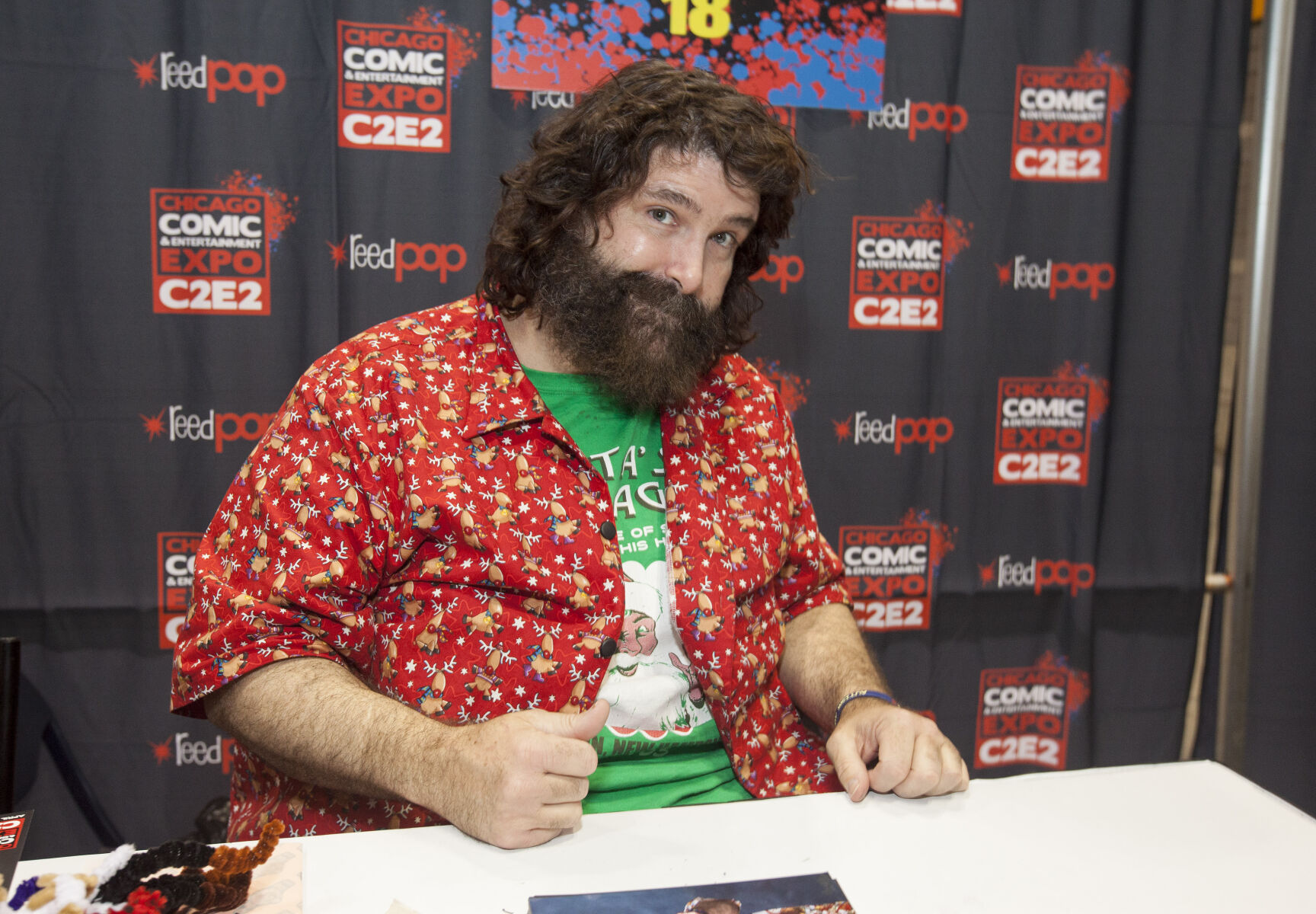
WWE Hall of Famer Mick Foley at the Chicago Comic & Entertainment Expo at McCormick Place on Sunday, April 27, 2014, in Chicago.
Historically, wrestlers fiercely protected “kayfabe,” the public-facing fiction that wrestling promotions ask fans to believe. “Have a Nice Day” and Foley’s books and stories reveal what goes on behind the curtain, but he said he has never gotten blowback from others in the locker room. He believes that’s because of what he shows.
“I think what I did was make people realize how difficult it was, and the drive that goes into the hopes of being a professional wrestler,” Foley said. “If you put someone else in my body, they’d think it was hell on Earth, whereas I think I feel pretty good these days.”
Mick Foley: ’40 Years of Foley’ Tour
WHEN: 7 p.m. Monday, March 9
WHERE: Southport Hall, 200 Monticello Ave., New Orleans
INFO: SouthportHall.com/events/mick-foley-40-years-of-foley-tour; (504) 835-2903
TICKETS: $40-$150