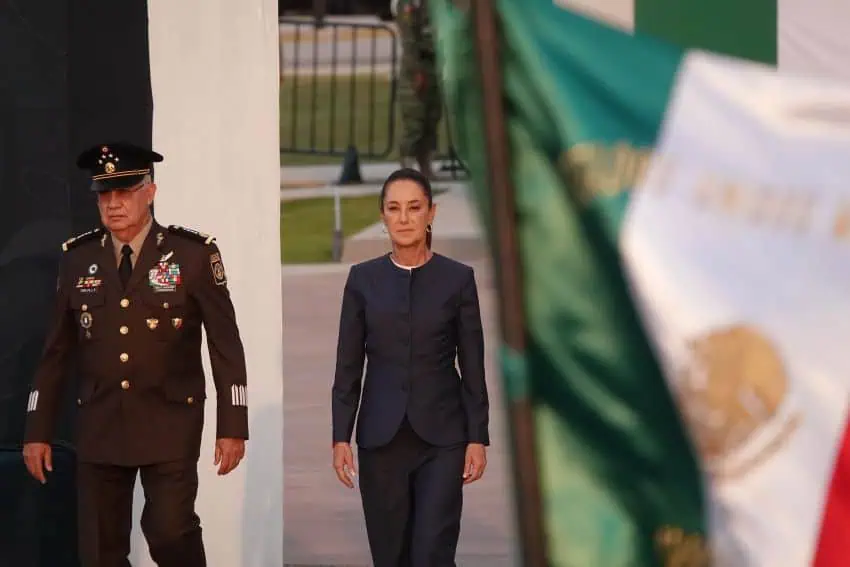
President Claudia Sheinbaum said Saturday that she rejected an offer from United States President Donald Trump to send the U.S. Army into Mexico to combat drug cartels.
On Sunday, Trump confirmed that he made the offer, and accused Sheinbaum of being “afraid” of Mexican cartels, six of which were designated as foreign terrorist organizations by the U.S. government in February.
En Texcoco, Estado de México, la presidenta Sheinbaum confirmó que rechazó la oferta de Donald Trump para que el Ejército de EE. UU. entrara a México. #LasNoticiasDeFORO con @_fernandanews | #nmásforo | #SiempreEnVivo | #SiempreContigo | Sigue la señal en vivo por… pic.twitter.com/GoAIaERKdj
— N+ FORO (@nmasforo) May 3, 2025

Speaking at an event in Texcoco, México state, on Saturday, Sheinbaum said that she told Trump that Mexico’s territory and sovereignty are “inviolable” when he offered to send U.S. troops to Mexico.
“Yesterday, it came out in a United States newspaper, in The Wall Street Journal, that President Trump, in one of our calls, told me that it was important for the United States Army to come into Mexico to help us in the fight against drug trafficking. I want to say it’s true, that in some of the calls … he said: ‘How can we help you to fight against drug trafficking? I propose that the United States Army come in to help you,” she said.
“And do you know what I told him? No, President Trump. [Mexico’s] territory is inviolable, [our] sovereignty is inviolable, sovereignty is not sold,” said Sheinbaum, provoking a rousing response from the attendees of the inauguration of a new government-funded “well-being university” in Texcoco.
“Sovereignty is loved and defended,” she continued.
“… We can collaborate, we can work together, but you in your territory and us in ours. We can share information, but we’re never going to accept the presence of the United States Army in our territory,” Sheinbaum said.
The president, who has previously made it clear that she would never accept any kind of U.S. military intervention in Mexico, said that she had also told Trump that if he wants to help combat Mexican cartels, he should “help us” stop the entry of firearms to Mexico from the United States.
Firearms smuggled into Mexico from the United States often end up in the hands of powerful Mexican cartels, which frequently use the weapons to commit homicides and other crimes.
Trump says US would be ‘honored’ to combat cartels in Mexico
On board Air Force One on Sunday, during a flight from Palm Beach, Florida, to Washington D.C., Trump told reporters it was “true” that he made an offer to Sheinbaum to send the U.S. Army into Mexico.
“So Mexico’s saying that I offered to send U.S. troops into Mexico to take care of the cartels. … It’s true. … They are horrible people that have been killing people left and right. … They’ve made a fortune on selling drugs and destroying our people. We lost 300,000 people last year to fentanyl and drugs. They’re bad news,” he said.
“… If Mexico wanted help with the cartels, we would be honored to go in and do it. I told [Sheinbaum] that, I would be honored to go in and do it. The cartels are trying to destroy our country, they’re evil,” Trump said.
“… We had 300,000 people die last year from fentanyl and all of that, we had millions of people brought into this country that shouldn’t be here, the cartels brought them in so if [Sheinbaum] said that I offered to do that she’s 100% right,” he said.
“She’s so afraid of the cartels she can’t walk. … I think she’s a lovely woman, the president of Mexico is a lovely woman, but she is so afraid of the cartels that she can’t even think straight,” Trump said.
As was the case in his first term as president, Trump has pressured Mexico to do more to stem the flow of migrants and narcotics to the United States. In early March, he briefly imposed 25% tariffs on all imports from Mexico and most imports from Canada due to what the White House said was the two countries’ failure to adequately stem the flow of “lethal drugs” such as fentanyl into the U.S.
WSJ: Sheinbaum and Trump sparred in April 16 call
The remarks made by Sheinbaum and Trump over the weekend came after The Wall Street Journal published an article on Friday under the headline “Trump, Mexico’s Sheinbaum spar over drug cartels.”
Citing “people familiar with the discussions,” the WSJ reported that “President Trump is pressuring Mexico to allow deeper U.S. military involvement in the fight against drug cartels.”
Again citing its unnamed sources, the newspaper said that “tension rose toward the end of a 45-minute telephone conversation with Mexican President Claudia Sheinbaum on April 16 when Trump pushed to have U.S. armed forces take a leading role in battling Mexican drug gangs that produce and smuggle fentanyl to the U.S.”
The report continued: “Sheinbaum told Trump her administration would cooperate on matters such as intelligence sharing but not accept a direct military presence, the people added.”
Citing Mexican officials, the WSJ also reported that “Mexico won’t consent to a U.S. military presence because of the nations’ fraught history, which includes two invasions since 1846.”
Both Sheinbaum and Trump described their April 16 call as “very productive,” but didn’t reveal at the time the apparent offer to send the U.S. army into Mexico.
Sheinbaum has spoken to Trump by telephone six times since he won the U.S. presidential election last November. Trade has been a key focus of their most recent calls, as Trump has imposed tariffs on a range of imports to the United States from Mexico, despite the two countries being party to the USMCA free trade pact, which also includes Canada.
Key Mexico-US security developments since Trump took office
Here is a timeline of some of the key Mexico-U.S. security developments since Trump began his second term as U.S. president on Jan. 20. The hyperlinks will take you to previous Mexico News Daily articles.
- Jan 20: On the first day of his second term, Trump declared a national emergency at the United States’ southern border and laid the initial groundwork for the designation of Mexican cartels as foreign terrorist organizations. Asked at the time whether he would consider “ordering U.S. special forces into Mexico” to “take out” cartels, Trump said it “could happen.”
- Jan. 22: The U.S. government announced the immediate deployment of 1,500 active duty troops to the United States’ southern border.
- Feb. 1: The White House asserted that “Mexican drug trafficking organizations have an intolerable alliance with the government of Mexico,” and that “the government of Mexico has afforded safe havens for the cartels to engage in the manufacturing and transportation of dangerous narcotics.”
- Feb. 3: President Sheinbaum agreed to send 10,000 National Guard troops to Mexico’s northern border to stem the flow of drugs to the United States.
- Feb. 5: The U.S. government announced it intended “to pursue total elimination of Cartels and Transnational Criminal Organizations.”
- Feb. 11: CNN reported that the U.S. military had “significantly increased its surveillance of Mexican drug cartels over the past two weeks, with sophisticated spy planes flying at least 18 missions over the southwestern U.S. and in international airspace around the Baja peninsula.”
- Feb. 18: CNN and The New York Times reported that the United States Central Intelligence Agency had been flying drones over Mexico to spy on drug cartels and hunt for fentanyl labs.
- Feb. 19: The United States government designated six Mexican cartels as foreign terrorist organizations.
- Feb. 27: Mexico extradited 29 cartel figures including notorious drug lord Rafael Caro Quintero to the United States.
- March 13: United States ambassador-designate to Mexico, Ronald Johnson, said that the U.S. military could unilaterally take action against drug cartels on Mexican soil if the lives of U.S. citizens were at risk.
- March 17: A U.S. Navy warship was deployed to the Mexico-United States maritime border in the Gulf of Mexico to counter illegal immigration, drug and weapons trafficking, as well as transnational crime.
- March 22: The U.S. government sent another warship to waters near Mexico as part of Trump’s call to secure the United States’ southern border.
- March 25: Trump praised the Mexican government for ramping up the fight against the trafficking of illegal drugs to the U.S. and the northward flow of migrants.
- April 8: Sheinbaum said she didn’t believe the Trump administration would carry out drone strikes against cartels in Mexico “because there is a lot of dialogue on security issues and many other issues.”
- April 15: Trump asserted that Mexico is “very afraid” of drug cartels, and claimed that they “run large sections” of the country.
- April 16: Sheinbaum rejected Trump’s claim that she is afraid of cartels, and revealed that Mexico had sent a diplomatic note to the United States after the U.S. moved to militarize its southern border. On the same day, she said that the United States is “always looking to intervene more” in Mexico.
Source: Mexico News Daily