For the umpeenth time this week, I’m at La Cabra Illuminada in San Miguel de Allende, enjoying a creamy piccolo and a hefty plate of enchiladas verdes stuffed with vegan pea cheese and zucchini and crowned with tiny sprigs of verdolaga, when a retired American couple eagerly saddles up next to me, waiting for the right moment to spark up a conversation. As usual, there is no such thing — I’ve got two hours before the kids are out of camp, I’m the breadwinner for my family of five and I’m working.
But there, sitting in silent awe of the weeping fig tree that’s been allowed to keep sprouting skyward in the very center of the café, thanks to Mexico’s signature green architecture, I do something I don’t usually do; I lean into the conversation. And when I surrender, I learn they’re in their late 60s, having just sold the majority of their belongings in order to complete an itinerary-less cross-country U.S. trip in a van. They’re currently splitting their time between Puerto Vallarta, California and, they hope soon, San Miguel de Allende.
I applaud their strong commitment to speaking Spanish and instantly recognize their post-COVID-19 journey as the mirror image of so many like it: sick of the cold and itching for adventure in their golden empty-nester chapter.
“I’ve got to ask,” says the wife once she senses we’ve built enough of a friendly rapport, “what should we be tipping?”



I shut my laptop. I have a lot of thoughts about this. In September 2020 — during the late-stage COVID pandemic days — my business partners and I led a movement to eliminate tipping in restaurants (including in our own, where we implemented what we called Flat30).
We were early adopters with a radical-socialist-y philosophy, determined to push our customers and industry beyond a “minimum wage” mentality into the more complex reality of a livable wage, healthcare access and a sustainable labor model that offered a win-win for all. Wouldn’t it be nice if the price listed on the menu simply included everything you needed to pay — plus the peace of mind that the people serving you could truly afford their rent and groceries?
Nearly five years later and just a few days before meeting this lovely couple, I found myself grappling with another conundrum entirely: Have I been overtipping in Mexico? While COVID-19 upended how many hospitality professionals — and guests — thought about the total compensation of U.S. restaurant workers, the idea of a livable wage in any sector in Mexico is still a castle in the sky for most servers, bartenders, dishwashers and bussers south of the border.
And as the antigentrification movement gains momentum in Mexico City, those of us living on the other side of the Rio Grande could stand to more honestly examine how our behavior could be harming our neighbors, beyond willingly overpaying for housing and complaining in online forums about the daily fluctuations of the dollar-to-peso exchange rates.

According to data provided by Mexico’s 2019 Economic Census, food services here drive an 855 billion peso industry. Even more sobering is the distribution of these restaurants, with nearly 700,000 eateries employing 0–10 staff, while the categories of 11–50 and 51–100 employees demonstrate starkly lower numbers: 24,000 and 1,500 establishments, respectively.
As a former restaurateur, this tells me that the overwhelming majority of Mexico’s dining operations consist of mom-and-pops. Labor statistics claim to monitor “average earnings,” but it’s reasonable to assume most people are making significantly less.
For reference, the average monthly salary for restaurant workers in 2024 was reported to be around 9,000 pesos (US $470). Figures provided by the crowdsourced database Livingcost set monthly median spending for a family of four at 61,000 pesos(US $3,261), which, if these estimates are accurate, would leave most restaurant workers beyond priced out of a family dwelling in their hometown.
Now, let’s assume you live in Mexico, or visit often, but that you’re not considering any of the nitty-gritty economic statistics or the glaring social inequities when thinking about tipping. You’re likely of one of two minds: the first being that your income streams are in U.S. dollars and so it is your responsibility to leave generous gratuities wherever you go. The second assumes that you should neither overtip nor undertip and that you certainly don’t ever want to feel you’re being taken advantage of by being forced to pay a “gringo tax” for eating out.
Here’s my take: Given that I spent nearly three decades in hospitality — working grueling hours on my feet, scrubbing dirty towels and dishes, plunging toilets, somehow enduring the dreaded “triple-double” shifts and doing it all with a forced smile — I spent my first four years in Mexico in the former camp. Now add to that empathy the gratitude I feel when anyone has to pick up after my twin toddlers and their age-appropriate penchant for hurling bits of whatever’s in front of them to the ground.
I was, admittedly, a chronic overtipper.
But, recently, a local mompreneur gave me something to chew on.
“Stop tipping so much,” she wrote in all caps in our mixed-race San Miguel Social Moms group chat; yes, in all caps. She went on to explain that the well-meaning percentages that foreigners have been repeatedly tipping — above the socially accepted national standard of 10% and the above-and-beyond the norm for exceptional service of 15% — were not only catalyzing a domino effect of poor treatment of Mexican clientele by staff but also creating a self-fulfilling prophecy of servers conjecturing that Mexican customers wouldn’t tip “well.” The Mexicans, in turn, were expecting poor service even before it was delivered.
So where does this leave us? Is it acceptable to tip above 15% if you’ve had the best experience in your recent memory? Absolutely. But do you need to try to prove something noble to an invisible morality police every time someone cooks you a meal and delivers you a check for it? I think that’s up for debate.
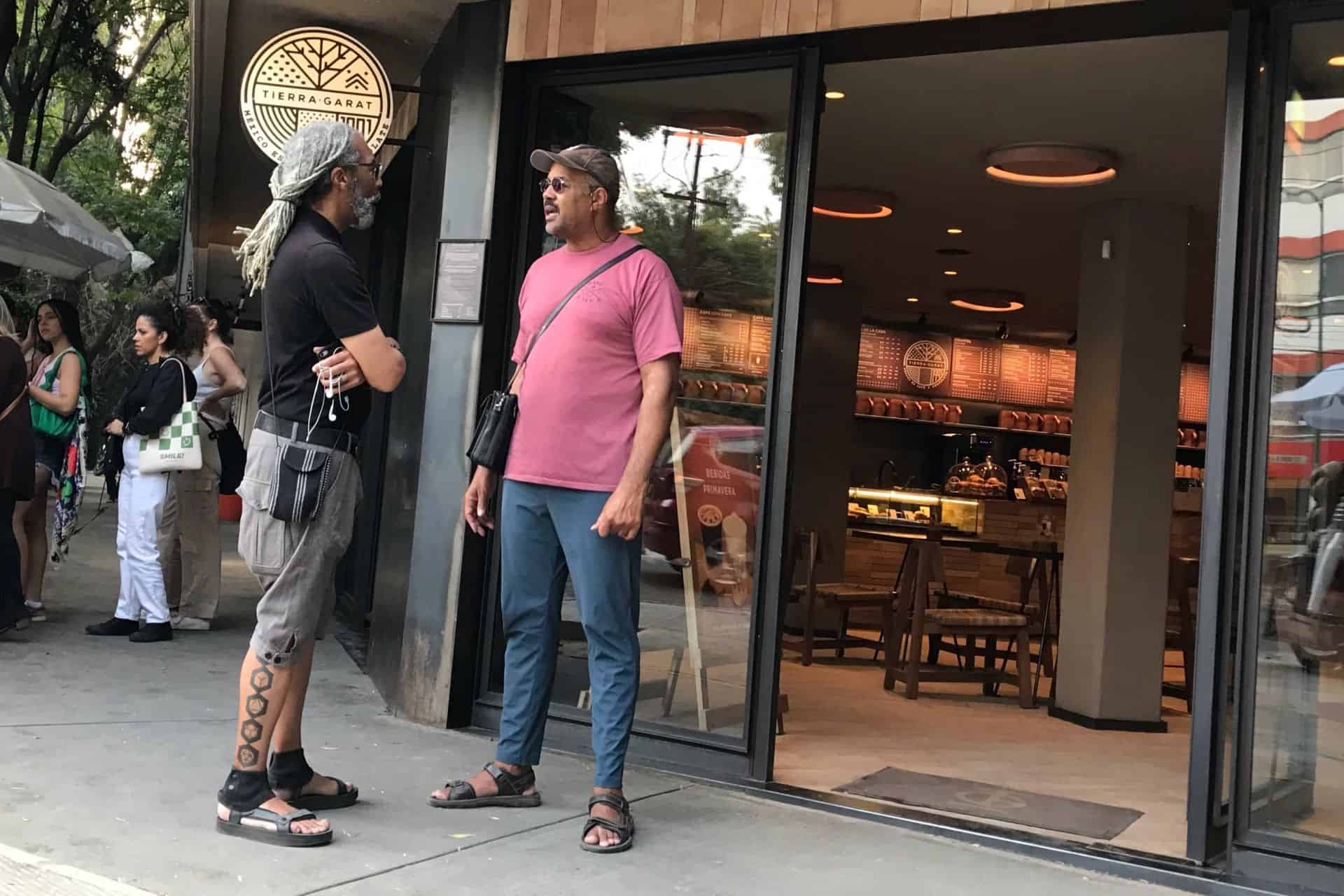
If you want to be less of a colonizing presence and more of a mutual aid to your Mexican neighbors, do as I say, not as I do. The famous adage “vote with your dollar,” comes to mind, as does the TED Talk by the effervescently brilliant writer Taiye Selasi: “Don’t ask me where I’m from, ask where I’m a local.”
I think this is what my new couple friends were yearning to become.
To my fellow “locals,” next time someone provides you a service, whether it be at a restaurant or elsewhere, pause before you pull out your wallet. Rather than asking, “What should I be tipping?” it may be more compassionate to weigh a few alternative queries: “Why am I tipping this amount? Who benefits and who could potentially be damaged or displaced by my spending election?”
Whatever you decide, it’s ultimately a self-inquiry worthy of our discomfort, especially at a time when gentrification in Mexico is inching towards a tipping point of its own.
Simone Jacobson is a Burmese American former Top 10 in America restaurant owner, cultural connector, toddler twin mama and writer based in San Miguel de Allende. By day, she is the Content Director for Well Spirit Collective. In all other moments, she strives to raise compassionate children who never lose their curiosity, tenderness and radiant light. Read more by Simone here.
Source: Mexico News Daily