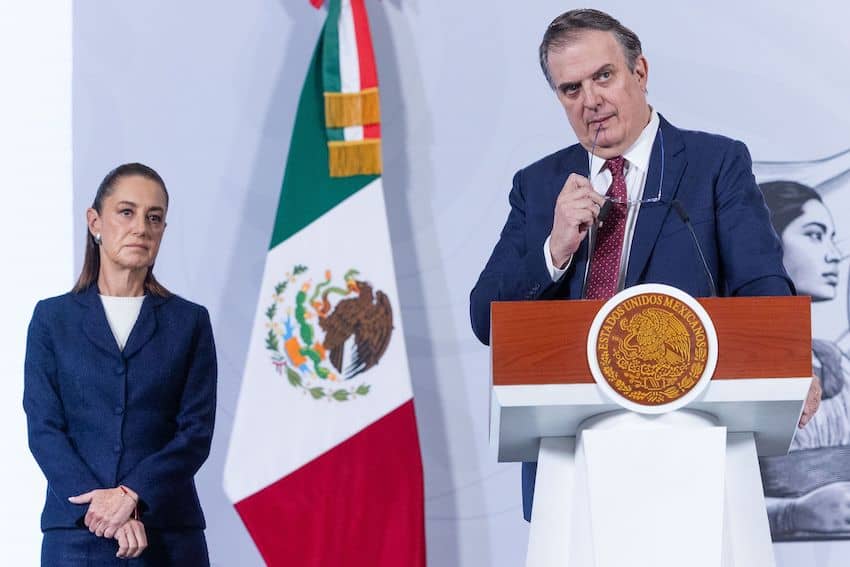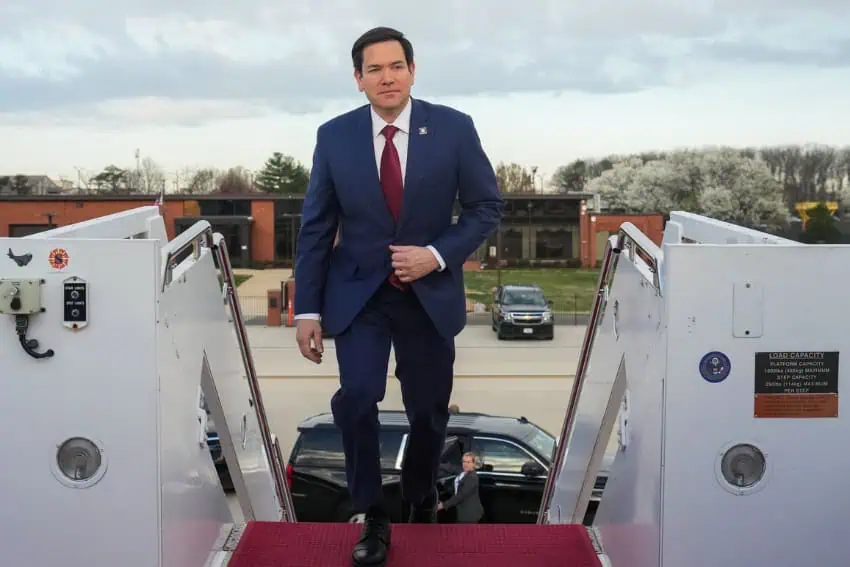
President Claudia Sheinbaum said Monday that it is likely that United States Secretary of State Marco Rubio will come to Mexico next week to sign a new bilateral security agreement.
“He will very probably come … in the first week of September; it’s probable. It will be confirmed this week,” Sheinbaum said at her morning press conference.
🇲🇽🇺🇸 Sheinbaum anuncia posible visita de Marco Rubio a México
La presidenta @Claudiashein informó que el secretario de Estado de EUA, @marcorubio, podría visitar México en la primera semana de septiembre para firmar el acuerdo de seguridad bilateral; sin embargo, aclaró que la… pic.twitter.com/PHb4eBWCrj


— Político MX (@politicomx) August 25, 2025
Asked whether the new Mexico-U.S. security agreement would be signed during Rubio’s visit, Sheinbaum responded: “Yes, that’s the idea.”
The president has said on repeated occasions this month that the new security agreement is “ready.”
She said last week that the bilateral pact was on the verge of being signed and is “fundamentally” based on “sovereignty, mutual trust, territorial respect … and coordination without subordination.”
“They are the four principles,” Sheinbaum said last Tuesday.
The Mexico-U.S. security relationship is currently governed by the Bicentennial Framework for Security, Public Health and Safe Communities. That agreement took effect in late 2021, superseding the Mérida Initiative.
Pact to be signed amid tension in the Mexico-US relationship
The signing of a new Mexico-U.S. security agreement in the first week of September would come after an eventful and turbulent August.
On Aug. 8, The New York Times reported that U.S. President Donald Trump had “secretly signed a directive to the Pentagon to begin using military force against certain Latin American drug cartels that his administration has deemed terrorist organizations.”
‘There won’t be an invasion’: Sheinbaum de-escalates after Trump orders US military to target cartels
That prompted Sheinbaum to reassure Mexicans that “the United States is not going to send its military into Mexico.”
“We cooperate [with the U.S. on security], we collaborate, but there will be no invasion. That’s ruled out … because, in addition to what we’ve stated in all our conversations, it’s not allowed, nor is it part of any agreement,” she said at her Aug. 8 press conference.
Last Friday, Sheinbaum declared that a U.S. airstrike against cartel targets in Mexico “won’t happen” when asked about the remarks DEA Administrator Terrance Cole made on the topic.
Earlier in August, the president said that a U.S. military intervention in Mexico is “not on the table,” and throughout the month — and indeed during the entirety of her presidency to date — she has stressed that her government would never accept any kind of violation of Mexico’s sovereignty.
Also in August, Sheinbaum asserted that her government hasn’t entered into an agreement with the DEA after the U.S. agency announced what it called a “bold bilateral initiative to dismantle cartel gatekeepers and combat synthetic drug trafficking.”
Sheinbaum’s frequent pushback to U.S. announcements and rhetoric has occurred as Trump and other U.S. officials have talked tough about their desire, and intention, to combat Mexican cartels that smuggle large quantities of fentanyl and other narcotics into the U.S.
Sheinbaum revealed in May that she had rejected an offer from the U.S. president to send the U.S. army into Mexico to combat criminal groups such as the Sinaloa Cartel and the Jalisco New Generation Cartel, both of which are now designated as foreign terrorist organizations by the U.S. government.
While the president has remained defiant in her rhetoric and her opposition to any kind of U.S. military intervention in Mexico, the Mexican government has allowed U.S. drones to fly over Mexico to assist the fight against organized crime, including in a flight deep into Mexican territory this month.
In addition, the Sheinbaum administration has sought to appease the U.S. government by deploying thousands of troops to the northern border region while cracking down on cartels with operations across the country that have resulted in the arrests of thousands of suspects and the seizure of huge quantities of narcotics. It has also sent more than 50 cartel figures to face justice in the United States.
In May, Rubio praised Mexico for its efforts to combat cartels.
The pressure on Mexico from Trump, largely in the form of the threat — and imposition — of tariffs has been relentless. His administration has even asserted that “Mexican drug trafficking organizations have an intolerable alliance with the government of Mexico,” and that “the government of Mexico has afforded safe havens for the cartels to engage in the manufacturing and transportation of dangerous narcotics.”
All these factors, and others, add up to a complex and tense bilateral security environment even as Sheinbaum and Trump maintain that they, and their governments, have a good working relationship.
The signing of a new security pact between Mexico and the United States should give greater clarity and renewed impetus to the joint fight against organized crime, but the complexity and tension in the security relationship will likely remain, as will the calls of some U.S. officials and politicians — and some Mexican ones as well — for the U.S. to adopt a more proactive, and even bellicose, posture, against Mexican cartels.
Source: Mexico News Daily