Sheinbaum announces plan to standardize medical records and care: Tuesday’s mañanera recapped

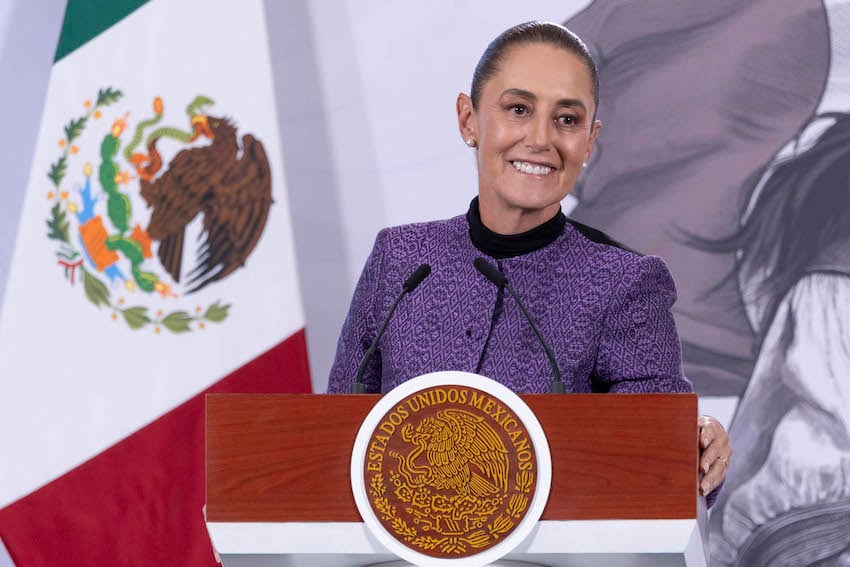
The federal government’s plan to issue public health care cards to all Mexicans was the main focus of President Claudia Sheinbaum’s Tuesday morning press conference.
Here is a recap of her Jan. 20 mañanera.
Mexico to issue public health care cards
“This is the new identification card for the universal health care service,” said Deputy Health Minister Eduardo Clark as an example of the credencial was displayed on a screen behind him.
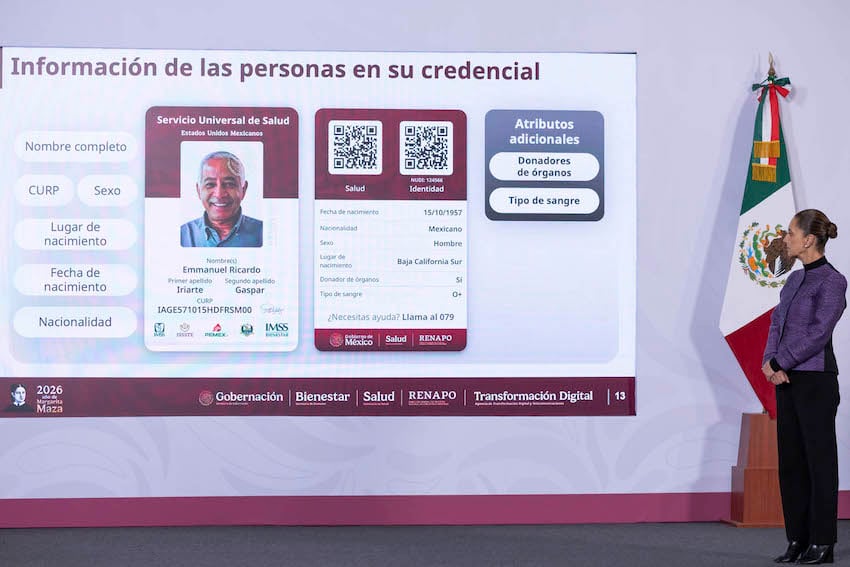
The card, he said, is “the guarantee of the right to health care” for Mexican citizens and eligible foreign residents of Mexico.



People will use their ID card when accessing the services of the public health care providers to which they belong. Those providers include the Mexican Social Security Institute (IMSS), the State Workers’ Social Security Institute (ISSSTE), IMSS Bienestar and state governments in the eight states that haven’t signed on to the federal government’s universal IMSS Bienestar scheme.
Clark said that the new ID card will come in physical and digital versions. The latter will become available in April.
“What does the card have? First, your full name, your CURP [national ID code], your sex, your place of birth and date of birth, and your nationality,” Clark said.
“And on the back there are two QR codes that allow us to validate the health care provider to which you belong and allow you to check which is your closest [health care] unit,” he said.
“In addition, it also has information about organ donation, which we’re going to request during the registration [process], as well as your blood type,” Clark said.
The Health Ministry official also said that people’s health care cards will be linked to an “electronic medical record” — i.e., their medical history.
“The credencial is a way of linking all this information,” he said.
Clark highlighted that Mexicans have a constitutional right to free health care.
“This is a way of putting a face to that right,” he said.
Clark also said that the card will allow people to know which health care provider they are affiliated with.
“We often don’t know which entitlement we have. … For example, there are students who perhaps don’t know they have IMSS. There are, perhaps, pensioners who, having been married to a person who was a beneficiary of a [health care] institution, have the right [to health care at the same institution],” he said.
Registration process to start in March
Welfare Minister Ariadna Montiel Reyes told reporters that the government will issue the health care cards to “the entire population of Mexico,” including children.
She said that 14,000 Welfare Ministry workers will work to register Mexicans so that they can receive their cards. Citizens will complete the registration process at 2,365 “modules” to be set up by the Welfare Ministry in an initial stage, Montiel said.
She said that adults will need to provide an official form of identification with a photo, such as a passport or voter ID card, and a document that includes their address in order to register to receive a health care card. Montiel said that people who register will have their photo and fingerprints taken for their new card.
At a later date, people who have registered will receive a telephone call or a text message advising where and when they can collect their physical card, she said.
La #MañaneraEnBreve de la presidenta @Claudiashein:
🪪 Credencial del Servicio Universal de Salud.
🥼 Salud Casa por Casa: más de 10 millones de consultas.
💉 Vacunas suficientes contra sarampión. pic.twitter.com/5XB5jzEDtC
— Gobierno de México (@GobiernoMX) January 21, 2026
Montiel said that the registration process will commence on Mar. 2 in 14 states that have signed onto the federal government’s IMSS Bienestar scheme. The process will begin in other “federalized” states on Mar. 23, and will subsequently take place in the states where IMSS Bienestar doesn’t operate.
How much will the issuance of the health care cards cost?
Sheinbaum said that the government will spend around 3.5 billion pesos (US $198.8 million) on the registration process and the issuance of the new health care cards.
She said that the government’s goal is for “all Mexicans” to get a card.
It remains to be seen how close the Sheinbaum administration will get to achieving that goal.
Many Mexicans who have private health insurance or can afford to pay for private treatment out of their own pocket prefer to seek medical treatment in the private system. Convincing such people to register for a universal health care card could prove to be a challenge.
Toward a more integrated public health care system
Sheinbaum said that the government needs to issue the cards in order to make progress toward a more integrated public health care system.
This year, Sheinbaum said, people will continue to access health care services at the facilities of the health care provider to which they belong. However, she indicated that the public health care system will become more unified at some point in the future, allowing people to access treatment at any public health care facility.
“Let’s suppose that I belong to ISSSTE and I go for treatment at IMSS. Where does IMSS get its money from? From the workers who are affiliated with IMSS, from employers and from the federal government. If an ISSSTE beneficiary [receives treatment from IMSS], … ISSSTE will have to pay IMSS for the treatment of that patient so that [public] health services don’t become unbalanced. For that to occur we have to make what we call a clearing house so that … [payments] are automatic,” Sheinbaum said.
“… When I was mayor [of Mexico City] we did that for the public transport systems,” she said, noting that her administration in the capital created an “integrated mobility” card that people can use on the Metro, in the Metrobús and on various other forms of public transport.
“And then every month we say, ‘Metro, you get this much; Metrobús, you get this much; Trolebús, you get this much,’” Sheinbaum said.
“So the process of digitalization is necessary to enter into a system of this type [for health care], [a system] that ensures that no entity is disadvantaged, but rather that resources are allocated appropriately to each of them,” she said.
“By law, IMSS can only treat its beneficiaries. It could treat others if you pay for the service. Of course, all this has to be developed gradually,” Sheinbaum said, adding that the “first step” is to issue the public health care cards.
By Mexico News Daily chief staff writer Peter Davies ([email protected])
Source: Mexico News Daily