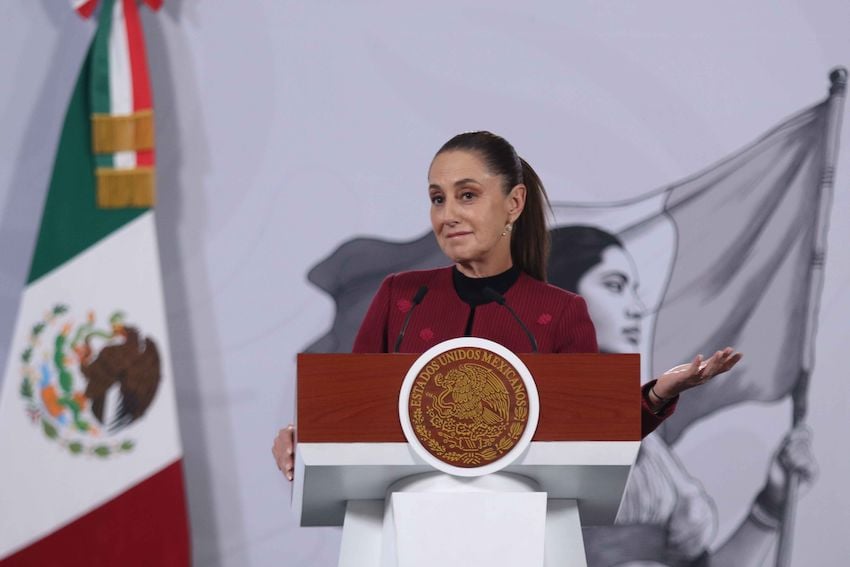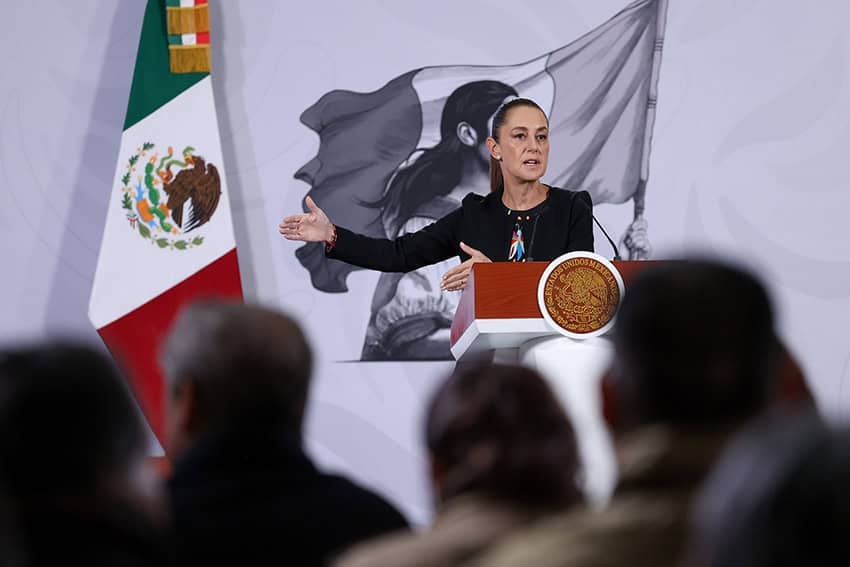
Mexico’s soon-to-be enacted tariffs, a 1944 water treaty and tourism promotion in China were among the topics spoken about at President Claudia Sheinbaum’s Thursday morning press conference.
Here is a recap of the president’s Dec. 11 mañanera.
Sheinbaum: Tariffs don’t specifically target China
Sheinbaum said that the tariff bill that has now been approved by both houses of Congress “is not aimed at China,” whose exports to Mexico have increased significantly in recent years, leaving Mexico with a large trade deficit with the world’s No. 2 economy.
“That’s very important,” she said. “It’s [aimed] at the countries with which we don’t have trade agreements.”


The legislation passed by the House of Representatives and the Senate on Wednesday will, as of Jan. 1, implement or increase tariffs on imports of more than 1,400 products from China and other countries with which Mexico doesn’t have trade agreements, including India, South Korea, Thailand and Indonesia. A central aim of the tariffs is to protect Mexican industrial sectors, some of which struggle to compete with cheap imports from Asia.
Sheinbaum said that the implementation of the new and higher tariffs is part of the strategy outlined in Plan México, the federal government’s ambitious economic initiative that was presented in January.
🇲🇽MEXICO:
Widely seen as a move to appease Trump ahead of the #USMCA 2026 review, Sheinbaum’s coalition in Congress just passed a drastic increase in tariffs on imports from countries with which Mexico does not have trade agreements
Some wonder if Sheinbaum caved in too soon https://t.co/dA4HEXDPy1
— José Díaz Briseño (@diazbriseno) December 11, 2025
“What is the strategy? To produce more in Mexico,” she said.
Sheinbaum acknowledged that many of the tariffs she originally proposed in a bill sent to Congress in September were lowered after consultation with Mexican and foreign business representatives.
“There was also communication with South Korea, there was communication with China. Our ambassador in China was very active in explaining the reasons [for the tariffs], and the original proposal changed significantly,” she said.
Asked about the Chinese government’s call for Mexico to promptly “correct its wrong practices of unilateralism and protectionism,” Sheinbaum said that her government engages with its Chinese counterpart on trade in “work meetings” with China’s Ministry of Commerce.
“We recently proposed that there could be a high-level meeting … about different issues, and the idea is that these meetings can take place,” she said.
“Our interest is not to generate conflict with any country in the world. And we respect China a lot and have very good relations with them,” Sheinbaum said.
“The reason for these adjustments in the Law [on General Import and Export Taxes] has to do with strengthening the national economy,” she added.
Bilateral water talks continue
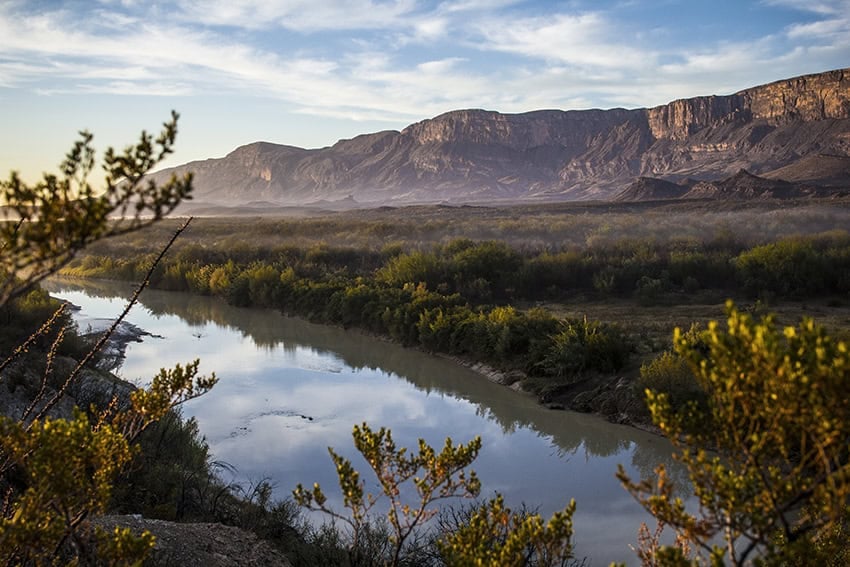
Sheinbaum said that her government remains in talks with the Trump administration over Mexico’s obligation to deliver water to the United States.
The latest talks began after U.S. President Donald Trump threatened on Monday to impose an additional 5% tariff on Mexican goods if Mexico doesn’t promptly release a significant quantity of the water it owes to the United States under the terms of a 1944 treaty.
Mexico faces new tariff threat from Trump over water debt
Sheinbaum subsequently expressed confidence that “we’re going to reach an agreement for the benefit of the United States and for the benefit of Mexico.”
On Thursday morning, she said that progress has been made, but noted there would be another bilateral meeting later in the day.
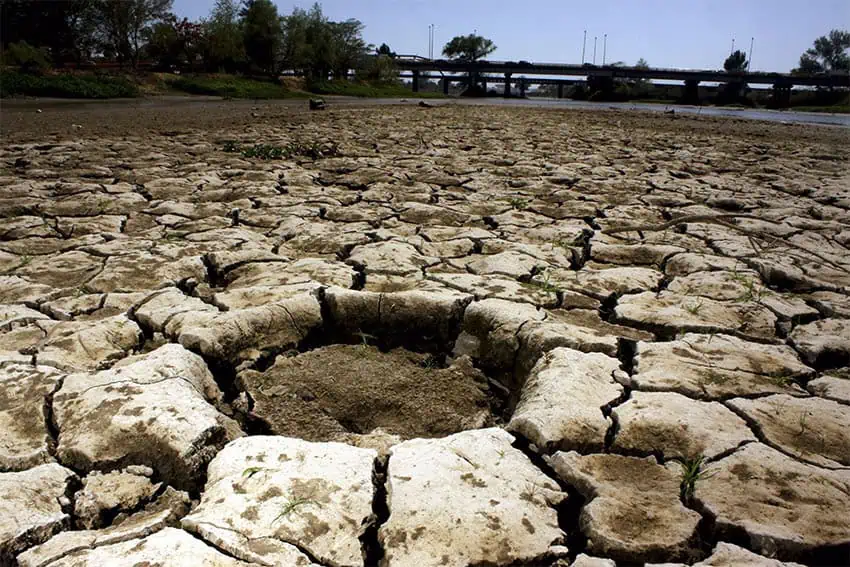
Sheinbaum said that “there has to be recognition from both countries” that Mexico endured “five years of drought” during the last five-year cycle of the water treaty.
In each five-year cycle, Mexico is required to send 1.75 million acre-feet of water across the northern border from six tributaries of the Rio Grande. However, it only delivered just over half that amount in the 2020-25 cycle.
Sheinbaum said that Mexico’s failure to deliver all the water it was supposed to transfer to the U.S. during the last five-year cycle was not because it didn’t want to.
Rather, she said, it was because “there was drought — because there wasn’t water, it’s as simple as that.”
Sheinbaum noted that the 1944 treaty establishes that if a country fails to meet their water obligation to their neighbor, it can make up the shortfall in the next five-year cycle.
“That’s what we’re working on,” she said.
How soon Mexico can make up the shortfall “depends on how much rain we have,” Sheinbaum said.
Mexico’s tourism promotion strategy in China
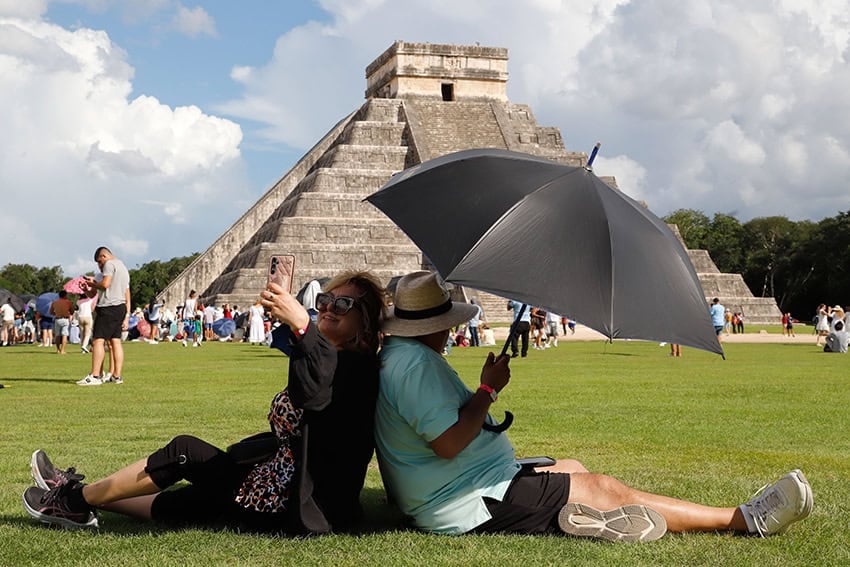
While the Mexican government is seeking to limit the entry of Chinese goods to Mexico it would like to see more Chinese people visiting the country.
Tourism Minister Josefina Rodríguez acknowledged that goal on Thursday morning, telling reporters that the ministry she leads will commence a campaign of “constant promotion” in “emerging” tourism markets, including China, in 2026.
She noted that the number of Chinese visitors increased 10.6% annually in the first 10 months of the year, and offered an insight into how Mexico is being promoted as a tourism destination in China.
International visitation is up over 13% this year
Rodríguez noted that Mexico held a tianguis turístico (tourism fair) in Beijing this year, and revealed that it will attend two international tourism events in China next year.
She said that some Chinese tourists come to Mexico because of their interest in Day of the Dead celebrations. Rodríguez highlighted that Coco, the 2017 film that is inspired by Day of the Dead, was very popular in China.
“And all this makes the Chinese market want to come to learn about the culture. We share many ancestral things,” she said.
Rodríguez also said that Mexico’s tourism promotion strategy in China is different to that employed in other countries.
“As you know, you can’t look at Instagram, you can’t look at Facebook [in China]. So, the strategy is very different,” she said.
Rodríguez explained that the Tourism Ministry is working with “Mexican influencers who have lived in China for many years” — and presumably appear on digital platforms that are more readily accessible to Chinese citizens — as well as Mexican restaurants in China.
Those influencers and restaurants are “helping us to say: This is Mexico,’” the tourism minister said.
By Mexico News Daily chief staff writer Peter Davies ([email protected])
Source: Mexico News Daily