An ABC News analysis of satellite imagery and tracking data shows the oil tanker seized by the United States off the coast of Venezuela on Wednesday may have manipulated its location data — an apparent attempt, experts said, to circumvent restrictions imposed by sanctions.
The crude oil tanker, named the “The Skipper,” according to four people familiar with the operation, was sanctioned by the U.S. in 2022.
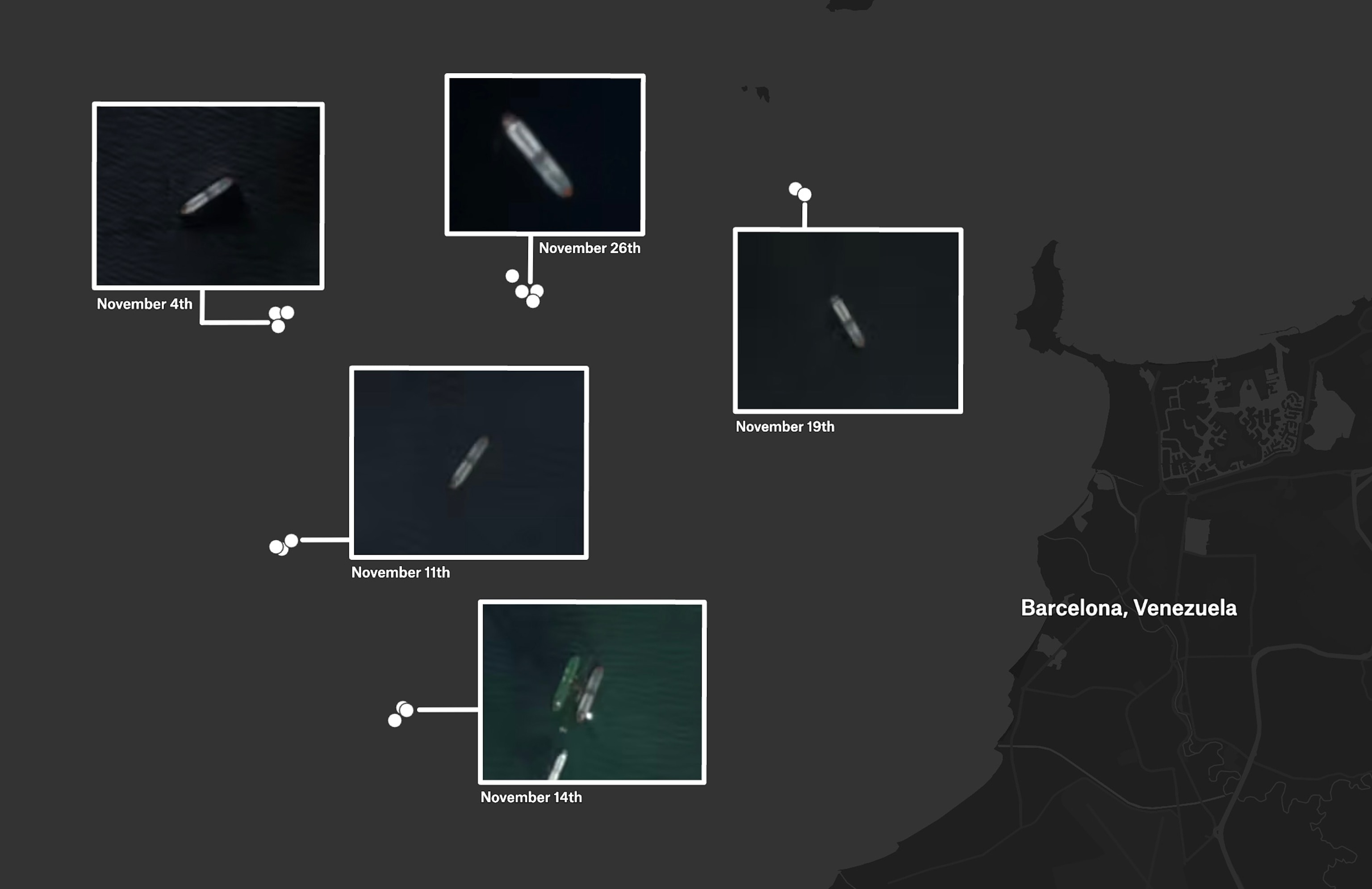
Digital broadcast signals emitted from the vessel’s transponder and tracked by analytics company Kpler placed the Skipper near Guyana’s offshore between November and December. However, more than a dozen satellite images verified by ABC News confirmed Skipper was in fact operating in waters off the coast of Barcelona, Venezuela, around 550 miles away during this same period.
Over a dozen satellite Images show The Skipper off the coast of Barcelona, Venezuela from October 30th to December 4th, 2025.




TankerTrackers.com/Copernicus Sentinel/Felt Maps
Citing a “pattern of deliberate obfuscation,” Dimitris Ampatzidis, a senior risk and compliance manager at Kpler, told ABC News the allegedly “spoofed signals” indicate “a broader pattern of sanctions evasion logistics.”
Satellite imagery captured by two providers appears to show the Skipper loading barrels of crude at Venezuela’s José Oil Terminal on Nov. 14, followed by a third sighting there by Planet Labs on Nov. 18.

A satellite image shows the Skipper at José oil terminal off the coast of Barcelona, Venezuela on November 14 , 2025.
Planet Labs PBC
An image taken by TankerTrackers.com, an organization that monitors global oil shipping, also shows the Skipper at the José oil terminal in a similar time period.
Satellite images captured the Skipper continuously off the coast of Barcelona between Oct. 30 and Dec. 4, as its signal was allegedly being spoofed.

A photo of the Skipper off the coast of Barcelona, Venezuela around November 2025.
TankerTrackers.com
In a statement to ABC News, Matt Smith, an analyst at Kpler, confirmed in mid-November that the vessel “covertly” loaded “1.1 million barrels of heavy sour Merey crude” without its transponder switched on.
Smith noted the Skipper had previously engaged in what he said was “dark activity,” a reference to ships operating without their transponder switched on.

The route of the Skipper throughout the year of 2025 according to its transponder data.
Marine Traffic/Felt Maps/TankerTrackers.com
In an extensive analysis of satellite imagery from February 2025, TankerTrackers.com identified the Skipper’s movements off the coast of Iran and China from March to September.
The site estimates that the Skipper carried 1.87 million barrels of oil from Iran to China in February of this year, and another 1.95 million barrels again from Iran to China in July of this year.
The tanker was spotted off the coast of Madagascar in October, before making its way across the Atlantic Ocean.
It was spotted again north of Trinidad and approaching Venezuela on Oct. 29, before spending over a month off the coast of Barcelona.

Satellite images show the Skipper as it headed from Asia toward Venezuela.
TankerTrackers.com/Copernicus Sentinel/Felt Maps
According to data from MarineTraffic, a vessel tracking platform owned by Kpler, the Skipper’s registered owner is Triton Navigation Corporation; its beneficial owner is listed as Thomarose Global Ventures. Triton Navigation, along with the Skipper, then known as Adisa, was the subject of U.S. sanctions in 2022 for alleged ties to Hezbollah and Iran’s Islamic Revolutionary Guard Corps-Qods Force.
ABC News’ Kerem Inal contributed to this report.
Source: abc news