The week of Dec. 15-19 saw Mexico navigating complex regional tensions while making strides in energy infrastructure and economic positioning.
As the Mexican peso reached its strongest exchange rate in months, the administration also faced criticism over the Maya Train’s mounting losses and a viral congressional brawl motivated by dissent from the ruling party’s actions.
From offers of mediation with Venezuela to trade talks with India and Canada, Mexico demonstrated both pragmatic diplomacy and strategic economic planning as it approaches the crucial USMCA review year.
Didn’t have time to follow this week’s top stories? Here’s what you missed.



Venezuela tensions and regional diplomacy
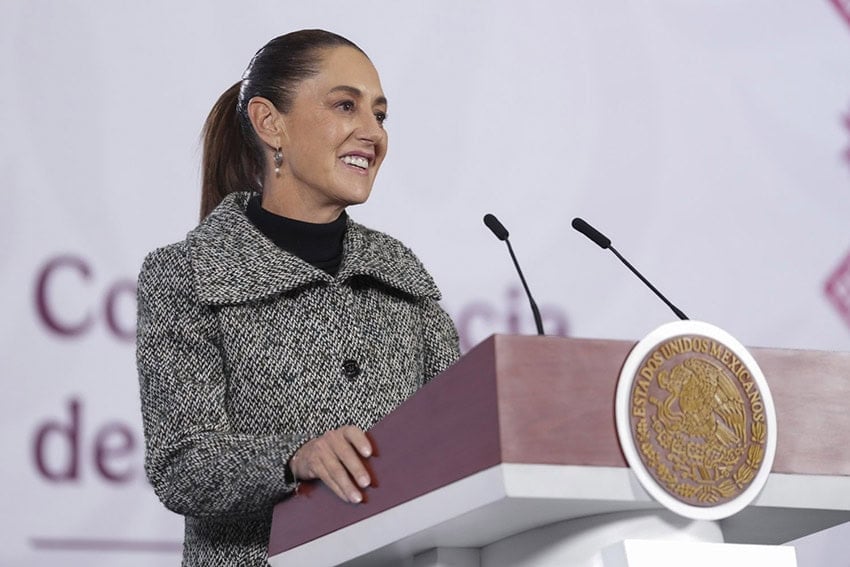
President Sheinbaum positioned Mexico as a potential mediator between the United States and Venezuela as tensions between the two nations escalated dramatically.
The diplomatic crisis intensified after U.S. President Donald Trump announced a “total and complete blockade” of sanctioned oil tankers entering or leaving Venezuela on Tuesday, while declaring the Venezuelan regime a foreign terrorist organization and surrounding the country with what he called the largest armada ever assembled in South American history.
At her Wednesday morning press conference, Sheinbaum reiterated Mexico’s constitutional position of non-intervention and opposition to foreign interference, emphasizing peaceful conflict resolution and self-determination of peoples. She called on the United Nations to assume its role in preventing bloodshed, asserting the international body had not been sufficiently visible amid the crisis.
🚨 Sheinbaum responde a Trump por bloqueo a Venezuela
Luego de que el presidente de EUA, @realDonaldTrump, ordenó el bloqueo “total y completo” de todos los buques petroleros que entren o salgan de Venezuela, la presidenta @Claudiashein se pronunció y señaló que la posición de… pic.twitter.com/Tp5qAzHECe
— Político MX (@politicomx) December 17, 2025
Sheinbaum later suggested Mexico could serve as a negotiation or meeting point for talks between the U.S. and Venezuela if both parties were interested in dialogue, or help seek other mediators to avoid regional conflict. The Venezuelan government called Trump’s blockade announcement a grotesque threat, with President Nicolás Maduro vowing to defend Venezuela’s sovereignty over its oil, gas and mineral wealth.
Energy infrastructure push
The Mexican government unveiled ambitious plans to transform the nation’s power grid through a combination of public and private investment totaling nearly $9 billion.
Energy Minister Luz Elena González announced Wednesday that 20 renewable energy projects proposed by private companies had been rapidly approved, representing $4.75 billion in investment and adding 3,320 megawatts (MW) of generation capacity across 11 states.
The 20 projects, selected from 98 proposals submitted in response to the Energy Ministry’s October call, include 15 solar power plants and five wind farms to be built in Campeche, Hidalgo, Yucatán, Guanajuato, Oaxaca, Tamaulipas, Quintana Roo, Puebla, Veracruz, Zacatecas and Querétaro.
The government plans to issue a second call for proposals in January to reach the targeted 6,000 additional megawatts of generation capacity. Meanwhile, the state-owned Federal Electricity Commission (CFE) announced $4.32 billion in investment for five new combined cycle power plants in Tula, Salamanca, Altamira, Mazatlán and Los Cabos, along with $710 million for expanding the Puerto Peñasco solar plant to become Latin America’s largest at 1,000 MW capacity.
Trade developments
India seeks FTA with Mexico
Facing steep new Mexican tariffs that could hit $2 billion worth of Indian exports, India accelerated efforts to negotiate a free trade agreement with Mexico. The tariffs, which could reach as high as 50% and take effect Jan. 1, target countries without free trade agreements with Mexico, including India, China, South Korea, Thailand and Indonesia.
India’s trade secretary Rajesh Agrawal announced Monday that preliminary technical discussions had begun following an online meeting with Mexico’s deputy minister this month. The new duties are expected to particularly impact India’s automotive sector, which exports around $1 billion worth of vehicles annually to Mexico, its third-largest car export market, with import duties on cars climbing from 20% to 50%.
Last year, India exported $5.73 billion of goods to Mexico while importing $3.01 billion, with key exports including vehicles, base metals, auto parts and textiles. Mexican officials have defended the tariffs as necessary to protect domestic industry and reduce trade imbalances rather than as a political measure.
Canada plans its largest trade mission yet
Canada announced it will send its largest-ever trade mission to Mexico in February 2026, with stops in Mexico City, Monterrey and Guadalajara.
Ambassador Cameron Mackay told Canadian media that hundreds of Canadian businesses have applied to join the mission, which will be led by Canada-U.S. Trade Minister Dominic LeBlanc.
The Feb. 15-20 mission will focus on opportunities in agriculture, advanced manufacturing, information communications technology, clean energy and creative industries. Two-way trade between Mexico and Canada reached nearly $41 billion in 2024, up from less than $5 billion before NAFTA took effect in 1994. Canada ranked as the fourth-largest foreign investor in Mexico in 2024 behind the United States, Japan and Germany.
Water agreements ease cross-border tensions
Two significant water-related agreements helped defuse tensions between Mexico and the United States this week.
Mexico, US reach agreement on water deliveries
After Trump threatened a 5% tariff on Mexican imports over unmet water delivery obligations, Mexico and the U.S. reached an understanding on Friday on water management under the 1944 Water Treaty. Mexico committed to releasing 202,000 acre-feet of water starting this week, with deliveries extending into 2026 rather than meeting Trump’s year-end deadline.
The agreement addresses Mexico’s water deficit from the 2020-25 treaty cycle, when the country delivered only about 50% of the required 1.75 million acre-feet due to severe drought conditions. President Sheinbaum emphasized that Mexico isn’t delivering more than treaty requirements and that transfers won’t adversely affect domestic water availability. Both countries agreed to continue negotiations and finalize a plan for repaying the outstanding deficit by January 31, 2026.
Separately, Mexico and the U.S. signed Minute No. 333 on Monday, addressing the decades-long sewage crisis affecting San Diego and Tijuana.
The accord calls for $93 million in improvements to Tijuana’s sewage system, including doubled treatment capacity, a new ocean outfall, sediment capture basins and a water infrastructure master plan. EPA officials emphasized the improvements would not cost U.S. taxpayers, though a cost-sharing formula will apply to river cleaning operations.
The peso strengthens
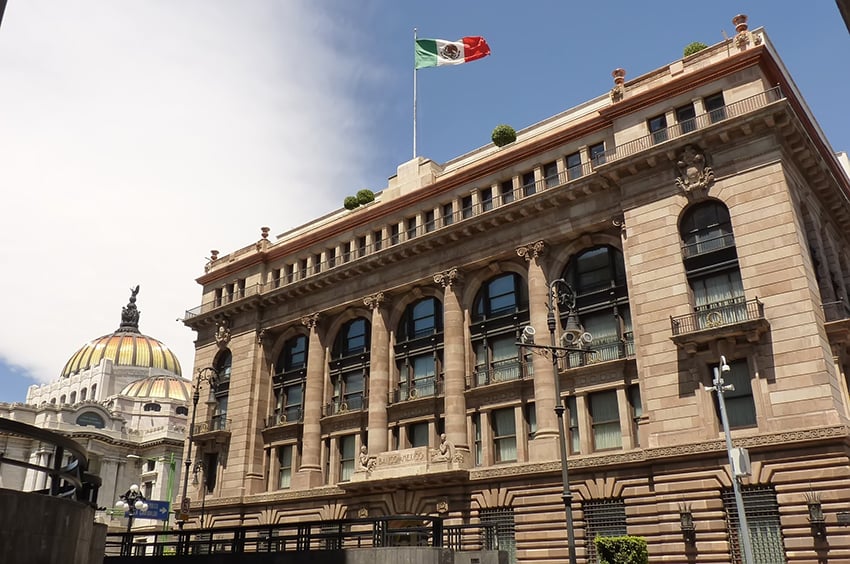
The Mexican peso reached its strongest position since July 2024, trading below 18 to the US dollar on Monday morning. The currency closed the week around 17.99 per dollar, marking an approximately 16% appreciation in 2025 after ending 2024 at 20.88 to the dollar.
Analysts attributed the peso’s strength to the continued decline of the U.S. dollar on international markets and the resolution of tensions with the United States over water disputes. Other factors supporting the peso include the Bank of Mexico’s still-high benchmark interest rate, despite 11 consecutive cuts bringing it to 7.25%, and strong foreign investment inflows.
On Wednesday, Banxico announced a 50 basis point cut to 7%, citing weak economic activity despite rising inflation.
Central bank cuts interest rate to 7% citing weak economic activity
Other news to know
- Middle class surpasses poverty: For the first time in Mexican history, more citizens are categorized as middle class than living in poverty, according to government data based on World Bank findings. The middle class — defined by WB as people with daily incomes above US $17 (around 340 pesos) — grew from 27.2% of the population in 2018 to 39.6% in 2024, while poverty declined from 35.5% to 21.7% during the same period.
- Brawl erupts in Mexico City Congress: Physical confrontation broke out Monday between lawmakers during a debate over disbanding the Mexico City Transparency Institute. The melee, involving hair-pulling and minor blows between female deputies from the PAN and Morena parties, went viral on social media after PAN lawmakers invaded the congressional dais to protest changes to an agreed-upon replacement structure that would give the Morena party greater authority.
- Maya Train marks first anniversary amid losses: One year after becoming fully operational, the Maya Train generated revenue covering just 12.6% of its operating expenses during the first nine months of 2025. Experts predict the train will need government support for 10 to 20 years before becoming profitable, potentially costing nearly $1.4 billion over the next decade. Freight operations, key to financial viability, are not expected to begin until late 2026 or 2027.
- Volaris and Viva plan merger: Mexico’s two major low-cost airlines announced Thursday plans to merge under a single holding company while maintaining separate brands and operations. The combination would control more than 70% of Mexico’s domestic air travel market, with Viva holding 38% and Volaris 33%. The merger, structured as a 50-50 partnership, is subject to regulatory approval and expected to be finalized in 2026. The new airline group would operate a combined fleet of 211 aircraft, significantly outnumbering flagship carrier Aeroméxico’s 161 planes.
Looking ahead
At her Friday morning press conference, President Sheinbaum outlined her administration’s 2026 priorities while expressing optimism about upcoming challenges.
She identified public investment as a key driver of economic growth, alongside continued focus on security improvements, social and human rights, education, healthcare, housing and welfare programs.
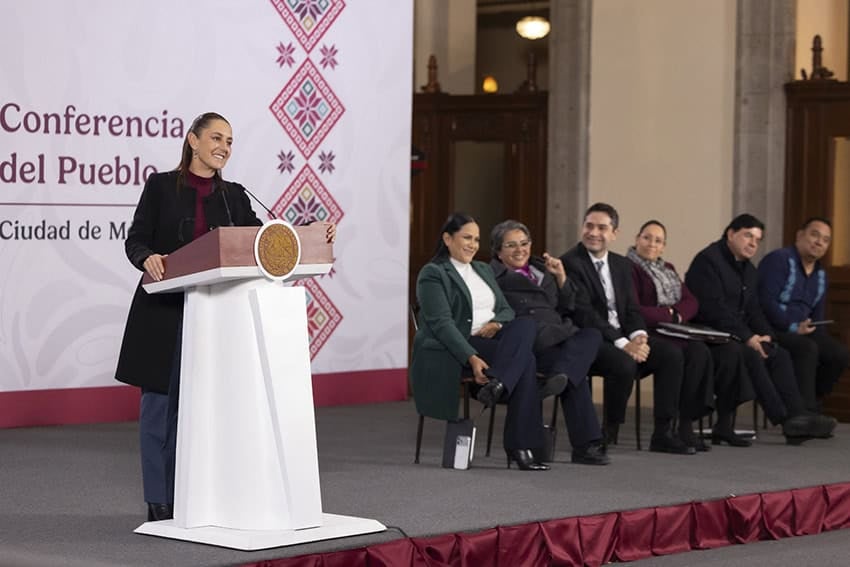
On trade matters, Sheinbaum clarified that the USMCA will undergo a “review” next year rather than a full renegotiation, declaring herself “very optimistic” despite Trump’s numerous tariff impositions. She noted that U.S. Trade Representative Jamieson Greer recently acknowledged the agreement’s overall benefits.
Regarding Mexico’s new tariffs on imports from China, India and other non-FTA countries, Sheinbaum indicated openness to dialogue but suggested significant modifications are unlikely, as the tariffs serve Plan México’s goals of reducing import dependence and creating 1.5 million new jobs.
Mexico News Daily
This story contains summaries of original Mexico News Daily articles. The summaries were generated by Claude, then revised and fact-checked by a Mexico News Daily staff editor.
Source: Mexico News Daily