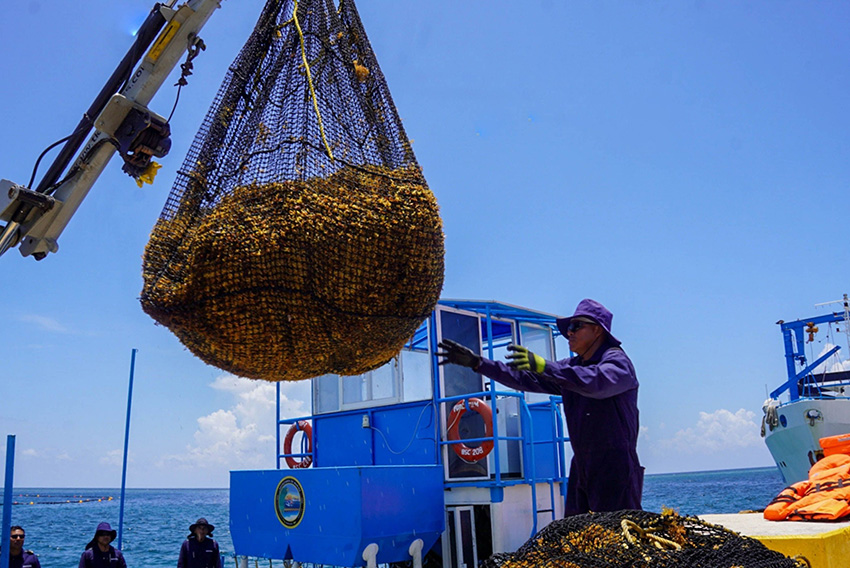
After more than six months out of service for maintenance work, two Navy sargassum collection vessels are operational again off the coast of Tulum, boosting efforts to keep the noxious seaweed off the beaches of Mexico’s Yucatán Peninsula.
While sargassum removal efforts continue on the beaches of the state of Quintana Roo, the Navy (Semar) vessels are designed to collect sargassum in the open sea before it reaches the sand.
David Buchanan García, head of the Federal Maritime Terrestrial Zone (Zofemat) in Tulum, confirmed that the offshore sargassum collection vessels renewed operations a couple of weeks ago.
To improve the vessels’ efficiency, local authorities and federal agencies are installing a floating dock that will facilitate embarkation and disembarkation as they load and unload the seaweed. Promoted by the National Commission of Natural Protected Areas (Conanp), the project will also improve safety in the daily operations of the naval units.




With these efforts, authorities hope to make more headway in controlling the tourist-discouraging seaweed, which has washed ashore in record-breaking quantities this year.
In May, the National Autonomous University of Mexico (UNAM) had warned that sargassum levels would increase by 40% compared with previous years. Researcher Leticia Durand Smith, from the UNAM Regional Center for Multidisciplinary Research, warned that the natural phenomenon would reach unprecedented levels, surpassing the records of 2018 and 2023, when sargassum invaded beaches and reefs.
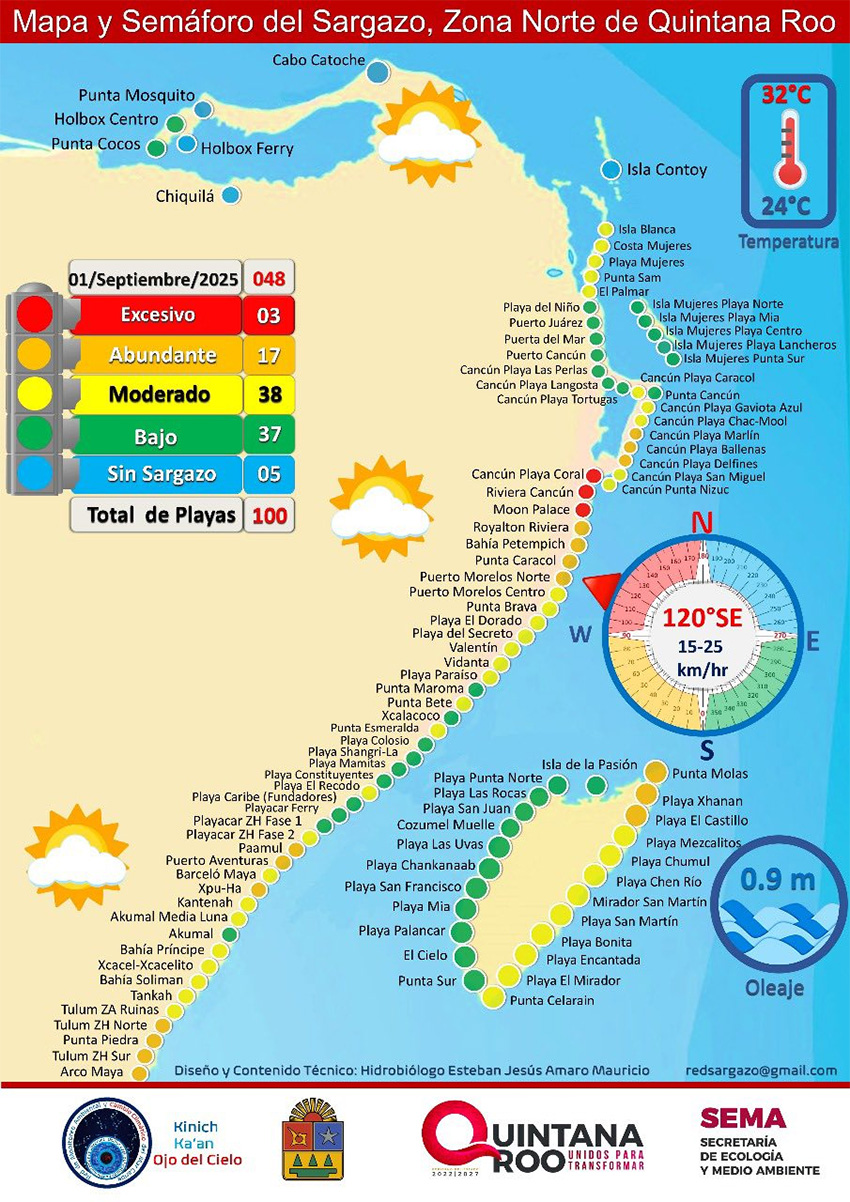
In the resort city of Cancún, for instance, officials have reported collecting nearly four times more sargassum this year compared to all of 2024, when 3,700 tons were collected.
“We surpassed last year’s figures since June,” said Antonio Chambé, director of municipal public services of Benito Juárez, Cancún’s municipality. “Today’s figure is historic. We’ve had large amounts of sargassum arriving, especially along the coast from Delfines toward Chac Mool.”
Sargassum is a yellow-brown seaweed that floats in the central Atlantic Ocean for much of the year, providing food, shelter and breeding grounds for various marine species. However, once it reaches the shore and begins to rot, it releases toxic gases such as hydrogen sulfide and ammonia, which can be harmful to humans and the environment.
Authorities in Quintana Roo have said that the landing season generally ends in November, when cold fronts begin. The “Everyone Against Sargassum” program will continue until then.
With reports from La Jornada Maya and Reportur
Source: Mexico News Daily