A university professor cycles 550 kilometres across summer Hokkaido, meeting craftsmen and testing local foods while tracing the island’s pioneer spirit.
This episode continues our Japan by bicycle series, a string of rides that treat the road as the thread tying together places, people and traditions. On this trip James Hobbs, a university professor from England who has lived in Japan for 26 years, tackles summer Hokkaido, a 550-kilometre route that begins in the historic port city of Hakodate and finishes at the jagged cliffs of Cape Kamui. The ride moves between long straight plains, bright green mountain passes and coastal villages, and James uses his pedals to meet people who still make their livelihoods from the sea and the soil.
He boards the ferry across the Tsugaru Strait with the sun on his face, soaking in the crossing and calling back to the camera, “Okay, so we’re on the boat heading to Hokkaido, the weather is fabulous, the legs are feeling good.” That easy confidence suits this island, a place where scale is generous, the plains run wide and the roads invite long days in the saddle. Hakodate gives the trip an old-world opening, its steep streets lined with Western-style houses that recall the early pioneers who arrived here about 150 years ago to work on Hokkaido’s resources.
Riding north along the coast, James slips between sea and mountain and comes upon racks of kombu drying beside the road. Kombu is the kelp used to make dashi, the stock at the heart of much Japanese cooking, and the town of Shikabe, on Hokkaido’s southern coast, is famous for its kombu cultivation. There James meets Hidekazu Iida, whose family have been fishermen in Shikabe for six generations, and watches as the small processing yard turns the day’s harvest into product.


Iida explains that July and August are the peak months, as they need to dry a ton of seaweed each day to retain the best umami. Their neighbours all pitch in because it is too much work for one family alone. James volunteers to hang and peel the blades, learning how the kelp must be dried within the same day it is picked, and later tastes a simple home-cooked dish of young kombu shoots, konnyaku and steamed fish cake, calling it “delicious.”
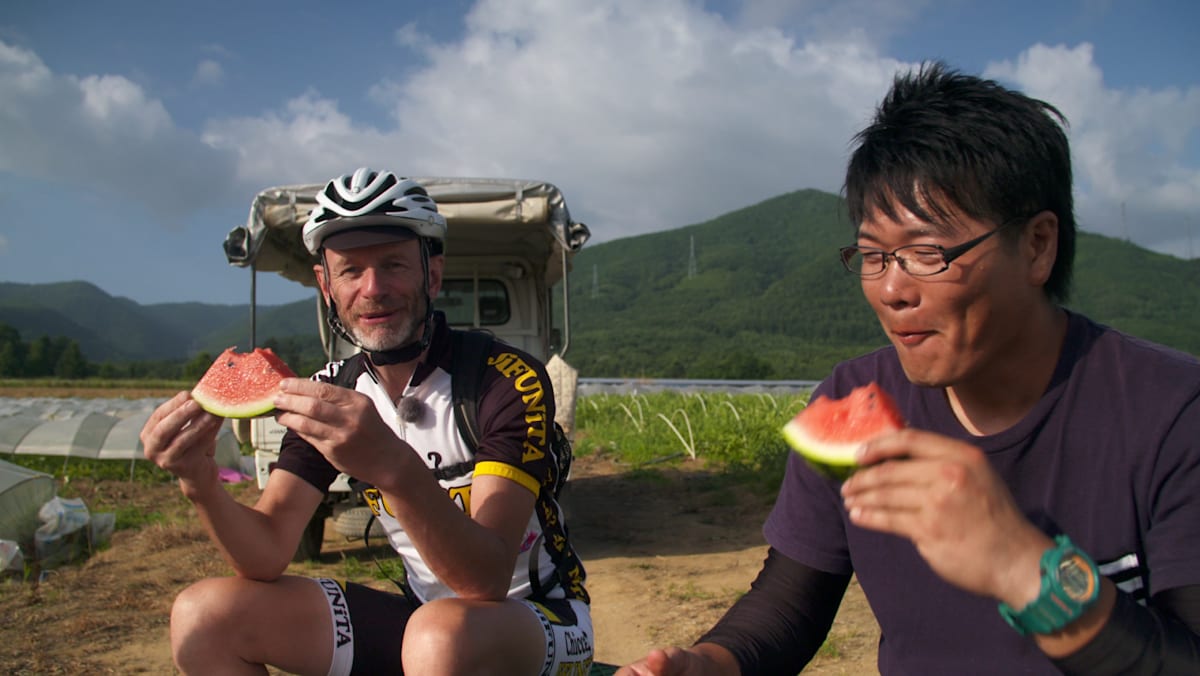
The episode keeps returning to the link between craft and season. In inland Kyowa, a farming town in Hokkaido, James visits the watermelon fields that have become a local specialty. Farmers such as Mikiyo Kamisaka show him rows of ripe fruit and describe how, sixty years ago, local growers shifted from rice and barley to higher-value crops like watermelons to boost the town’s economy. James hefts a watermelon himself, surprised by its weight, and watches pickers working at speed, harvesting hundreds a day at the height of the season. The fruit tastes of sun and water, a direct reward for long summer labour.
Rider houses, a form of simple guesthouse created for touring cyclists and motorcyclists, provide the trip’s quieter moments. James finds one on a dairy farm in Kuromatsunai, where farmer Yoshimasa Takeda and his wife welcome guests with a shared kitchen, barbecues and milk direct from the cow. These modest stays are part hostel, part home, and they show how hospitality in Hokkaido often arrives in small, generous forms.
The itinerary moves into mountain country at Niseko, the resort region that sits beneath the near-perfect cone of Mt Yotei. Niseko is a summer magnet as well as a winter ski zone, and James stops for gelato made with Hokkaido milk, the dairy richness lifting flavours such as blue honeysuckle and cheesecake. The cafe owner, originally from the Netherlands, talks about the international cycling community that now calls Niseko home, and recommends the Niseko Panorama Line, a scenic road that climbs to excellent viewpoints.
Small workshops and old industries appear at every turn. In Otaru, a port town north of Sapporo, James visits Little Glassworks where Saiichiro Asahara, fourth generation of a family business, still blows the round glass buoys once used by fishermen to mark nets. During the herring boom of the early 20th century glassmaking flourished, and even after the fisheries declined and plastics arrived, Asahara decided to return from a white collar job and keep the buoy tradition alive. He now adapts the craft to make decorative and interior items, showing how a living tradition can survive by finding new markets.
Remote villages show another kind of resilience. In Otari village, where winter snows are heavy, Paul sees houses with steeply pitched roofs that shed snow and meets Harumi Aizawa who practices boro-ori. Boro-ori is a local weaving method that reuses old cotton clothing as yarn to create thick, warm fabric. It began in necessity, but today Aizawa adapts it into modern products like tote bags and accessories, bringing younger residents into a tradition that might otherwise have been lost.
The final stage returns to the sea and a walk along the cliff path to Cape Kamui. James parks his bike and makes the last stretch on foot, rewarded by a sweeping view of the ocean and rock-carved headlands. At the end he reflects on what the ride has given him, “The best memory is the friends I’ve made,” a line that ties together the encounters, the meals and the small acts of help and hospitality that define this route.
What this ride shows is how Hokkaido’s environment shaped its people, how pioneer efforts turned rough land into farms and ports, and how communities now sustain traditions that are practical, seasonal and social. The bicycle provides a pace that lets James stop, help, taste and listen, and the result is a portrait of a summer island that feels generous, work-focused and warmly connected to its past.
Source: CNA