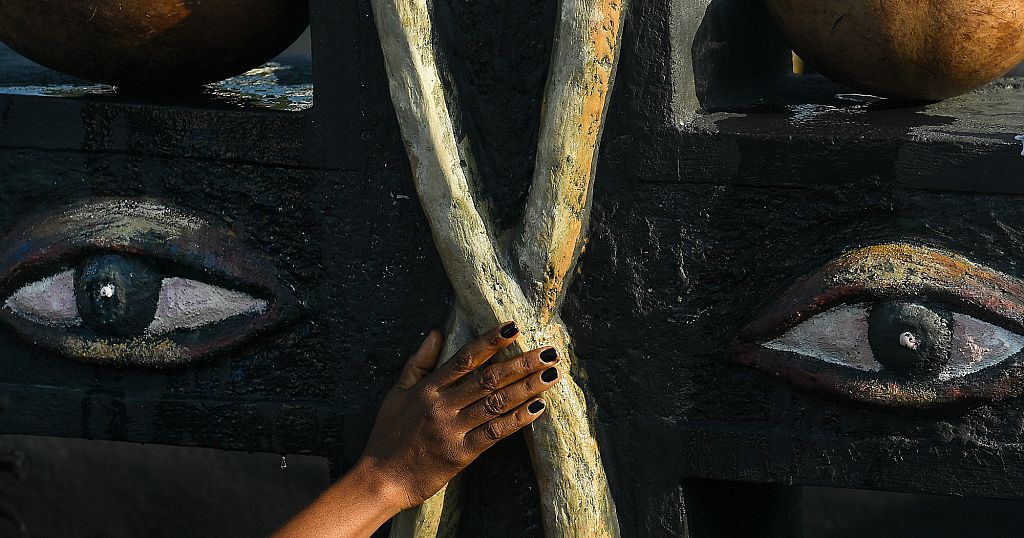
Dance is Life: Performers in Haiti’s capital Port-au-Prince reassert the nation’s cultural identity in the face of gang violence.
Twenty dancers gathered in a leafy garden in Port-au-Prince on Saturday for an event called “Dance is life.” They were there to show that their culture and music are resilient in the face of Haiti’s security crisis.
The performance was the brainchild of dance teacher and choreographer Pascale Durosier:

“I always say that dance is my language, how I can express what’s deep inside, what I can’t speak out loud. It’s my way to express myself and forget about everything else. It’s my way of coping with the situation.”
The performance was inspired by the 18th century Bois-Caiman Vodou ceremony that led to the only successful slave revolt in history – and the founding of Haiti as a free nation.
“It’s in our blood,” Durosier says. “We feel the drums; we feel the connection with music. So, what made our independence? It was the ceremony of Bois-Caïman. In Bois-Caïman, you have the Petro dance, you have the drums, you have all the spirits with us. It was through dance. So, dance for me is a revolution. Dance, for Haitians, has to mean power. Dance has to be identity, to know who you are.”
That revolution had its roots in Vodou, a religion born in West Africa and brought across the Atlantic by enslaved people. It melds Catholicism with animist beliefs has no official leader or credo. It has a single God known as “Bondye,” which means “Good God” in Creole and more than 1,000 spirits known as the lwa.
According to the United Nations, an estimated 90 percent of Haiti’s capital, Port-au-Prince, is under the control of criminal groups, who are expanding their attacks into surrounding areas and previously peaceful regions.
Source: Africanews