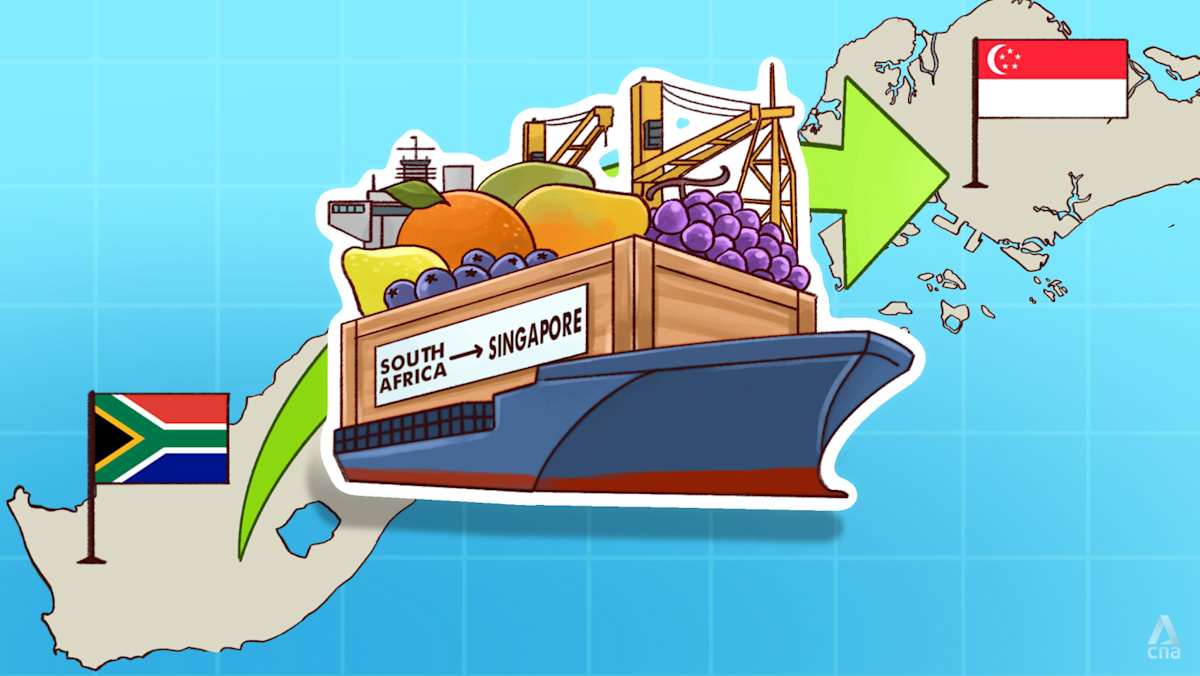
JOHANNESBURG: From his farm in Paarl, Western Cape, Altus Kirsten exports grapes and blueberries to Singapore, a market he describes as “important” despite accounting for only 1 to 2 per cent of his company’s total exports.
The figure has remained “fairly stable” year on year, said Mr Kirsten, managing director of Angon Fruit, a homegrown supplier that started in 2011.
His business is part of South Africa’s expanding fruit sector that has caught Singapore’s attention as the Southeast Asian country pursues its import diversification strategy.
Singapore’s largest retailer, FairPrice Group, has sourced South African fruits for over a decade, with popular items such as blueberries, grapes, apples, oranges and pears showing gradual increases in demand, a spokesperson said.




The diversification of import sources was emphasised as a key pillar of Singapore’s new food security strategy, unveiled by Minister for Sustainability and the Environment Grace Fu last month.
It aims to reduce risks from depending on a few sources during disruptions such as adverse weather, geopolitical tensions, trade route blockages and pandemics, said Ms Elyssa Kaur Ludher, visiting fellow at the ISEAS-Yusof Ishak Institute.
The issue of food security was also front and centre at the G20 Summit held in Johannesburg recently, where Prime Minister Lawrence Wong attended at the invitation of South African President Cyril Ramaphosa, despite Singapore not being a G20 member.
WHY SOUTH AFRICA FITS THE STRATEGY
South Africa’s suitability stems from its geographical location, food safety standards and political stability, experts said.
“South Africa offers a geographic advantage as it is in the southern hemisphere and so, in principle, can cater to that time of the year when not much is coming from the northern hemisphere,” said Professor Paul Teng, a food security expert at the S Rajaratnam School of International Studies.
Ms Ludher noted that few southern hemisphere countries possess well-developed agri-food production industries with proper food safety safeguards. “South Africa, along with Australia and New Zealand, is among the leaders,” she said.
The country’s size and varied agroclimatic zones also enable diverse agricultural production, added Ms Ludher.
These factors mean that South Africa offers “a diverse crop basket and counter-seasonal production that complements our existing suppliers”, said Mr Bjorn Low, food sustainability observer and founder of urban farming social enterprise Edible Garden City.
Prof Teng added that South Africa is the most advanced among Sub-Saharan African countries, with a reasonable level of political stability, plus strong research and development capacity in agriculture that will likely improve export potential for products like citrus fruits.
Source: CNA