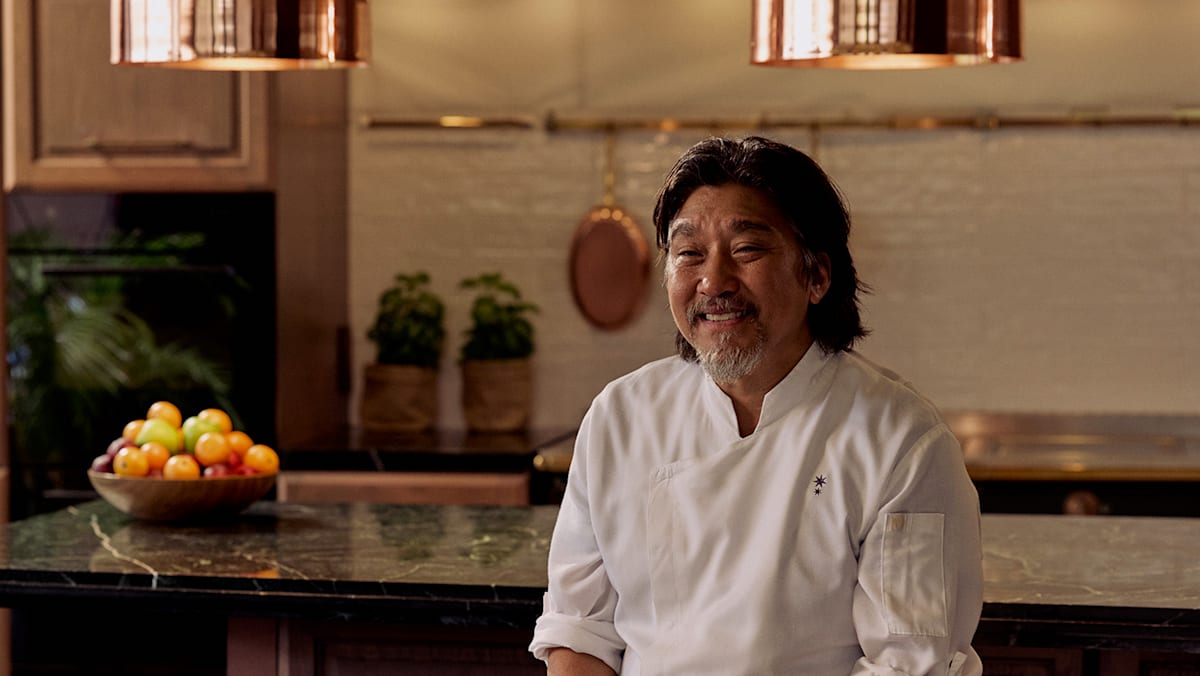
“Kitchens are really hard places to work in,” said Lee. “But if you want this industry to have a future, you need more balance – more inclusive, more diverse. Historically, women wrote cookbooks and ran restaurants in America. It’s only when restaurants became profitable, competitive, that they became male-dominated. We’re just trying to restore that balance.”
Sustainability is part of the same arc. To start, SHIA’s team identified and suggested sustainable swaps for 31 common plastic items used in restaurant kitchens, such as cling wrap and disposable gloves. Plastic quart containers, for example, were replaced with ceramic, stainless steel and glass containers. SHIA’s no-plastic rule has made headlines, but for Lee it’s less provocation than common sense. “Fifty, a hundred years ago, Asian restaurants didn’t use plastic. Why do we now? Delicious food doesn’t require it.”
A CHEF WITHOUT BORDERS
For all the accolades, Lee still described himself not as a celebrity but a storyteller.
“You don’t choose to go into TV, TV chooses whether it’s going to have you,” he said emphatically.



“TV, books, social media – the medium doesn’t matter,” he said. “My job is to bring the message of my food to people. That’s all I’ve ever wanted.”
That message continues to evolve. While working with Capella, Lee is also filming a BBC documentary on South Korea’s seafood traditions, due for release in 2026. The project will take him to the republic’s coastal villages and fishing towns. “Every time I think I understand Korean food, I discover another world within it,” he said.
With that, he rises to return to the kitchen, signalling the interview is over. Good jang, as it turns out, waits for no one.
Source: CNA