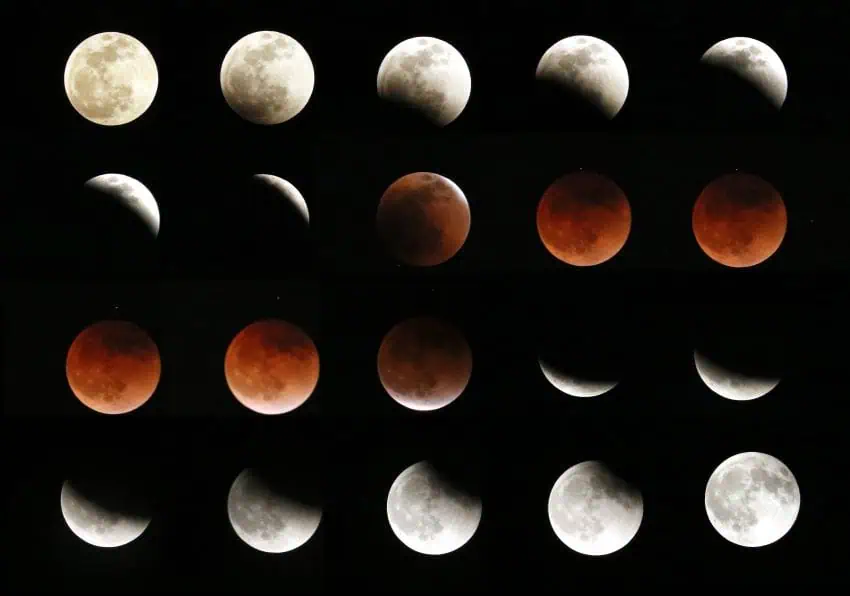
One of the most anticipated astronomical phenomena of 2025 — a total lunar eclipse that will turn the moon red — will be visible throughout Mexico tonight.
The dramatic six-phase event during which the moon will change color from white to red will begin at approximately 9 p.m. Central Mexican Time, but it will be a slow-developing phenomenon. The peak of the total eclipse will not occur until roughly 12:26 a.m. and will last for about an hour.
Here are the six phases to look for:
Phase 1: The moon enters the Earth’s penumbra, the outer part of the shadow and begins to dim, but the effect is quite subtle.



Phase 2: The partial eclipse becomes visible by 10:30 p.m. as the moon enters the Earth’s umbra (the dark central shadow cast by our planet). By 11:10 p.m., as the shadow moves from lower left to upper right, it will look like someone has taken a bite out of the side of the moon.
Phase 3: Total eclipse as the moon passes completely behind the Earth, the shadow moving from lower left to upper right of the moon.
Phase 4: The moon begins to emerge from the umbra, Earth’s inner shadow, receding from upper left to lower right as the red hue diminishes and looks like someone has taken a bite out of the other side of the moon.
Phase 5: The moon begins to pass out of the penumbra around 2:45 a.m., leaving a slight shadow on the moon.
Phase 6: The total lunar eclipse comes to a close at around 4 a.m.
Why a total lunar eclipse appears red
A lunar eclipse occurs when Earth’s orbit places it between the sun and moon, all three celestial objects lined up in a nearly perfect row. The alignment — called a syzygy — sees the moon pass into Earth’s shadow.
According to NASA, the shadow on the moon isn’t perfect as “faint sunbeams sneak around the shadow’s edges on all sides in the colors of a sunset, bathing the moon in brilliant, warm hues.”
“When the moon is within the darkest part of Earth’s shadow, called the umbra, it takes on a dramatic reddish hue, which has led to the nickname ‘blood moon’ for a lunar eclipse,” NASA explains.
Unlike a solar eclipse, the moon remains visible during a total lunar eclipse “because sunlight passing through Earth’s atmosphere reaches the moon’s surface.”
The dim lighting causes the moon to appear orange or red, NASA says, because “air molecules from Earth’s atmosphere scatter out most of the blue light.” That’s because colors with shorter wavelengths — blues and violets — scatter more easily than colors with longer wavelengths, such as red and orange.
The remaining light from the sun reflects onto the Moon’s surface with a red glow, making the Moon appear red in the night sky.”
Additionally, the presence of clouds or dust in the atmosphere will make the moon appear even redder.
With reports from Infobae, NASA and Gaceta UNAM
Source: Mexico News Daily