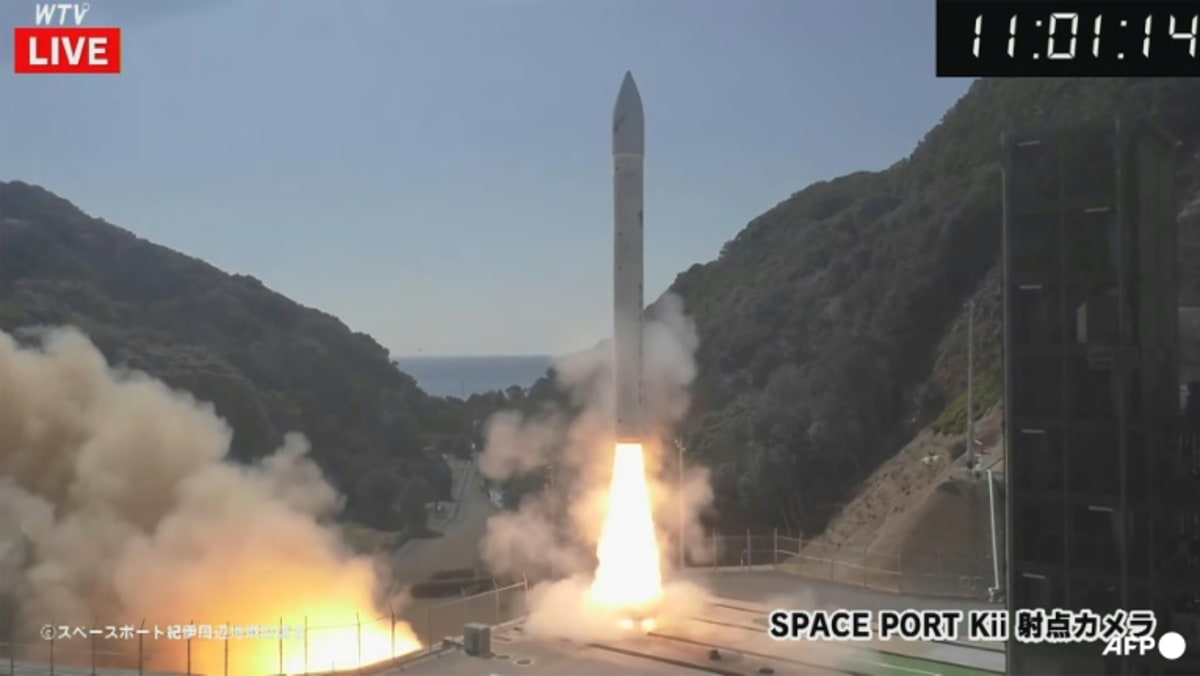
The failure marks a blow to Japan’s efforts to enter the potentially lucrative satellite-launch market.
The government wants to assess if it can quickly launch temporary, small satellites when and if its existing spy satellites malfunction.
Kairos had been hoped to put the satellite into the orbit around 51 minutes after the launch.
Space One was established in 2018 by a team of major Japanese tech businesses, including Canon Electronics, IHI Aerospace, construction firm Shimizu and the government-owned Development Bank of Japan.


Last July another Japanese rocket engine exploded during a test around 50s after ignition.
The solid-fuel Epsilon S was an improved version of the Epsilon rocket that had failed to launch the previous October.
Its testing site in the northern prefecture of Akita was engulfed in flames and a huge plume of grey smoke rose into the sky.
The malfunction came after Tokyo in March 2023 had seen its second attempt to launch its next-generation H3 rocket fail after liftoff.
Last month though Japan’s space agency toasted a successful blast-off for its new flagship rocket, the H3, after years of delays and two previous failed attempts.
The H3 launched from the Tanegashima Space Center in southwestern Japan, sparking cheers and applause at JAXA control centre.
It has been mooted as a rival to SpaceX’s Falcon 9, and could one day deliver cargo to bases on the Moon.
That followed Japan’s successful landing in January 2024 of an unmanned probe on the Moon – albeit at a wonky angle – making it just the fifth country to achieve a “soft landing” on the lunar surface.
Source: CNA