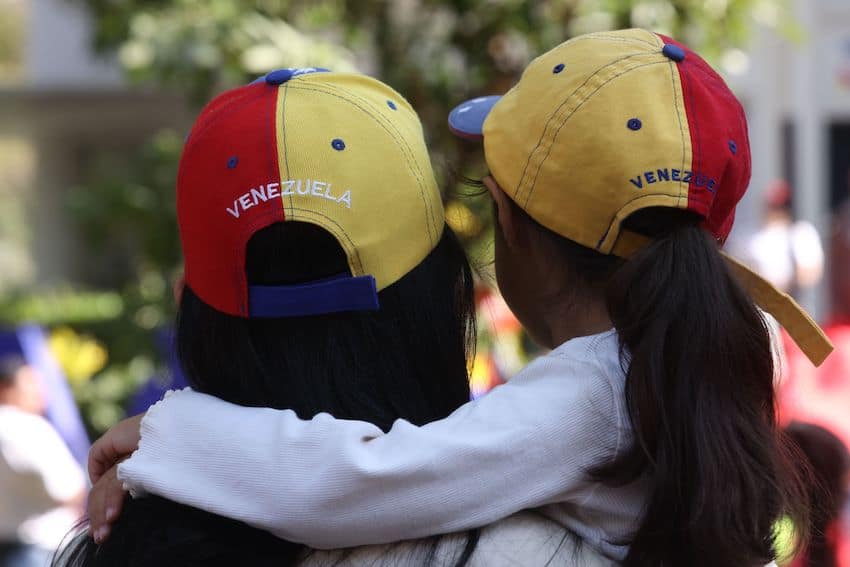
The Jan. 3 detention of Venezuelan President Nicolás Maduro by the United States prompted street celebrations and protests in equal measure.
For most Mexico-based Venezuelans, however, the situation is far more complex than images of demonstrations and debates on social media suggest.
On Saturday morning, U.S. military forces entered Venezuelan territory, killing at least 80 people, including 32 Cuban members of the president’s security detail, before capturing Maduro and his wife, Cilia Flores, in the capital of Caracas. The pair was transported to New York, where they now face trial on charges including cocaine trafficking, to which both have pleaded not guilty.
Hours after the operation, U.S. President Donald Trump announced at a press conference that his administration would oversee Venezuela “until we can do a safe, proper and judicious transition,” adding that U.S. companies would start operating in Venezuela’s oil reserves.

Many Venezuelans living in Mexico, far away from most of their family members, experienced a mix of emotions as information trickled in.
Jessica Valero, who arrived in Mexico in August 2024 after a long and arduous overland journey that took her through the Darién Gap, woke up to a message from her father saying that Caracas had been bombed. “I was really scared, really, really scared. I have some relatives in the military, and I’m very concerned for their safety.”
Valero immediately called her dad, who confirmed all her family members were safe, and told her that Maduro had been captured. “And I swear you won’t believe me, but I couldn’t feel my legs. I mean, I had to kneel down and lean on something because I couldn’t believe it.”
‘A necessary evil’
Many Venezuelans in exile shared a similar experience: initial confusion, followed by excitement after hearing the news of Maduro’s arrest. However, their perspectives on what is to come differ.
“Certainly, the situation in my country is very complex, and everything that has happened has generated a lot of controversy, but in my opinion, I think that this surgical intervention by the United States is a step that was necessary to restore democracy and stability to the country,” Valero said, adding that, “deep down, Venezuelans know that the United States’ involvement right now is a necessary evil.”
Bárbara Guevara, who has owned a Venezuelan restaurant in Mexico City for 12 years, echoed a similar sentiment. “I think that if it hadn’t happened this way, we would be like Cuba, and that scares me much more,” she said. However, her fear still outweighs hope. “I want Venezuela to become a new Panama. But based on Trump’s own statements, it’s going to become an Iraq.”
Manuel Chacón, a Chief Operating Officer of a technology company in Mexico City, who left Venezuela in 2017 after being at the forefront of many anti-government protests, is also hesitant to celebrate. “I’m not truly content. Obviously, one feels joy at seeing Maduro imprisoned, but matters are far from being properly resolved.” Worse, he fears the situation could deteriorate. “If the U.S. oversimplifies the problem and only changes the middleman, replacing Maduro with Delcy Rodríguez [Maduro’s vice-president], the situation could become much more complex than it was with Maduro.”
Chacón had brought a special bottle of rum from Venezuela to celebrate the eventual fall of the Chavista regime, but it remains in his cupboard. “I didn’t want to open it even though I saw the photo of Maduro’s arrest. No, there is still some way to go.”
Mariela Hernández, who has lived in Mexico City for 10 years and currently runs an art workshop business, has a more positive outlook. “A country like the United States is not going to invest millions of dollars for another actor of the same Chavista government to remain in power; that is not going to happen.” She noted that “the transition will certainly be difficult, but there will be a path to democracy for Venezuela that has undoubtedly already begun.”
A Mexican lens
Hernández voiced that some Mexicans have expressed to her that they oppose the United States’ military actions in her country because they violate the sovereignty of the people. To this, she responded, “The sovereignty of my people was violated 26 years ago; there is no longer any sovereignty, there is nothing left to protect.” She added, “Yes, it’s an invasion, but it’s an invasion that will bring freedom to a country that has been oppressed for 26 years.”
Silvia Lopez, a market analyst with a bachelor’s degree in political science from Monterrey, agrees that, as a Mexican who has not lived in Venezuela during Maduro’s regime, she does not have the knowledge to comment on what the end of Maduro’s presidency means for the country. At the same time, she fears that the foreign invasion of Venezuela sets a precedent for other countries, especially Mexico, as immediate neighbors of the United States: “Today it’s them, and tomorrow it could be us.”
“I see it as a double-edged sword,” Lopez commented. “On the one hand, you want to celebrate the good news for all the people who have lived in precarious conditions because of Maduro’s regime. But at the same time, it is also worrying to see how easily the U.S. government was able to intervene and kidnap the current president of a country, although not a legitimate or democratic president, and drop bombs and attack the civilian population.”
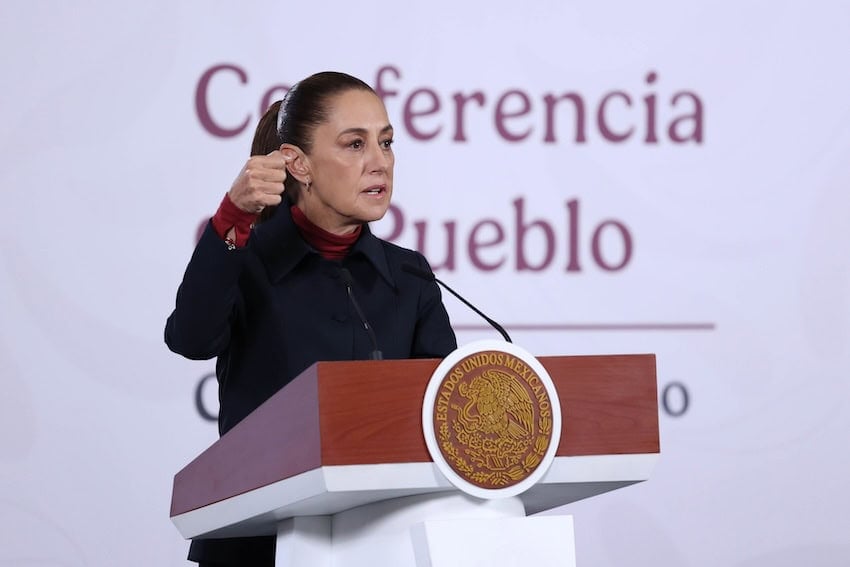
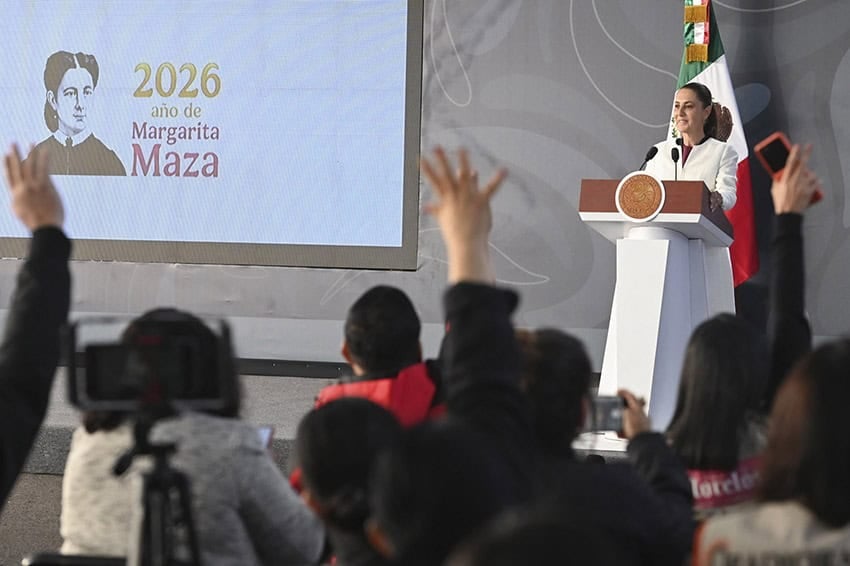
Mexican President Claudia Sheinbaum has also condemned the U.S. military operation. “We categorically reject intervention in the internal affairs of other countries,” she said during her daily press conference on Monday, after Trump suggested over the weekend that “something has to be done about Mexico.”
Sheinbaum: ‘Intervention does not bring democracy to the people’
Mariana Pinto, a communication sciences graduate from Mexico City, takes a different stance. “I am in favor of the intervention. Whether it was Russia, China or the United States, someone had to intervene because the country was under a dictatorship that had plunged it into extreme poverty.”
Pinto prefers to trust the opinion of the Venezuelans she has spoken to, who seem happy, instead of casting her own judgment as an outsider. “You shouldn’t talk about a country’s government and give your opinion, because they are the only ones who know what is happening.”
Two communities, contrasting responses
Many Mexican protestors who joined demonstrations on Saturday and Sunday would disagree with Pinto.
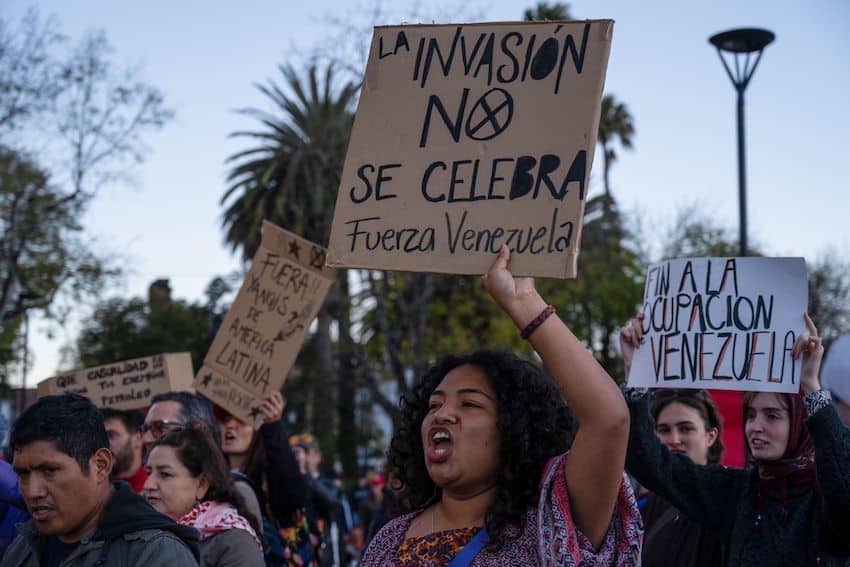
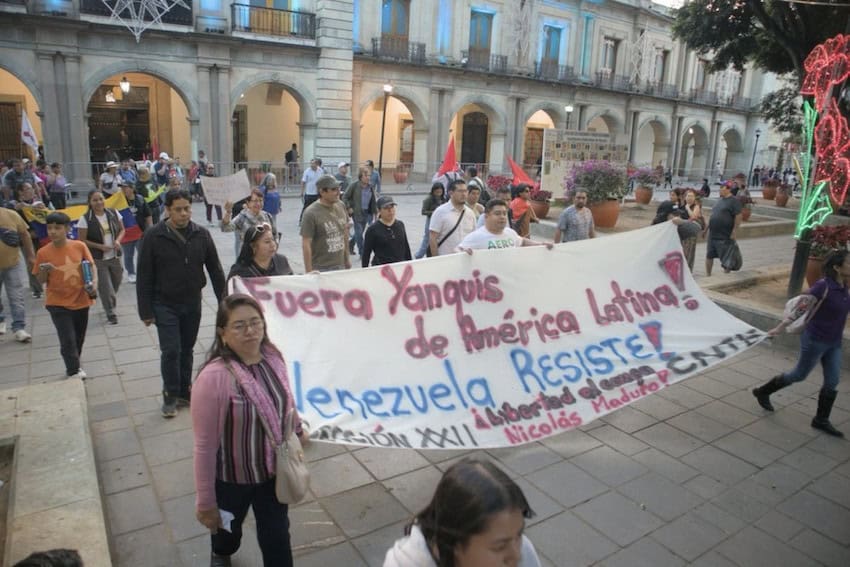
In Oaxaca city, for example, members of the National Coordinator of Education Workers (CNTE) and other social organizations took the stage on the main square’s kiosk after marching through the city center on Jan. 3 to voice their disapproval of Maduro’s capture.
“The aggression against Venezuela is an aggression against all peoples who fight for their sovereignty, self-determination and control of their natural resources. It is a message of war to any nation that dares to break away from imperialist logic,” one of the spokespeople exclaimed.
“That is why from Oaxaca, a territory of struggle, resistance and dignity, we call for immediate and permanent mobilization, reaffirming that peace can only be built with social justice and popular sovereignty,” she added. Meanwhile, the public chanted “Stop the imperialist war,” “Yankees out of Venezuela” and “Yankees out of Latin America.”
The same day, a group of protestors in Mexico City gathered at the U.S. and Venezuelan embassies to “express the total rejection of any kind of U.S. intervention,” as Jorge Rivas, a political activist and an active member of the Communist Party of Mexico, put it.
“This is a clear message to Mexico and the entire continent that any country that does not bow to U.S. interests will be invaded or intervened in,” Rivas said. “Always with an excuse supported by a narrative, such as the weapons of mass destruction of Asian countries, and today, the word terrorism is replaced by drug trafficking, and the same approach is taken.”
Some Venezuelans in Mexico City struggled to understand Mexican protestors’ motives and felt that by using Venezuelan flags, they were posing as Venezuelans while defending Maduro’s government.
Valero shares this opinion: “It would be very inconsistent of me, coming from a country where freedom of expression is not currently possible, to say these protests [by Mexicans] are wrong.” But she argued, “As a Venezuelan, I reject the fact that there are people of other nationalities who pretend to be Venezuelan, supporting something they don’t really know because they haven’t experienced it themselves.”
Hernández agreed. “We don’t understand why the Mexicans not only spoke, but also pretended to know more about the situation in Venezuela than we ourselves, who have suffered all these years.”
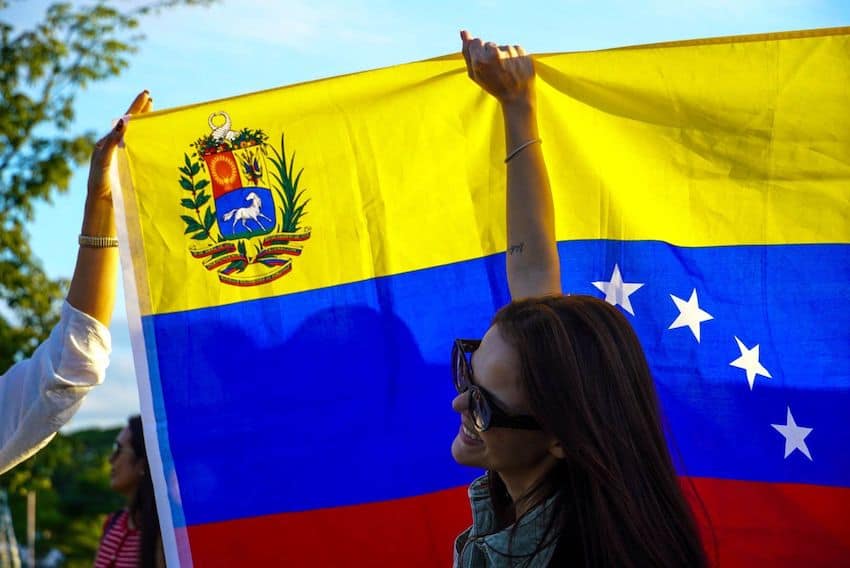
Contrary to these protests, following the capture of Maduro, some Venezuelans took to Mexico’s state capitals to celebrate.
Hernández herself was one of dozens of Venezuelans who gathered at Polanco’s Parque Lincoln in Mexico City. “What motivated me to join this gathering was to celebrate the beginning of the end of the dictatorship in Venezuela,” she explained.
Valero, on the other hand, noted that celebrations feel premature. “There are many families in Venezuela that are crying for their relatives,” she said, “and others cannot celebrate or raise their voices because they are not allowed to.” As the situation develops, for most people, joy and fear continue to exist side by side.
Vera Sistermans is a freelance journalist and security analyst based in Mexico City. Her work mostly focuses on Indigenous culture, violence and resilience.
Additional reporting by David Martínez.
Source: Mexico News Daily