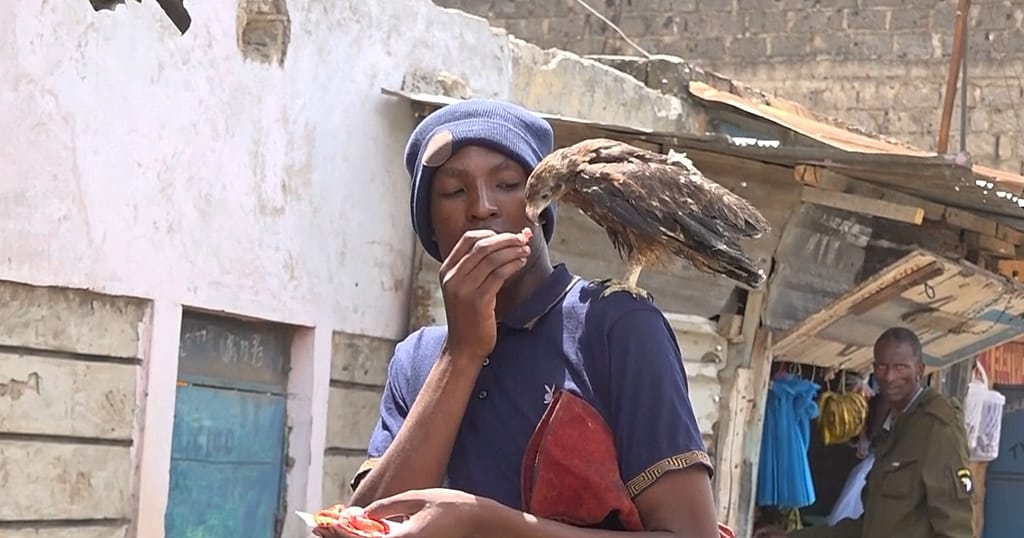
A Kenyan man who once lived on the streets now shares his small home with a small flock of rescued birds. Rodgers Oloo Magutha has nursed dozens of injured kites, owls and storks back to health, filling a gap in a country with few rehabilitation centres.
A black kite on his head. Pigeons flapping around his home. Rodgers Oloo Magutha’s calling is plain to see.
His passion for birds began long before he understood what bird conservation meant.


Growing up near Lake Nakuru National Park, he lived just steps away from the lake’s edge, a place filled with birdlife. As a child, he often slipped quietly into the park during his free time. There, surrounded by flamingos, kites, storks, and countless other species, something awakened in him.
“I used to sneak inside to see the birds, to watch the water,” he recalls. “That’s when my passion of rescuing and taking care of birds started.”
What began as innocent curiosity evolved into a calling. Over the years, Rodgers has rescued more than twenty different species of birds from black kites, African pied crows, barn owls, marabou storks to pigeons, and many others.
Some arrive with broken wings, some starving, others tangled in traps or weakened by disease. He takes them in, cares for them as best as he can, and watches many of them eventually take flight again.
“They are thriving in nature and they are so happy,” he says. “Mine is to rescue them and then set them free to explore nature.”
Rescuing birds, even without a home
But this journey has not been easy. Rodgers grew up on the streets, and for a long time, he had no shelter of his own let alone a place to care for injured birds.
At one point, he lived outside with more than ten rescued birds at a time.
“We used to stay with the birds on the streets,” he says. “You see, I cannot put more than ten different species of birds in one place, so if I can find a place, where I can open a shelter, it can be very good because I will end up rescuing more birds and my dream and my passion will grow.”
Even now, with a small place to stay, the challenges are real.
Feeding scavenger species such as marabou storks can be extremely difficult. “It eats a lot of meat,” he explains. “It is hard for me to get a lot meat to feed the birds. So I end up releasing the birds early before maybe they are healed or they are ready to go.”
Lack of medical knowledge and veterinary support has also made the work overwhelming. When a bird is sick, starving, or suffering from broken limbs, he is the only one they can depend on.
Some people misunderstand his work. Some even accuse him of sorcery or witchcraft because of his close bond with the birds.
Filling a critical gap in wildlife rescue
Conservation expert Paul Gacheru of Nature Kenya notes that bird rescue is crucial because Kenya’s avian species face numerous threats such as habitat loss, poisoning, collisions with power lines, and injuries from human activities.
“There are many things,” Gacheru explains. “There is disease of the bird, they might have broken limbs, they might have broken wings etc and if you are not a vet you need to be like a para-vet.”
He emphasizes that proper care requires training, and that administering treatment legally requires licensing by the Kenya Veterinary Board.
“All these skills can be gained through passion but on the other hand we ensure that we are within the right side of the law,” he says.
Gacheru also highlights the shortage of rehabilitation facilities in the country. People like Rodgers fill a critical gap by helping injured wildlife that might otherwise be ignored.
Rodgers dreams of opening a proper bird rescue shelter somewhere safe, legal, and equipped for their needs. Until then, he continues his work quietly, driven by the same wonder he felt as a boy watching birds lift off from the waters of Lake Nakuru.
Source: Africanews