Ancient Egypt
Ancient Egypt was one of the world's earliest and longest-lasting civilizations, flourishing along the Nile River for roughly three thousand years under the rule of pharaohs.
Long before Rome or Greece rose to prominence, a civilization along the Nile had already been thriving for over two thousand years, developing writing, mathematics, and monumental architecture that still draws visitors today.
Unification Along the Nile
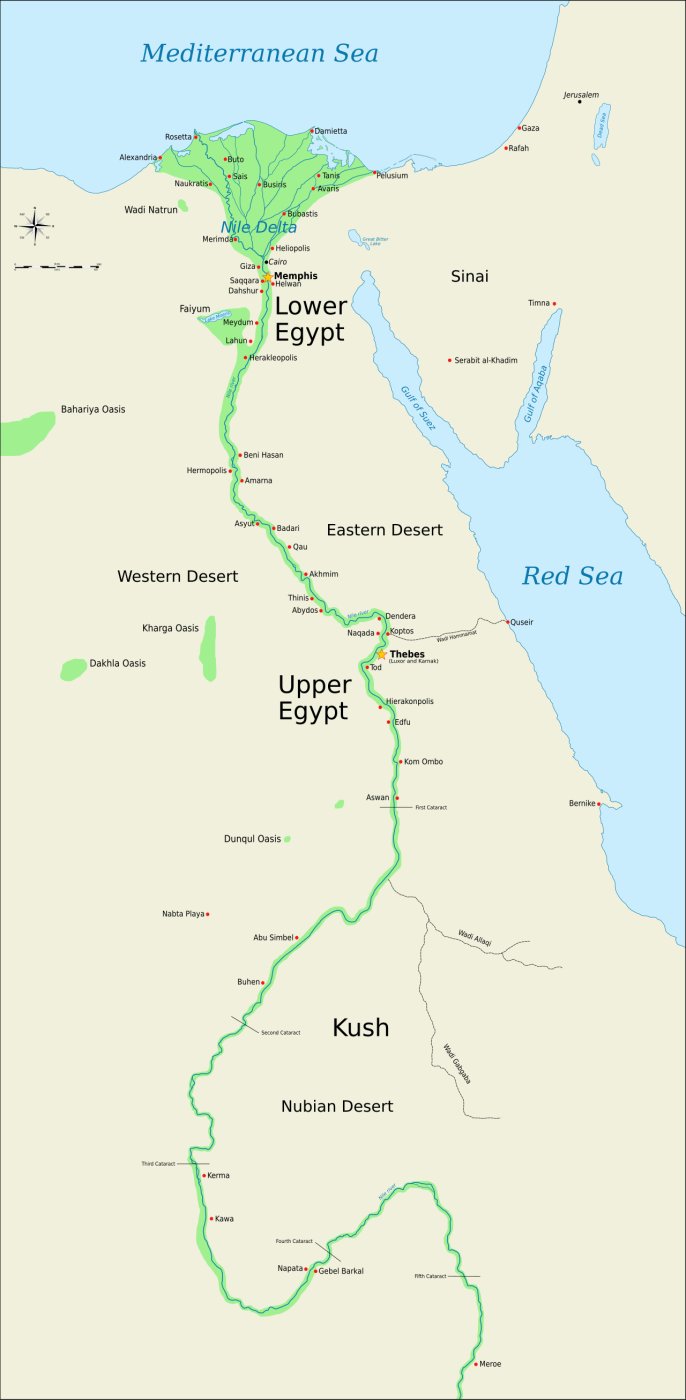
Ancient Egyptian civilization began around 3100 BCE with the unification of Upper and Lower Egypt under the first pharaoh, traditionally identified as Narmer, establishing a centralized kingdom that would endure, with periods of fragmentation, for nearly three millennia.
Writing and Learning
Egyptians developed a sophisticated writing system known as hieroglyphics, along with significant advances in mathematics, astronomy, and medicine. Their calendar system, based on the predictable annual flooding of the Nile, was remarkably accurate for its time.
Monuments to the Divine Pharaohs
Egyptian pharaohs were considered divine rulers, and much of the civilization's resources were devoted to monumental architecture built in their honor, including the pyramids of Giza and the great temple complexes of Luxor and Karnak, constructed to secure the pharaohs' passage into the afterlife.
Periods of Glory and Fragmentation
Egyptian history is traditionally divided into several major kingdoms — the Old, Middle, and New Kingdoms — interspersed with periods of political fragmentation and foreign rule, including conquest by the Hyksos, Assyrians, and Persians at various points.
The End of Independence
Ancient Egyptian independence formally ended in 30 BCE following the death of Queen cleopatra-vii" class="wiki-link" data-preview-slug="cleopatra-vii">Cleopatra VII and Egypt's conquest by Rome. Despite this, Egypt's cultural and architectural legacy remains among the most studied and celebrated of any ancient civilization.