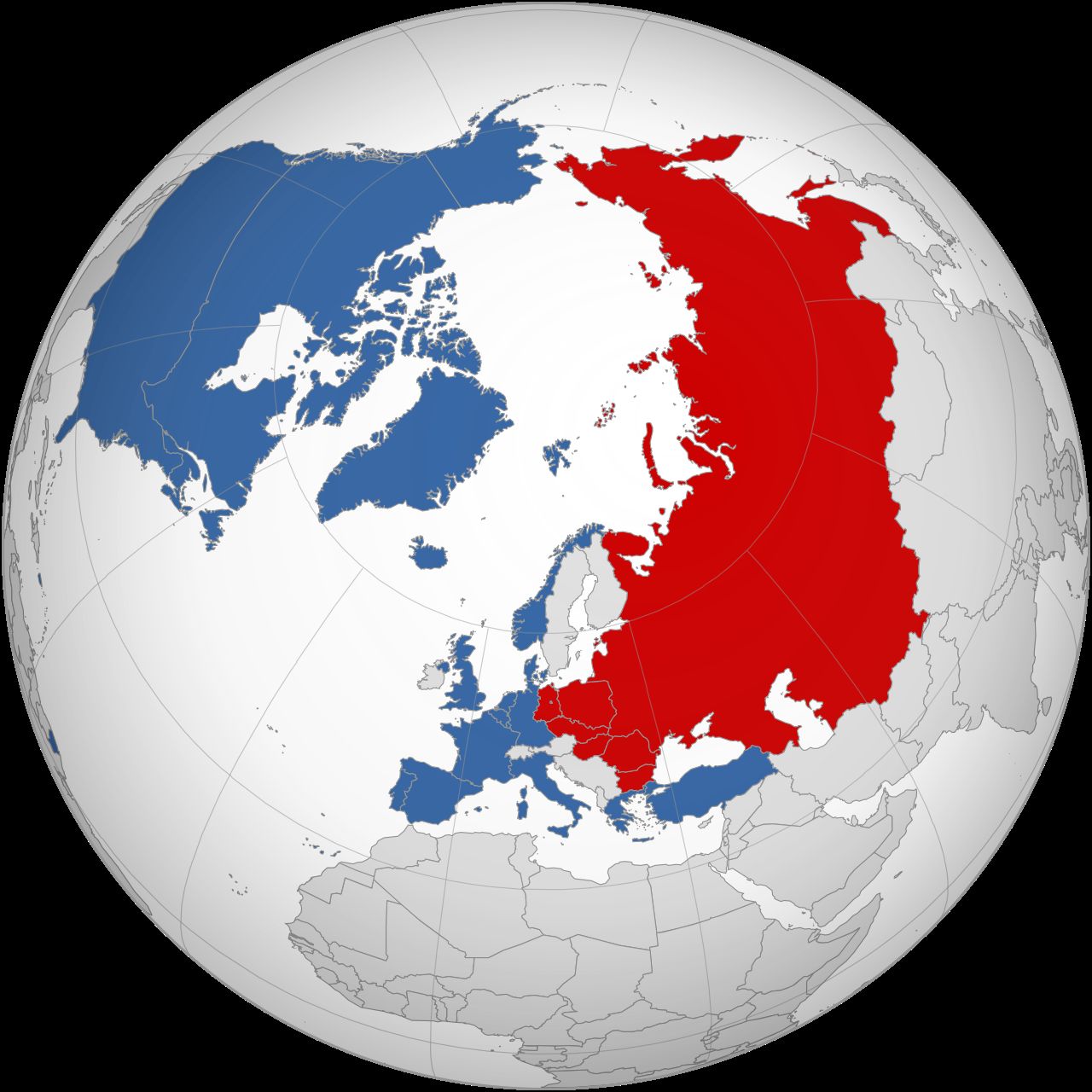
The Cold War
The Cold War was a decades-long period of geopolitical tension between the United States and the Soviet Union following World War II, characterized by proxy wars, nuclear arms buildup, and ideological rivalry rather than direct military conflict between the two superpowers.
Two allies who had just defeated a common enemy turned almost immediately into rivals, spending the next four decades competing everywhere except on an actual battlefield against each other.
Allies Turned Rivals
The Cold War emerged from the rapid breakdown of wartime cooperation between the United States and Soviet Union after 1945, as the world divided into rival capitalist and communist blocs, each seeking to expand its influence and ideology across the globe.
The Nuclear Arms Race
A defining feature of the conflict was the nuclear arms race, in which both superpowers accumulated massive stockpiles of nuclear weapons under a doctrine known as "mutually assured destruction," theoretically deterring direct war due to the catastrophic consequences either side would face.
Proxy Wars Around the World
Rather than fighting each other directly, the superpowers engaged in numerous proxy conflicts across the globe, including the Korean War and the Vietnam War, in which each side supported opposing factions in regional conflicts to advance their broader geopolitical interests.
The Cuban Missile Crisis
The closest the world came to direct nuclear conflict was the Cuban Missile Crisis of 1962, a tense 13-day standoff triggered by the discovery of Soviet nuclear missiles in Cuba, which was ultimately resolved through diplomatic negotiation.
The Wall Falls
The Cold War effectively ended with the fall of the Berlin Wall in 1989 and the formal dissolution of the Soviet Union in 1991, dramatically reshaping the global balance of power and bringing an end to nearly half a century of superpower rivalry.