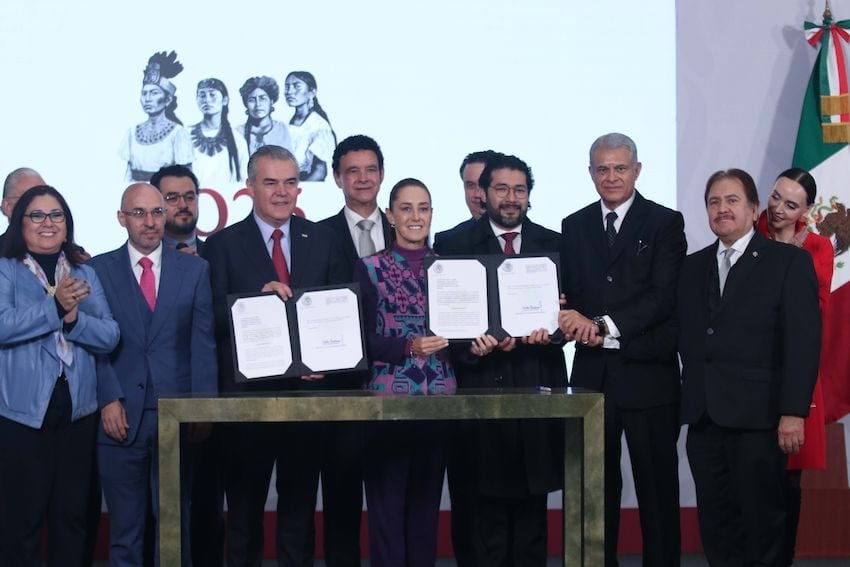
Mexico’s standard workweek will be reduced by two hours annually in the coming years to reach 40 hours in 2030, according to a proposal presented by the federal government on Wednesday.
Mexico currently has a standard 48-hour, six-day workweek. The establishment of a 40-hour workweek over five days — a demand of workers across the country — requires a reform to the Mexican Constitution.
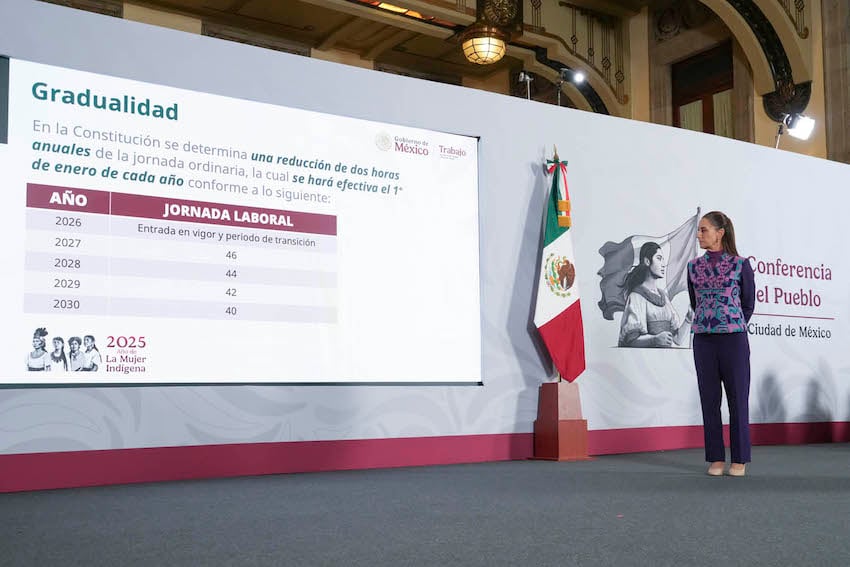
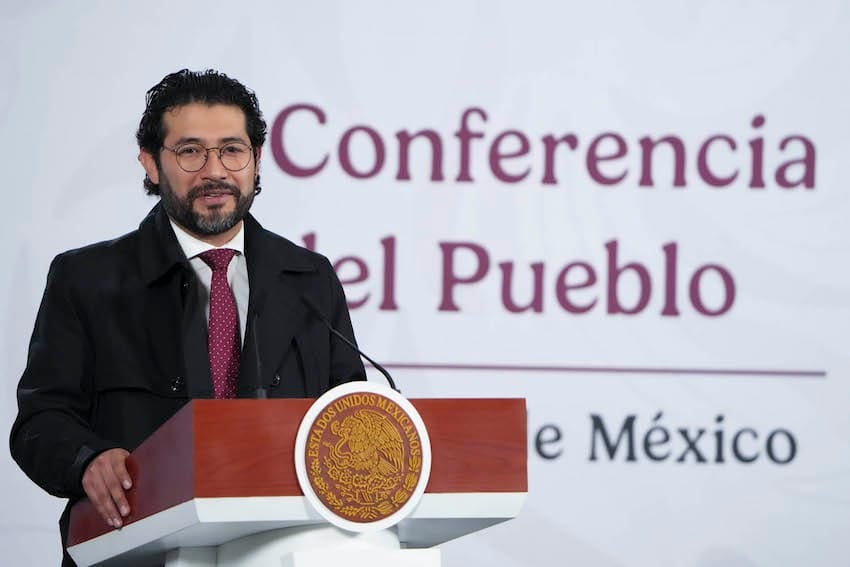
At President Claudia Sheinbaum’s Wednesday morning press conference, Labor Minister Marath Bolaños outlined the proposal to gradually reduce the workweek to 40 hours.
He said that the first two-hour reduction to the 48-hour workweek would occur in 2027, with additional reductions in the following years.



Thus, Mexico’s standard workweek is slated to be:
- 46 hours in 2027
- 44 hours in 2028
- 42 hours in 2029
- 40 hours in 2030, the final year of Sheinbaum’s six-year term.
Bolaños noted that lawmakers will need to approve changes to the constitution and the Federal Labor Law in order to establish a 40-hour workweek.
Constitutional changes require two-thirds congressional support, but achieving that threshold should not be a problem, especially considering that the ruling Morena party and its allies dominate both the Chamber of Deputies and the Senate.
The workweek legislation is expected to be approved in 2026.
Bolaños said that the proposal to reduce the workweek to 40 hours won’t allow workers’ salaries or benefits to be cut.
He said that the establishment of a 40-hour workweek will give workers more time for rest and recreational activities, and have a positive impact on their health, including by reducing fatigue levels, which in turn should reduce workplace accidents.
Citing “previous experiences in other countries” and academic research, Bolaños also said that the reduction in the length of the standard workweek will guarantee “decent working conditions” and lead to an increase in productivity.
In addition to gradually reducing the standard workweek to 40 hours, the proposal presented by the labor minister has a range of other aims. They include:
- Establishing a limit of a maximum of 12 hours work per day — a regular eight-hour shift plus a maximum of four hours of overtime.
- Establishing that overtime hours must be paid at double the agreed rate for normal hours.
- Establishing that workers can’t work overtime hours on more than four days per week.
- Prohibiting overtime hours for workers aged under 18.
Bolaños stressed that completing overtime hours is not an “obligation” for workers — i.e., they can’t legally be penalized or dismissed by their employers for refusing to work beyond their normal shift.
Workers, business leaders and union reps were consulted
Bolaños highlighted that the government sought “broad consensus” on the proposal to reduce Mexico’s standard workweek. To achieve that consensus, he noted that forums and roundtable discussions were held across the country between June and late November.
Bolaños said that more than 2,000 people participated in the dialogue, including workers, businesspeople, union representatives, academics and government officials.
He said that the planned establishment of a 40-hour workweek is “one of the policies that best condenses the spirit of Mexican Humanism,” the term former president Andrés Manuel López Obrador used to describe the political and economic philosophy of the “fourth transformation” (4T) political project he created and which is now led by Sheinbaum.
“It gives time back to workers so they can freely decide what to do with it and, in this way, have the conditions to achieve both material and spiritual well-being, because we must not forget that time is a finite and irreplaceable resource,” Bolaños said.
Sheinbaum said that in 2026 “companies will make the necessary adjustments to guarantee” that the workweek will decline by two hours per year starting in 2027 in order to reach 40 hours in 2030.
“It doesn’t imply greater costs for the business sector,” she said, adding that some industries will see productivity gains from a shorter working week.
Sheinbaum stressed that workers, the business sector and unions reached a “consensus agreement” on the 40-hour workweek proposal.
For his part, the president of the Business Coordinating Council, an umbrella organization representing 12 business groups, said that a “responsible process of tripartite dialogue” took place before the formulation of the 40-hour workweek proposal.
“For the Mexican business sector, the comprehensive development of workers and their families is a priority,” Francisco Cervantes said, adding that the reduction of the workweek “will bring benefits for companies and for society in general.”
How many Mexicans currently work more than 40 hours per week?
Bolaños presented data from the national statistics agency INEGI that showed that 13.4 million Mexicans currently work more than forty hours per week. That figure represents just over one in five workers, as Mexico’s workforce is made up of around 60 million people.
Of the 13.4 million people who work more than 40 hours per week, 8.6 million are on the job for 41-48 hours, while 2.76 million put in 49-57 hours, according to the INEGI data.
Just over 2 million workers are at work for 58 hours or more per week.
According to INEGI, the sectors with the highest numbers of workers who will benefit from the reduction of the workweek are the manufacturing, retail, hospitality, transport and wholesale commerce industries.
While it will be another 13 months before the gradual reduction of the standard workweek will commence, provided it’s approved by Congress, there have already been some positive changes for Mexican workers under the 4T governments led by López Obrador and Sheinbaum.
The minimum wage has increased, annual paid vacation days have doubled from six to 12 for formal sector workers who have completed one year of employment, and workers now have the legislated right to sit down and take a break during their shifts.
With reports from Sin Embargo and El Economista
Source: Mexico News Daily