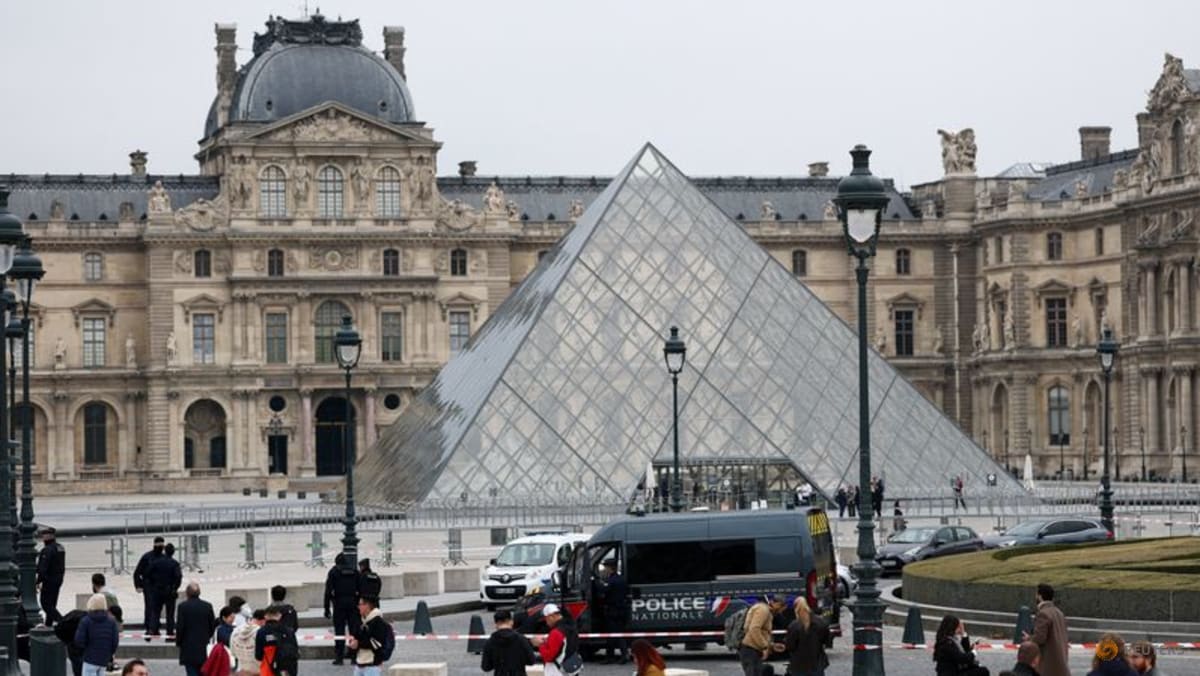
SERIES OF HEISTS
Several French museums have recently been targeted.
Last month, thieves broke into Paris’s Natural History Museum, making off with gold samples worth €600,000 (US$700,000).
They used an angle grinder and a blow torch to steal the native gold, a metal alloy containing gold and silver in their natural, unrefined form.
In November last year, four thieves stole snuffboxes and other precious artefacts from another Paris museum in broad daylight, breaking into a display case with axes and baseball bats.




They snuck into the Cognacq-Jay museum wearing gloves, hoods and helmets, striking in full view of other visitors to the museum.
The Louvre also has a long history of thefts and attempted robberies.
The most infamous was in 1911, when the Mona Lisa vanished from its frame, stolen by Vincenzo Peruggia, a former worker who hid inside the museum and walked out with the painting under his coat. It was recovered two years later in Florence – an episode that helped make Leonardo da Vinci’s portrait the world’s best-known artwork.
In 1983, two Renaissance-era pieces of armour were stolen and only recovered nearly four decades later. The museum’s collection also bears the legacy of Napoleonic-era looting that continues to spark restitution debates today.
Home to more than 33,000 works spanning antiquities, sculpture and painting – from Mesopotamia, Egypt and the classical world to European masters – the Louvre’s star attractions include the Mona Lisa, the Venus de Milo and the Winged Victory of Samothrace.
The museum can draw up to 30,000 visitors a day and last year it welcomed 8.7 million visitors.
French President Emmanuel Macron in January pledged the Louvre would be “redesigned, restored and enlarged” after its director voiced alarm about dire conditions inside.
He said he hoped that the works could help increase the annual number of visitors to 12 million.
Source: CNA