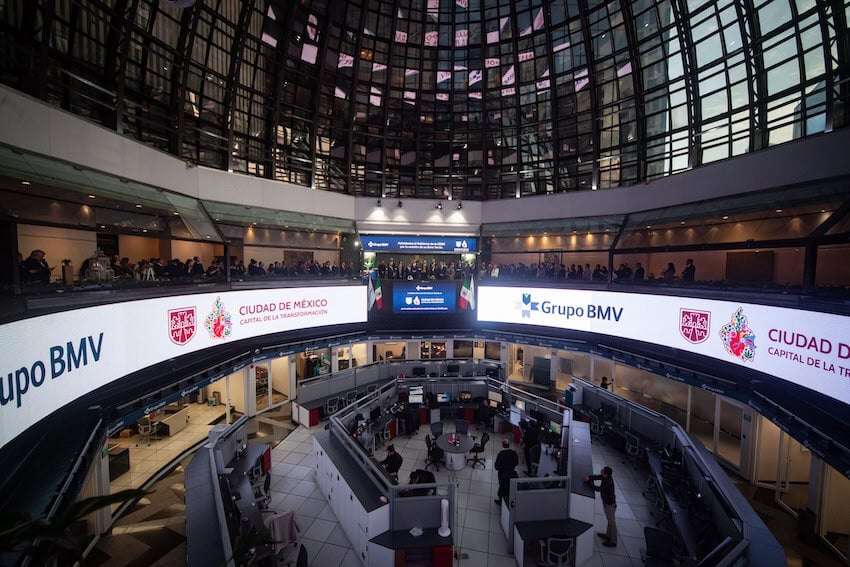
Despite ongoing struggles in the Mexican economy, Mexico’s stocks are outperforming Wall Street, as the country’s financial assets complete one of the strongest years in decades, including the peso’s best showing in 32 years.
The iShares Mexico ETF — an exchange-traded fund used to track the performance of investments in a range of Mexican equities — has risen by over 50% this year, marking the fund’s highest rise since 1999. The stock significantly outpaced several major U.S. benchmarks, such as the Vanguard S&P 500 ETF, which gained around 17%, and Invesco QQQ Trust, which rose by roughly 21% over the same period.
Global investors have been stunned by the outstanding performance of several Mexican stocks in 2025, particularly after the negative predictions that followed the introduction of U.S. tariffs on a wide array of Mexican products earlier in the year.
In the face of those tariffs, the Mexican peso has surprisingly appreciated by over 14% against the U.S. dollar, which has put it on track to achieve its best annual performance since 1993, when the modern peso was first introduced as the “new peso.”



The Bank of Mexico (Banxico) has significantly reduced interest rates since the beginning of the year, by 300 basis points, as the policy rate fell to 7%.
The cuts have helped boost investor confidence in Mexican assets by reducing trade-related uncertainty, while much-needed cash has been injected into the economy.
Several individual stocks have seen strong returns in 2025. For example, mining and materials companies have benefited from higher commodity prices.
Industrias Peñoles increased by over 260%, and Gentera rose by more than 100%.
Meanwhile, Cemex and Grupo México each experienced an increase of over 80%.
Mexican stocks’ strong showing carried a reminder of the gap that often exists between the markets and the on-the-ground economy. Mexico’s GDP contracted by 0.2% in the third quarter of this year after experiencing flat growth in the second quarter.
The contraction led Banxico to reduce its growth outlook to 0.3%. Meanwhile, the central bank expects Mexico’s economy to rebound gradually to 1.1% in 2026 and 2% in 2027.
Declining remittances, limited formal job creation, slowing credit growth and weak consumer confidence continue to hamper the country’s economic growth, despite support from government transfers and lower interest rates.
The hosting of the FIFA World Cup and the anticipated review and finalization of the USMCA North American free trade agreement could help reduce trade uncertainty in 2026, Bank of America economist Carlos Capistran was reported as saying by the Benzinga news site.
However, “If weakness persists, the central bank may continue cutting rates to stimulate demand,” Capistran said.
With reports from Yahoo Finance and Eje Central
Source: Mexico News Daily