Chinese Minister of Foreign Affairs Wang Yi said Wednesday that China is open to accepting more imports from Mexico, which currently has a large trade deficit with the East Asian economic powerhouse.
He made the comment during a bilateral meeting with Mexican Foreign Affairs Minister Juan Ramón de la Fuente in Beijing.
Citing a statement issued by the Chinese Ministry of Foreign Affairs, Reuters reported that “Wang said that China welcomes more Mexican products in its market and will encourage Chinese companies to invest in Mexico.”
CGTN, a Chinese state-owned English-language news outlet, reported that Wang told de la Fuente that “China is willing to deepen strategic mutual trust” with Mexico, “share its experience in Chinese modernization and offer the vast opportunities of its supersized market.”




The Chinese foreign minister “welcomed more high-quality Mexican products into the Chinese market and encouraged Chinese enterprises to invest in Mexico, expressing confidence in Mexico’s stable and friendly business environment,” CGTN reported.
According to CGTN, Wang also emphasized to de la Fuente that “China places its relationship with Mexico as a priority in its Latin American diplomacy.”
🇲🇽🇨🇳 Juan Ramón de la Fuente se reúne con su homólogo de China
El canciller Juan Ramón de la Fuente sostuvo un encuentro con Wang Yi, ministro de Asuntos Exteriores de China, en donde se presume, dialogaron sobre los esfuerzos para profundizar la cooperación entre las dos… pic.twitter.com/3FqCvs7Cii
— Político MX (@politicomx) May 14, 2025
The expression of China’s willingness to import more goods from Mexico comes at a time when the Mexican government is attempting to reduce Mexico’s reliance on Chinese products as part of its Plan México economic initiative.
Last July, then finance minister Rogelio Ramírez de la O said that Mexico needed to review its trade relationship with China because it isn’t “reciprocal,” given that Mexico’s imports from China far exceed its exports to the East Asian nation.
Mexico’s imports from China have increased significantly in recent years, posing a threat to Mexican industry, according to the federal government. The government has imposed new tariffs on some Chinese goods, such as textiles and clothing, as it seeks to protect domestic industry. It has also carried out raids on stores selling pirated Chinese goods.
The value of Mexico’s imports from China was just under US $130 billion last year, according to the United Nations COMTRADE database. That figure dwarves the value of China’s imports from Mexico, which were worth less than $20 billion in 2023.
“China sells to us but doesn’t buy from us and that’s not reciprocal trade,” Ramírez de la O said last July.
Finance minister: Mexico ‘must produce more’ amid growing trade deficit with China
Among Mexico’s top exports to China are copper ore and concentrates and auto parts.
It remains to be seen whether the current trade imbalance will change significantly as a result of Mexico shipping more goods to China and receiving fewer Chinese products.
Wang proposes China and Mexico work together to resist ‘unilateral acts’
Reuters also reported on Wednesday that Wang told de la Fuente that “China is willing to work with Mexico to resist and oppose ‘unilateral acts’ and defend the rules of free trade.”
The use of the term “unilateral acts” was a clear reference to Trump’s decision to impose tariffs on imports from around the world, including punishing duties on Chinese goods, and duties on some Mexican products.
Trump initiated a trade war with China during his first term as president and escalated it during his current term before the U.S. and China reached an agreement on Monday to significantly cut tariffs on each other’s goods for an initial period of 90 days.
While Wang proposed greater collaboration between China and Mexico on trade issues, Mexico’s trade relationship with China could in fact be a sticking point in the review of the USMCA free trade pact as United States President Donald Trump has accused Mexico of being a transshipment hub for Chinese goods whose final intended destination is the U.S.
President Claudia Sheinbaum has rejected that claim. The USMCA review is scheduled for 2026, but Mexico hopes to commence talks in the second half of this year in order to provide clarity to consumers and investors, Economy Minister Marcelo Ebrard said Tuesday.
With the review looming, Mexico is likely to be very cautious in its approach to its relationship with China in order to avoid any perception that it is cozying up to the Chinese government.
Ebrard said late last year that Mexico would “mobilize all legitimate interests in favor of North America” amid the trade war between the United States and China.
De la Fuente: ‘China and Mexico have a comprehensive strategic association’
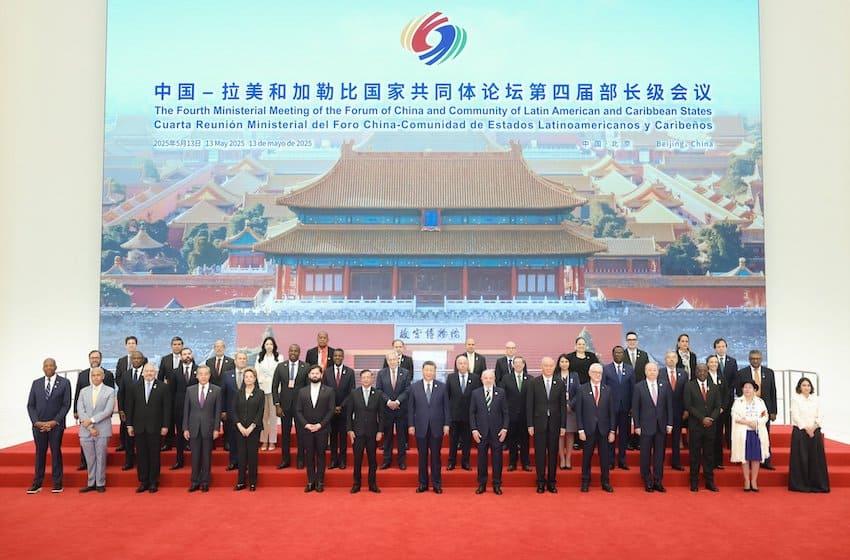
De la Fuente traveled to China this week to attend the fourth China-CELAC Forum ministerial meeting, at which Chinese officials gathered with representatives of Latin American and Caribbean governments.
At the plenary session of the meeting on Tuesday, the Mexican foreign minister “welcomed initiatives aimed at openness and building bridges between countries, along with projects that complement national, regional, and multilateral cooperation and development efforts,” according to a statement issued by Mexico’s Foreign Ministry.
At his bilateral meeting with Wang on Wednesday, de la Fuente said that “China and Mexico have a comprehensive strategic association that has given us good results.”
He highlighted the two countries’ “long history of trade relations” and reaffirmed Mexico’s commitment to recognizing “just one China.”
After the meeting between the Mexican and Chinese foreign ministers, a headline in the newspaper El Financiero screamed: “Mexico winks at China: highlights its trade relationship with Beijing despite tension with Trump.”
Sheinbaum met with Chinese President Xi Jinping at the G20 Summit in Rio de Janeiro, Brazil, last November. At the meeting, Xi said that China and Mexico should “make good use of the highly complementary nature of the two economies.”
At the China-CELAC meeting in Beijing, the Chinese president vowed “to boost China’s footprint in Latin America and the Caribbean with a new $9 billion credit line and fresh infrastructure investment,” Reuters reported.
Will more Chinese investment come to Mexico?
Wang’s remark that China will encourage Chinese companies to invest in Mexico has the potential to set off alarm bells in Washington, as President Trump has expressed concerns about such investment on numerous occasions.
Mexico has also faced criticism from some Canadian politicians for allowing what they see as unfettered Chinese investment in Mexico and for allegedly being a low-tariff “backdoor” into North America for Chinese goods.
Trump is particularly concerned about Chinese automakers’ plans to open plants in Mexico, although Sheinbaum has declared that “there is not yet any firm investment project from any Chinese automotive company.”
The Mexican government says it is open to Chinese investment in Mexico, but pressure from the United States reportedly led it to refuse to offer incentives to Chinese electric vehicle manufacturers planning to invest in Mexico, such as BYD.
As Mexico News Daily reported last July, Chinese investment in Mexico has increased significantly in recent years, but the East Asian nation is still a long way off matching the outlays of countries such as the United States and Spain.
Some major Chinese companies, such as BYD, have announced projects in Mexico, but have not yet acted on their announcements. There is no guarantee that BYD’s proposed plant, and other projects announced by Chinese companies, will go ahead.
China, and Chinese companies, have “a long history of making investment announcements they don’t follow up on,” Jorge Guajardo, a former Mexican ambassador to China, told Mexico News Daily last year.
Even if the Chinese government “encourages” Chinese companies to invest in Mexico, as Foreign Minister Wang says it will do, the fact remains that they will only do so if it makes economic sense.
The policies of the Trump administration, along with those of the Mexican government —including its willingness or reluctance to welcome Chinese companies — will be decisive in determining whether promised and potential Chinese investment in Mexico ultimately materializes.
With reports from CGTN, Reuters, Reforma, El Economista and EFE
Source: Mexico News Daily