Many different cultures around the world have seen the winter solstice as a spiritual death and rebirth of the sun. This idea seems appropriate as the date marks the shortest day and the longest night of the year. During the solstice, then, the sun and the forces of light are defeated by darkness. It is, however, from this moment on that the days grow longer and cosmic balance is restored with the triumph of the warrior sun.
For the Mexica or Aztecs — who ruled over much of modern-day Mexico between the 14th and 16th centuries — the winter solstice was a celebration of Huitzilopochtli, their patron deity, the “Sun Lord” who presided over government, war and commerce.
Huitzilopochtli, the warrior hummingbird
In Nahuatl (the language of the Mexica, which is still spoken by millions of people today), Huitzilopochtli means “Hummingbird on the Left” or “Left-Handed Hummingbird”. This mystical name refers to the fierce nature of hummingbirds, who, despite their pretty looks, are willing to protect their nests with unexpected violence. The Nahuatl word huitzillin, meaning hummingbird, comes from huitztli, or thorn, a stinging metaphor for both beauty and pain. In Mexica poetry, these birds are commonly associated with arrows that fly swiftly towards their enemy.
Huitzilopochtli is the ruler of the south, a region of combat and sacrifice; of the wars and rituals that nurture the sun with blood. Symbolically, the solar south is also midday, and the north, the land of the dead, is the lunar midnight.

The birth of the sun
Several Mexica testimonies, recorded during the early decades of the colonial period, tell the tale of Huitzilopochtli’s birth, a mythical story that explains the origin of day and night. It starts when Coatlicue, the Mother Earth, finds a precious feather one day while she is sweeping her temple. She keeps the feather under her skirt, and a few moments later, she realizes it is gone —and she is pregnant.
Coatlicue shares the news with her four hundred sons and her only daughter, but they are not happy. For them, Coatlicue’s unexpected pregnancy is a dishonor, especially since they do not know who the father is. Her daughter, Coyolxauhqui, commands her brothers to kill their mother before her child is born. Coatlicue seeks refuge in a sacred mountain, where she gives birth to a son, Huitzilopochtli, fully armed and ready for war.
Huitzilopochtli protects his mother, the Earth, by facing his brothers, whom he defeats single-handedly (he is, after all, a hard-to-defeat, left-handed warrior), and his xiuhcoatl, the serpent-shaped solar rays. He cuts off Coyolxauqhui’s head. His sister is then turned into the moon, who is defeated once every month, when her power becomes too strong, and his now enslaved brothers become the stars. This is how the sun constantly saves the Earth from the forces of night.
Solstice rituals in Tenochtitlán
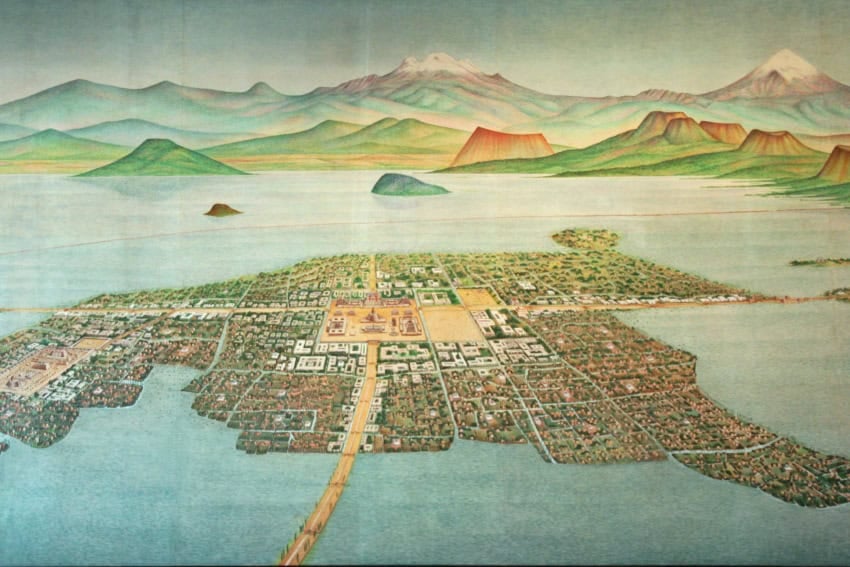
The myth of Huitzilopochtli’s birth is represented in the most important temple of the Mexica, the Huey Teocalli or Templo Mayor of their capital, Tenochtitlán, located in the heart of Mexico City. Upon its top would be an image of Huitzilopochtli, the sun. At its bottom, a disk-shaped stone represented his sister, Coyolxauhqui, the moon. During special festivities, war captives were sacrificed on the Huey Teocalli; their bodies would roll down the temple’s staircase, imitating the sacrifice of the warrior lady.
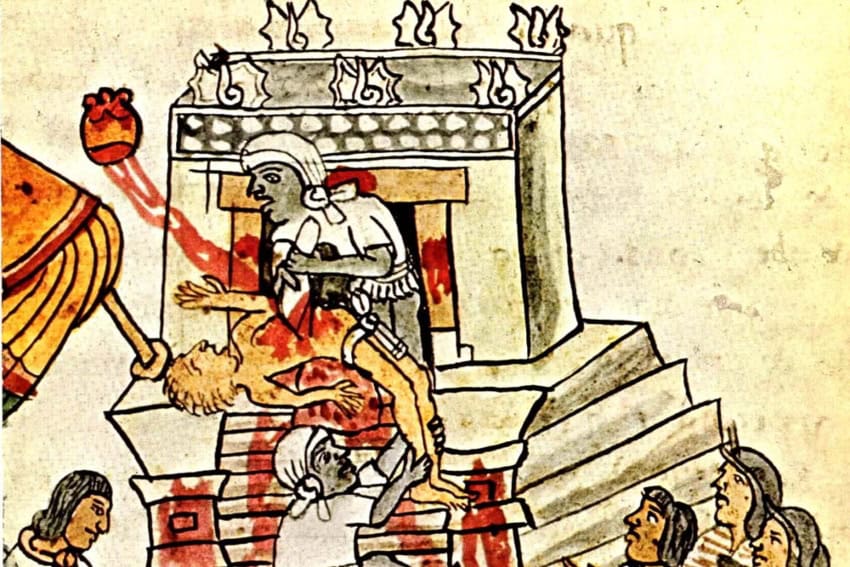
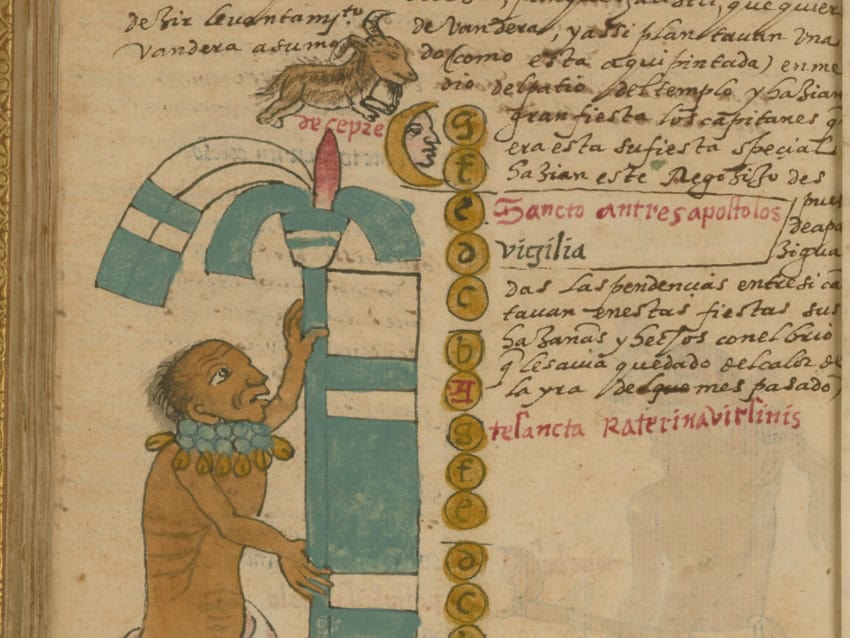
This place would have been the setting for the rituals dedicated to Huitzilopochtli. Written sources speak of a feast called Panquetzaliztli or “Raising of Flags,” which was celebrated around the winter solstice, the moment when the newborn sun defeats the moon. Panquetzaliztli is one of the 20 18-day-long months of the Mexica calendar, which dictated religious life in their city and most likely throughout their domain. To the subjects of the Mexica, Huitzilopochtli was the deity of foreign power and domination, the invincible lord of the enemies.
Justice is sometimes ironic. The top of the Huey Teocalli is long lost, and the image of Huitzilopochtli was most likely one of the first destroyed during the conquest. Coyolxauhqui’s carved disk was preserved and casually stumbled upon in 1978. Hers was the first discovery at the now thoroughly excavated archaeological site.
Panquetzaliztli ceremonies
In his 1580 treaty “Historia de las Indias de Nueva España e Islas de Tierra Firme” (“History of the Indies of New Spain”), Dominican friar Diego Durán recalls one of the ceremonies carried out during Panquetzaliztli in honor of Huitzilopochtli: “There was a feast dedicated to this said great idol, and it was that (they) sculpted him in dough, in a size that a man could carry him in arms and run so swiftly that the others could chase but never catch them.”
According to Durán, this race was called ipaina Huitzilopochtli or Huitzilopochtli’s rush. The fastest man in Tenochtitlan would carry the image of the deity and run “down the street of Tacuba … arrive at Tacubaya, and from Tacubaya he would go to Coyuacan and from Coyuacan to Huitzilopochco, and from there he would return to Mexico.” The circuit encompassed much of today’s Mexico City center-southern part, which would have been adorned with flower arches and paper flags to welcome the triumphant Sun Lord. Other people would follow them along the route. If any of them matched the runner, the author emphasises this would have been a very scarce occasion — they would attain a special blessing from Huitzilopochtli.
The sacrifices
Along with Durán’s book, one of the most precious sources for understanding Mexica ritual life is the “Historia General de las Cosas de la Nueva España” (“General History of the Things of New Spain”), compiled by the Franciscan Bernardino de Sahagún between 1540 and 1585. According to Sahagún, during the first days of Panquetzaliztli, women and men alike would sing and dance to hymns. The whole Mexica society would have been preparing for the most sacred moment of Huitzilopochtli’s feast, when the Lord of War demanded sacrifices of foreign captives during Panquetzalilztli.
Lydia Leija is a linguist, journalist, and visual storyteller. She has directed three feature films, and her audiovisual work has been featured in national and international media. She’s been part of National Geographic, Muy Interesante, and Cosmopolitan.
Source: Mexico News Daily