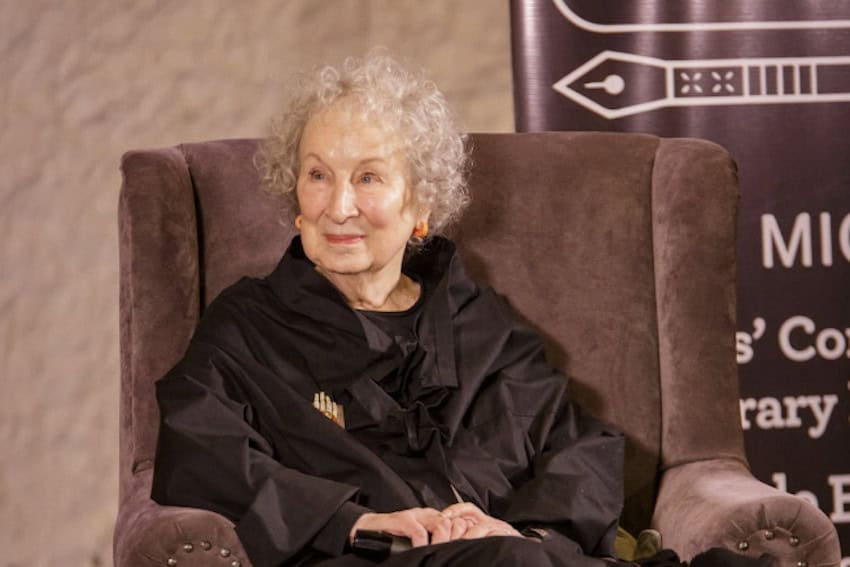
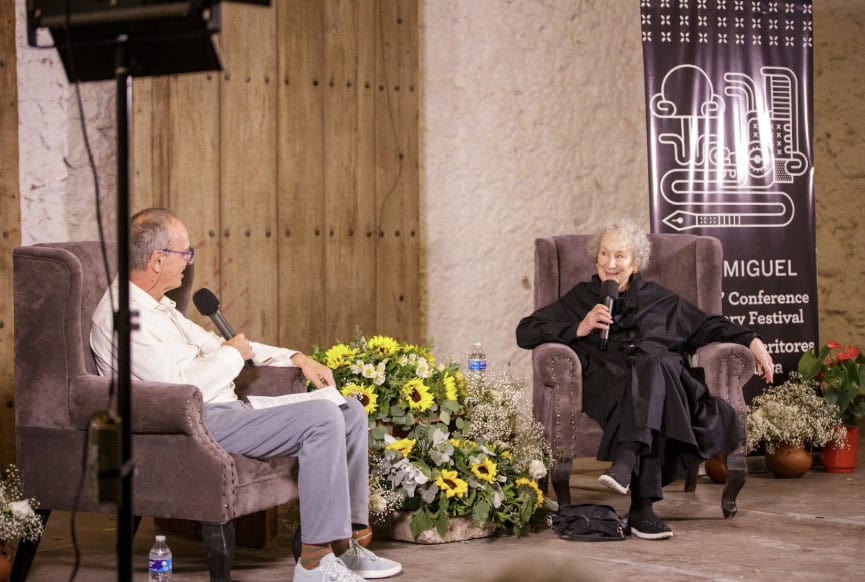
On January 12, five-time Emmy Award-winning journalist Martin Fletcher conducted a fascinating interview with literary icon Margaret Atwood in San Miguel de Allende. Entitled “From Fiction to Reality — Has Our Dystopian Future Arrived?”, the live event was a scholarship fundraiser for the upcoming 20th annual San Miguel Writers Conference.
Mexico News Daily reporter Ann Marie Jackson had the pleasure of continuing the conversation with both Fletcher — who is also a Mexico News Daily trustee — and Atwood, probing deeper into issues of importance to Mexico.
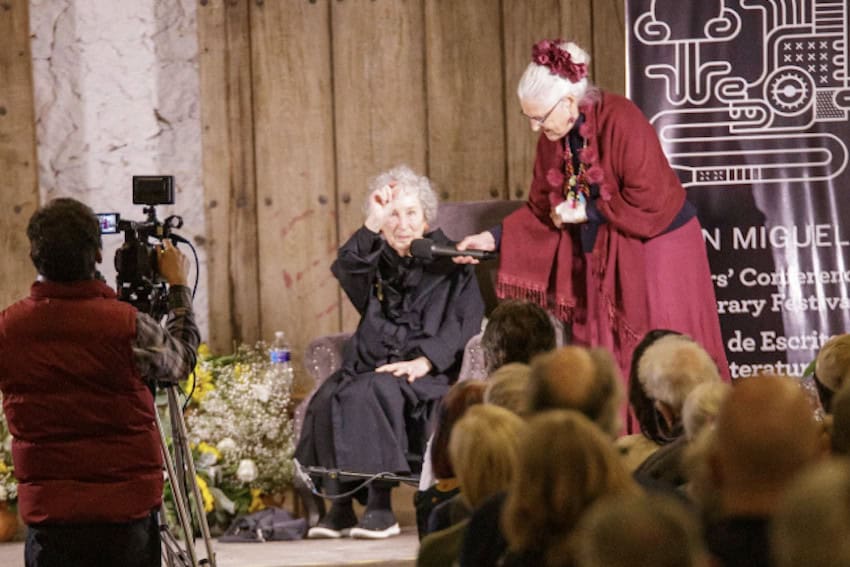
Atwood receives the San Miguel Writers’ Conference Award for Literary Excellence
Susan Page, Founder and President of the San Miguel Writers’ Conference & Literary Festival, and Executive Director Jodi Pincus launched the evening by presenting Ms. Atwood with the conference’s first annual Award for Literary Excellence.
“It is not an exaggeration to say that Margaret Atwood is a pioneer of the written word,” noted Page. “Her work transcends genres… and explores virtually every facet of the human experience. In addition to her extraordinary literary output, Margaret Atwood… uses her platform to speak out against injustice. She challenges us to think, to question norms, and I believe she is a model for a future in which literature serves as a guiding light in troubled times… We are grateful for her stories, courage, and relentless pursuit of truth.”


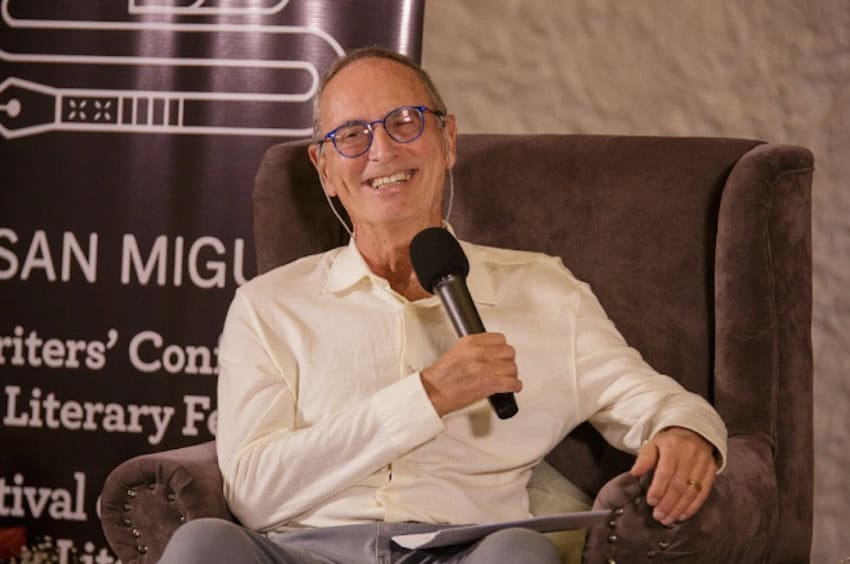
Martin Fletcher shares his ‘Margaret Atwood moment’
Martin Fletcher, former NBC Middle East correspondent and Tel Aviv Bureau Chief, current commentator for MSNBC and PBS NewsHour, and author of eight books, resides in San Miguel. Early in the conversation, Fletcher shared his own “Margaret Atwood moment,” which happened in Afghanistan.
After the first Taliban government fell in 2001, he went there to do a story on a women’s art class. “After living for years under extreme restrictions, these women were finally able to leave their houses unchaperoned by a male relative,” he explained. “And it was amazing. Their paintings were quite good, but what struck me was that half of them essentially showed the same image: dark edges all around and a little strip of the world showing in the middle — which was all they had been able to see through the eye slit in their burkas.”
“That sent a shiver down my spine. I thought wow, this is Margaret Atwood’s world in real life.”
Dystopian fiction from a female perspective
“Is it true,” Fletcher asked Atwood, “that you wrote The Handmaid’s Tale from a woman’s point of view because 1984 by George Orwell and most other works of dystopian fiction were written from a male viewpoint?”
“Nearly all,” Atwood responded. “There were some female-written utopian works early on, but not dystopian ones. Utopias were popular through the 19th century into the early 20th, but then there was a turning point… After World War Two, it was just not possible to write utopias for a while.” Ray Bradbury and others wrote powerful dystopian works in that era.
“I started thinking about writing The Handmaid’s Tale after the election of Ronald Reagan in 1980. He immediately began dismantling the progress made by 1970s second-wave feminism as well as the social contract of the New Deal. A friend of mine who escaped from Poland as a child, both from the Nazis and the Communists, could see a dystopia coming. She recognized one when she saw it. And she said to me, are you aware that the extreme, so-called ‘religious right’ is now refashioning itself as a political power, and one of the things they are saying is that women should be back in the home?”
“Whenever anyone says ‘women should,’ I always think about how they could implement it. Well, thanks to second-wave feminism, many women had jobs outside the home. They were earning money; they had credit cards; they had some freedom. How could those in power stop that, I wondered — and the answer I found was by obliterating the jobs and thereby cutting off the money.”
To write The Handmaid’s Tale, Atwood also knew she needed to fill in a gap in her knowledge of American history by studying Puritanism in the New England colonies. “So I studied that quite thoroughly, and I’m here to tell you that America did not begin as a democracy. Sorry, but it didn’t. It began as a theocracy — and if you have something like that in your background, it’s quite likely to recur.” Fletcher concurred that the current Christian nationalist movement in the United States is frighteningly influential.
American dystopia: false nostalgia and the belief in a golden past
“There’s a recurring tendency in human history,” noted Atwood, “to believe in a Golden Age and that there’s some way of returning to it. That goes all the way back to the Greeks, and it’s the same with Make America Great Again. Okay, which period of time are you thinking about? The 1950s? We actually don’t know when the supposed brightness was; it’s false nostalgia, a recurring human thing, and it’s very attractive.”
“The inauguration has not even taken place yet. Give it three months, and we’ll know what movie we’re in — is it Game of Thrones? Macbeth with Mrs. Vance playing Lady Macbeth? Or Julius Caesar? Will Mr. Trump have an unfortunate fall down a flight of stairs? All of these are intensely possible.”
“We’re watching a pitched battle for power amongst the billionaire courtiers, too, with Elon Musk, Peter Thiel and others who hate each other. I think we’re in the Machiavellian Renaissance,” said Atwood. Fletcher agreed, noting that the present political situation in the United States appears to be uniquely difficult in part because of the historic rise in the influence of unelected billionaires.
He also shared his concern with Jackson that Mexican immigrants in the U.S. will be targeted during the early months of Trump’s second term. Many of the new president’s campaign promises to the MAGA base will be impossible to fulfill, but sweeping up some undocumented immigrants is both possible and politically appealing.
When asked by Jackson about Mexico and America’s joint dystopian reality around illicit drug use and cartel violence, Atwood responded, “It’s a vicious spiral. The real solution I suppose is to remove the appetite for drugs, but you can’t do that without making life more attractive for those who consume them. America right now is a deeply unhappy nation — and the more drugs, the more unhappy.”
Prophet or not: Atwood on activism
Fletcher noted that as the writer of the incredibly prescient Handmaid’s Tale, Atwood, an astute student of the past, is now treated by many people as something of an oracle or prophet. Her deadpan response to his question of just how much could actually come true? “Well, I don’t think we’ll get the outfits.”
Fletcher and Atwood then more seriously discussed the responsibilities of writers as activists. Atwood volunteers with a group called the Theater of War that puts on Greek tragedies for targeted groups of people, such as veterans suffering from PTSD. She plays Tiresias, a know-it-all prophet who is always right. “I love playing that role, but it’s not who I am in real life. I am not a prophet. I cannot predict the future. If I could, I would have every horse race thoroughly covered.”
Atwood insisted that she is not a “real,” full-time activist, but acknowledged the importance of using her platform to speak out against injustice. “Real activists tend to have jobs, while I’m a self-employed writer who can’t be fired. Also, I’m so old; I’m not worried about my future. People can’t get at me the way they could if I had a job and were younger. So when I frequently get called to speak about these things, there’s no reason I can’t.”
Atwood also shared with Jackson her respect for Mexican activists and journalists covering narcos, impunity, and government corruption. “They’re amazingly brave people,” she said.
However, when asked about calling others to activism, Atwood responded, “I can’t tell other people how they should be called upon to behave. Their circumstances are different; they could be a lot more vulnerable. They could be supporting a family or they may be part of a community that’s quite censorious and punitive. There are all kinds of reasons why people can’t answer their inner conscience publicly. So it’s not up to me to tell people what to do. People will tell themselves what they can afford to do and should be doing.”
Attend the 20th annual San Miguel Writers’ Conference, February 12-16
This fascinating event raised funds for the San Miguel Writers’ Conference student scholarship program. For more information and to purchase tickets to the 20th annual San Miguel Writers’ Conference on February 12-16, visit https://sanmiguelwritersconference.org.
Based in San Miguel de Allende, Ann Marie Jackson is a writer and NGO leader who previously worked for the U.S. Department of State. Her award-winning novel “The Broken Hummingbird,” which is set in San Miguel de Allende, came out in October 2023. Ann Marie can be reached through her website, annmariejacksonauthor.com.
Source: Mexico News Daily