The week of Dec. 1-5 marked several milestones for Claudia Sheinbaum’s presidency, from announcing significant labor reforms to making her first visit to Washington as Mexico’s president. Meanwhile, contentious water legislation sparked nationwide protests, and the government moved to replace its attorney general, closing a controversial chapter in Mexican law enforcement.
As the ruling Morena party celebrated the seventh anniversary of the “fourth transformation” political project on Dec. 1, former President Andrés Manuel López Obrador broke his months-long public silence to promote his new book and offer support for his successor, declaring he would only return to activism in three cases: if democracy, Sheinbaum’s presidency or Mexico’s sovereignty came under threat.
Didn’t have time to read this week’s top stories? Here’s what you missed.
Sheinbaum’s historic Washington visit: World Cup draw and first Trump meeting
President Sheinbaum made history with her first U.S. visit as Mexico’s president on Friday, traveling to Washington, D.C., for the 2026 FIFA World Cup draw.

The event marked the first time the leaders of all three co-host nations met in person, with Sheinbaum joining U.S. President Donald Trump and Canadian Prime Minister Mark Carney on stage at the Kennedy Center.
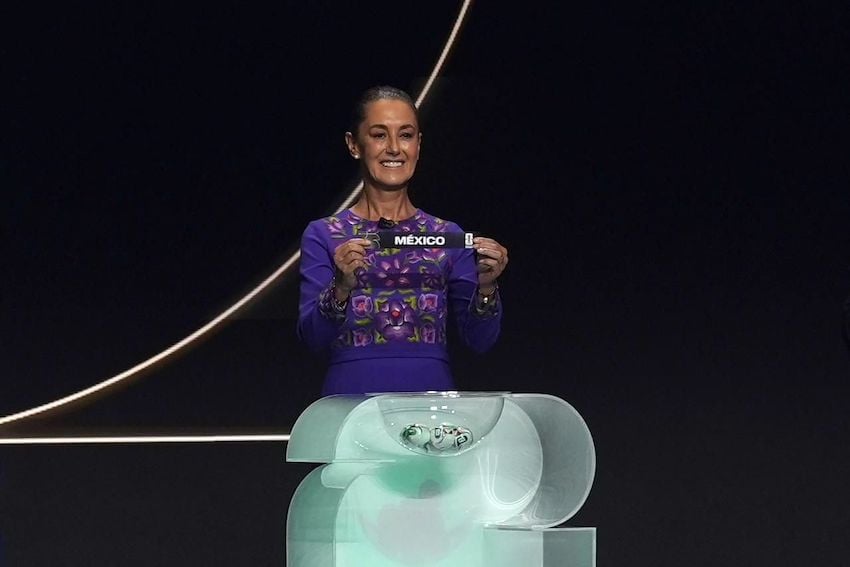
During the ceremony, FIFA president Gianni Infantino summoned the three leaders to participate as draw assistants. Sheinbaum drew Group A for Mexico, setting up a tournament-opening match against South Africa at Mexico City’s Estadio Azteca on June 11, 2026. Mexico will also face South Korea and a European playoff winner in group play.
The Mexican president took the opportunity to highlight her country’s unique distinction, noting that “Mexico is an exceptional country, beautiful and magical” and emphasizing that Mexicans have enjoyed playing ball games for centuries, referencing the ancient Mesoamerican ritual sport.
In a surprising moment captured by TV Azteca, Trump praised Sheinbaum when asked about the ceremony, saying, “Your president is here and she’s doing a very good job. She’s a good woman, doing very excellent work.” The brief interaction marked the first in-person meeting between the two leaders, who had previously only spoken by phone about tariffs and the binational issue of fentanyl trafficking.
Following the draw, the three North American leaders held a private mini-summit where trade was expected to dominate discussions. The USMCA free trade agreement enters its mandatory review period in 2026, and Trump had recently mused about letting the agreement expire.
Water law sparks new blockades
On Wednesday, the Chamber of Deputies approved legislation to establish tighter controls on water use, with 328 deputies voting in favor and 131 opposed.
The new General Water Law seeks to transform water from a tradable commodity into a recognized human right, with the federal government as the sole authority to issue concessions. The legislation also aims to combat water theft, prevent hoarding and create a national water reserve.
However, farmers mobilized across the country to oppose the measure, blocking highways in states including Zacatecas, Guanajuato, and Chihuahua, and stopping traffic at international bridges between Ciudad Juárez and El Paso.
Critics argue that the law threatens agricultural production by potentially reducing farmers’ access to water and creating uncertainty about whether concessions can be inherited. Elena Burns, a former Conagua official-turned-water-activist, warned that the law could result in farmers losing concessions if water goes unused for two years, effectively transferring agricultural water to government reserves.
The government made several modifications to address farmers’ concerns before the Chamber of Deputies approved the bill on Thursday. The Senate then fast-tracked the legislation, weathering criticism from opposition parties before voting 85-36 to approve the new water law Thursday night, sending it to President Sheinbaum for signing.
Following the Senate vote, protest leaders agreed to temporarily suspend their blockades after meeting with Conagua representatives early Friday, though they expressed reservations about the final version.
Interior Minister Rosa Icela Rodríguez warned that discontent with the legislation could lead to future demonstrations, while some farmer groups, including the National Front for the Rescue of the Mexican Countryside, threatened to return “with greater strength and better organization” if implementation proves problematic.
Ernestina Godoy becomes attorney general
In a swift transition following Alejandro Gertz Manero’s surprise resignation, the Senate confirmed Ernestina Godoy as Mexico’s new attorney general on Wednesday, with 97 senators voting in favor, 19 opposed, and 11 casting invalid votes.
Godoy, a longtime ally of President Sheinbaum who served as Mexico City attorney general during Sheinbaum’s mayorship and more recently as the president’s legal advisor, becomes only the second woman to hold the position. In her confirmation hearing, she pledged an Attorney General’s Office with “open doors” that would avoid fabricating culprits or engaging in political persecution, while vowing “there will be no impunity.”
The 71-year-old attorney general emphasized coordination with federal and state authorities, security forces, and human rights organizations, though she stressed the FGR’s autonomy would remain intact. “Justice is not negotiated,” Godoy declared, adding that rebuilding public confidence requires transparency, accountability, evidence-based decisions, and respect for human rights.
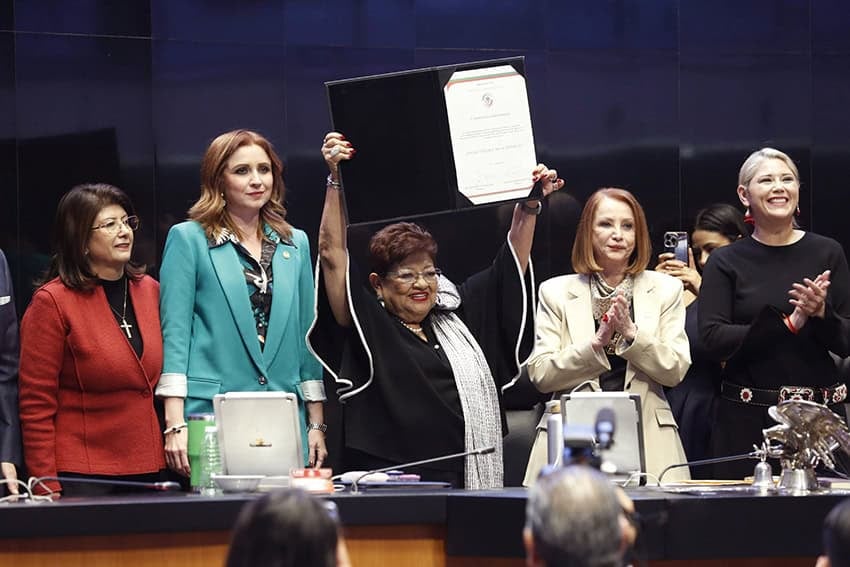
Opposition senators questioned Godoy’s close ties to Morena and Sheinbaum, with some characterizing the selection process as a simulation designed to install a government-friendly attorney general. The appointment means Godoy will inherit high-profile unresolved cases, including the 2014 disappearance of 43 students in Guerrero and corruption allegations against former Pemex CEO Emilio Lozoya.
Gertz Manero served nearly seven scandal-filled years as attorney general, during which he faced accusations of political persecution, particularly regarding the case of a woman accused of killing his niece. His tenure was marked by controversies over the handling of several high-profile investigations and his relationship with the previous administration.
Economic outlook and pro-labor announcements
This week, the OECD lowered its 2025 GDP growth projection following Mexico’s tepid 0.4% growth in the first nine months of the year, though the country continues to benefit from nearshoring trends.
On the positive side, Mexico set a record for exports and became the top buyer of U.S. goods, surpassing Canada for the first time in history. Between January and August, Mexico imported $226.4 billion worth of American products, underscoring the deep integration of the two economies.
Labor Minister Marath Bolaños unveiled two significant initiatives at Wednesday’s press conference. The minimum wage will increase 13% to 315 pesos daily in 2026, Sheinbaum’s second wage hike since taking office and part of her goal to set the minimum at 2.5 “basic baskets” of essential food items per month by 2030. Additionally, the Labor Ministry proposed gradually reducing the standard workweek to 40 hours by 2030, with mandatory two-hour reductions each year starting in 2027.
The announcement drew mixed reactions, with labor advocates celebrating the reforms while business groups expressed concerns about implementation challenges. The government emphasized that the changes would be phased in gradually to allow businesses time to adjust.
Other news to know
Looking ahead
President Sheinbaum’s successful Washington visit, where Trump praised her performance and the three North American leaders demonstrated unity ahead of crucial USMCA negotiations, provided a diplomatic bright spot for the administration.
The water law’s passage represents a significant legislative victory, but ongoing tensions with agricultural producers suggest the issue remains far from resolved. As Godoy takes the reins of the Attorney General’s Office, her approach to high-profile cases and ability to rebuild public confidence in the justice system will be closely watched.
With the seventh anniversary of the “fourth transformation” freshly marked and former President López Obrador’s conditional endorsement still resonating, Sheinbaum faces the challenge of converting strong approval ratings into tangible improvements that can quiet critics and demonstrate the movement’s continued relevance.
The World Cup draw not only set Mexico’s path to soccer glory but also showcased the president’s growing comfort on the international stage at a critical moment for the bilateral relationship with the United States.
Mexico News Daily
This story contains summaries of original Mexico News Daily articles. The summaries were generated by Claude, then revised and fact-checked by a Mexico News Daily staff editor.
Source: Mexico News Daily