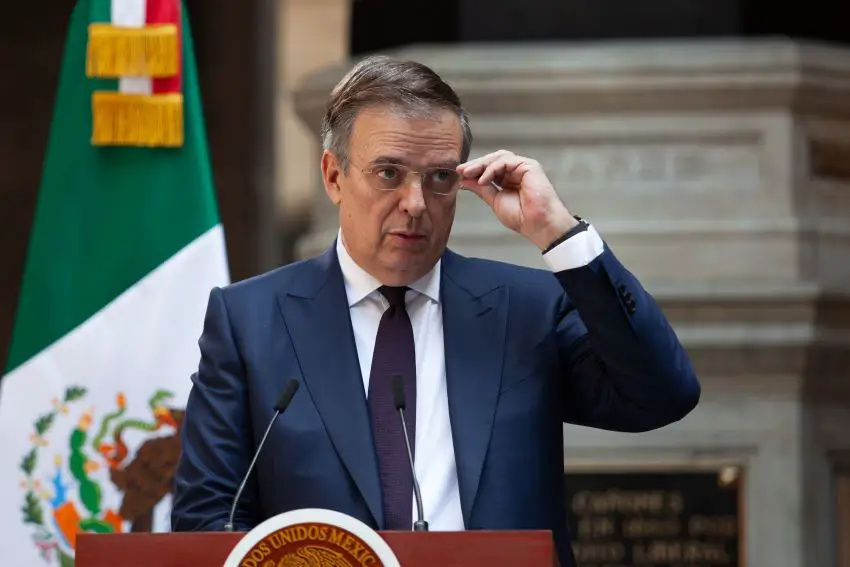
The elimination of autonomous government agencies in Mexico doesn’t violate the United States-Mexico-Canada Agreement (USMCA), Economy Minister Marcelo Ebrard said Thursday.
Nevertheless, in a move aimed at avoiding any violation of the three-way free trade pact, the Chamber of Deputies on Thursday modified a constitutional bill that seeks to disband seven autonomous agencies, including the Federal Economic Competition Commission (Cofece) and the Federal Telecommunications Institute (IFT).
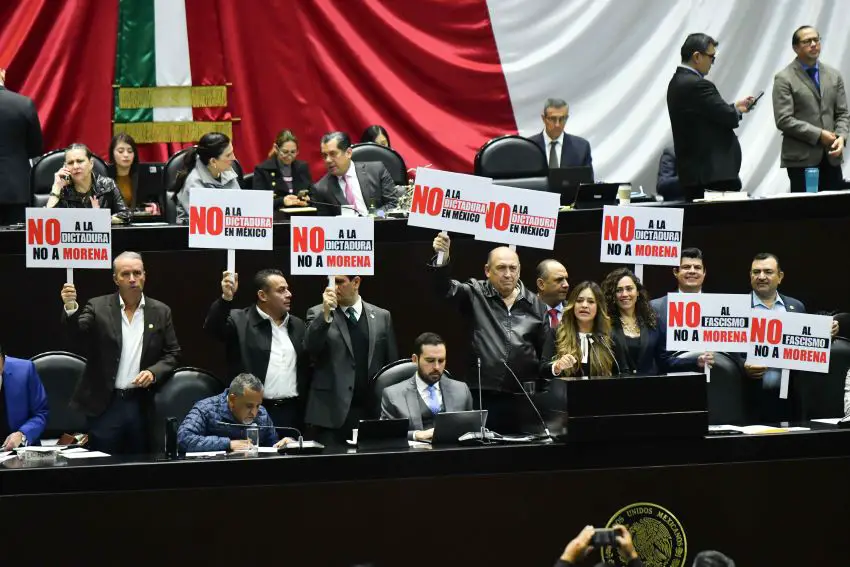
Ebrard’s assertion came a day after the lower house of Congress approved that bill en lo general, or in a general sense.
Reuters reported Thursday that “the scrapping of the telecoms regulator IFT in particular has stirred concerns among investors and analysts, who had warned it appeared to breach the USMCA … and could result in disputes with the United States and Canada.”


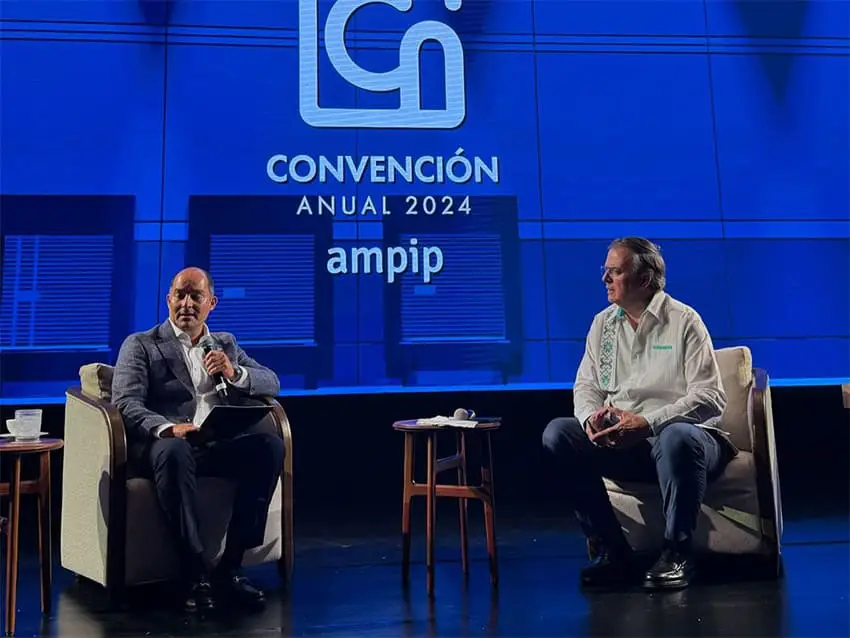
Speaking in Nayarit at the annual convention of the Mexican Association of Private Industrial Parks, Ebrard said “there is no obligation” in the text of the USMCA for the countries that are party to the agreement to have autonomous government agencies.
Such agencies “don’t exist in the Anglo-Saxon legal tradition,” he said, though the United States does have numerous independent regulatory agencies.
“… Autonomous is a concept that we brought from Europe, but … the United States wouldn’t sign an agreement with that principle,” Ebrard said.
The responsibilities of all seven of the autonomous agencies the constitutional bill seeks to disband were slated to be given to government ministries.
However, the Chamber of Deputies on Thursday approved a modification to the bill that allows the creation of a new “technically independent” body that would assume the responsibilities of Cofece, Mexico’s antitrust agency, and the IFT. The purpose of the modification was precisely to avoid falling foul of USMCA provisions.
Reuters reported that “analysts reacted positively to the adjustment” made by the Chamber of Deputies on Thursday, “but remained cautious about the implementation of the reform.”

The responsibilities of five other autonomous watchdog agencies — including the National Institute for Transparency, Access to Information and the Protection of Personal Data (INAI), the National Council for the Evaluation of Social Development Policy and the Energy Regulatory Commission — are slated to go to government ministries.
Before it can be signed into law, the bill needs to be approved by the Senate and a majority of state legislatures, requirements that the ruling Morena party should have little trouble meeting.
Opposition lawmakers argue that the proposed reform will have an adverse impact on transparency, Mexico’s regulatory environment and independent assessment of government policy.
Ebrard: Mexico’s new antitrust system will resemble that of the US
Ebrard said that the constitutional reform proposal that will soon be considered by the Senate will, if passed, create an antitrust system that is “almost exactly the same” as the system in the United States.
The new agency slated to take on the responsibilities of Cofece and the IFT will be “a national body” with “technical independence” whose objective will be to “prevent monopolies,” he said.
“In the United States there isn’t a Federal Telecommunications Institute, but there is a Federal Economic Competition Commission, or its equivalent,” Ebrard said, apparently referring to the United States Federal Trade Commission, which has a Bureau of Competition.
He said that the government’s view is that it is “too much” to have two bodies — Cofece and the IFT — with similar “characteristics.”
The IFT, like Cofece, has antitrust powers, although they are limited to the telecommunications sector.
Does the proposed reform now comply with the USMCA?
Vidal Llerenas, Mexico’s deputy economy minister for industry and trade, told reporters that the modification to the autonomous agencies bill makes a complaint from the United States or Canada unlikely.
“We do not think it will be a controversial issue,” he said.
Deputy Alfonso Ramírez Cuéllar, Morena’s deputy leader in the Chamber of Deputies, said that the new independent body that will take on the work of Cofece and the IFT will “comply exactly with what is established in the USMCA.”
Giving the IFT’s responsibilities to the Infrastructure, Communications and Transportation Ministry (SICT) — as was proposed in the original text of the constitutional bill — would appear to violate the USMCA.

According to article 17 in the telecommunications chapter of the trade deal, “each party shall ensure that its telecommunications regulatory body is separate from, and not accountable to, a supplier of public telecommunications services.”
“With a view to ensuring the independence and impartiality of telecommunications regulatory bodies, each party shall ensure that its telecommunications regulatory body does not hold a financial interest or maintain an operating or management role in a supplier of public telecommunications services,” the article continues.
The new body slated to take on the responsibilities of Cofece and the IFT would be “technically independent” but “assigned” to the SICT.
Ebrard: Mexico will discuss the USMCA with Trump in February
Ebrard said Thursday that Mexican officials will seek to speak to Donald Trump about the USMCA in February, the month after he will be sworn in for his second term as United States president.
“I believe that we will have to speak to President Trump about the agreement from February. Knowing him, it’s better to hurry, right? We’re going to do it and we’re prepared for that,” he said.
Trump said last month that he planned to renegotiate the USMCA, which is scheduled for “review” in 2026.
“I’ll … seek strong new protections against transshipment, so that China and other countries cannot smuggle their products and auto parts into the United States tax free through Mexico to the detriment of our workers and our supply chains,” he said during an address in Detroit.
The day before his victory in the presidential election, Trump pledged to “immediately” impose a 25% tariff on all Mexican exports to the United States if the government of Mexico doesn’t stop what he called an “onslaught” of criminals and drugs to the U.S.
Ebrard subsequently said that Mexico would impose retaliatory tariffs on imports from the United States if the incoming Trump administration slaps tariffs on Mexican exports.
With reports from El Economista, El Universal, Milenio, Reuters and Proyecto Puente
Source: Mexico News Daily