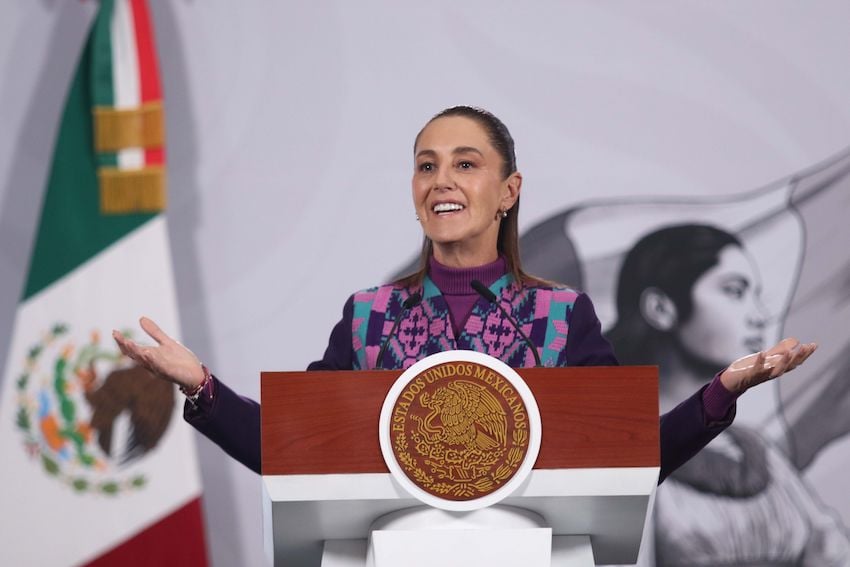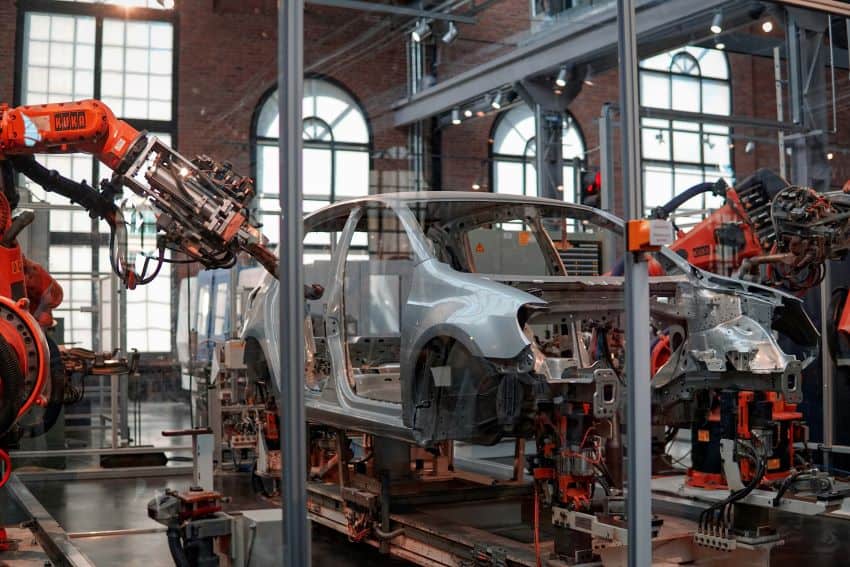
In a concession to automakers in the United States, U.S. President Donald Trump on Tuesday signed two executive orders to relax his auto tariffs, a move that President Claudia Sheinbaum said gives Mexico “an additional comparative advantage.”
The modifications to the 25% tariffs on imported vehicles and auto parts came just over one month after Trump first announced them. The U.S. tariff on imported vehicles took effect on April 3, while the tariff on certain auto parts is set to take effect on May 3.
🚨 @POTUS: “To keep my promise to the great state of Michigan, I terminated Joe Biden’s insane Electric Vehicle Mandate… I’ve just signed an Executive Order to give partial Tariff rebates to any company that assembles its cars right here in the USA.” pic.twitter.com/vGtdmfO7Rk
— Rapid Response 47 (@RapidResponse47) April 29, 2025


The United States’ justification for the duties is that imports of automobiles and certain auto parts pose a threat to the national security of the U.S.
During a speech in Michigan on Tuesday to mark 100 days since he began his second term as U.S. president, Trump said he was giving automakers in the U.S. “a little bit of a break.”
“They took in parts from all over the world. I don’t want that. I want them to make their parts here. But I gave them a little bit of time,” he said.
“… It’s called a little flexibility. … We give them a little time before we slaughter them if they don’t do this,” Trump said.
U.S. content in vehicles assembled in Mexico is exempt from the 25% tariff, lowering the effective duty on vehicles made in Mexico. Trump’s April 29 executive orders don’t change that situation.
Trump offers a partial reimbursement of tariffs on auto parts
According to a White House fact sheet, the United States will now offer an “offset to a portion of tariffs for automobile parts used in U.S.-assembled vehicles equal to 3.75% of the Manufacturer’s Suggested Retail Price (MSRP).”
That offset is retroactive, applying from April 3 of this year and until April 30, 2026.
For a year after that — May 1, 2026 to April 30, 2027 — the offset will be 2.5% of the MSRP of a vehicle.
“These percentages reflect the duty that would be owed when a 25% duty is applied to 15% of the value of a U.S.-assembled automobile in the first year, and to 10% of the value of a U.S.-assembled automobile in the second year,” the White House said.
“All other automobile imports will still be subject to the 25% tariff,” it added.
“… Legislation, pre-existing trade agreements like the USMCA, revisions to the U.S.-Korea Free Trade Agreement, and subsequent negotiations have not sufficiently mitigated the threat to national security posed by imports of automobiles and certain automobile parts,” the White House said.
What do Trump’s coming tariffs mean for Mexico’s auto industry?
No offset on auto parts tariffs will apply after April 30, 2027, at which time the Trump administration expects (or hopes) that vehicle manufactures in the United States will be sourcing more (or all) parts from within the U.S., even though “automakers and suppliers say two years is not enough time for them to reorganize their manufacturing operations,” according to The New York Times.
The U.S. content in parts made in Mexico is exempt from the 25% duty, per Trump’s announcement last month, while the White House said at the time that “USMCA-compliant automobile parts will remain tariff-free until the Secretary of Commerce, in consultation with U.S. Customs and Border Protection (CBP), establishes a process to apply tariffs to their non-U.S. content.”
The New York Times reported that the latest rules “leave in place an exemption for parts imported from Canada and Mexico that comply with a treaty [the USMCA] that Mr. Trump negotiated during his first term.”
It wasn’t clear whether non-U.S. content in Mexican auto parts would be subject to the 25% tariff — with the offsets — at a later date, as originally announced, but the White House indicated that it wouldn’t be taxed anytime soon.
“If a manufacturer builds a car in the U.S. that has 85% U.S. or USMCA content, the manufacturer effectively will not owe tariffs on that vehicle’s production for the first year,” the White House said in its fact sheet.
“If a manufacturer builds a car in the U.S. that is 50% U.S. or USMCA content and 50% imported from elsewhere, then instead of paying the tariff on the full 50% of the imported car parts, the manufacturer effectively only pays on 35% for the first year,” it said.
At her Wednesday morning press conference, President Sheinbaum acknowledged that the United States government originally said that only U.S. content in vehicles and parts made in Mexico would be exempt from U.S. tariffs.
“With the document that was signed yesterday, it is recognized [that the exemption] is not just for the part made in the United States, but in the three [USMCA] countries,” she said.
However, the exemptions only apply to vehicles made in the United States, meaning that vehicles made in Mexico will still be subject to the U.S. tariff, although the rate is lower than the full 25% because U.S. content in those vehicles is not taxed.
Apparently referring to the tariff exemption for USMCA-compliant Mexican parts, Sheinbaum said that “once again there is recognition of the value” of the USMCA.
Steel and aluminum tariffs won’t apply to vehicle and parts imports
In his executive order, Trump outlined rules pertaining to the “non-stacking of tariff measures.”
In effect, different tariffs imposed by the United States government for different reasons won’t apply to the same product in most cases (although some Chinese goods will still be subject to multiple tariffs, for example).
“I have now determined that, to the extent these tariffs apply to the same article, these tariffs should not all have a cumulative effect (or ‘stack’ on top of one another) because the rate of duty resulting from such stacking exceeds what is necessary to achieve the intended policy goals,” Trump said.
Consequently, importers in the United States will be exempt from paying 25% steel and aluminum tariffs on vehicles and auto parts they bring into the country.
The New York Times reported that the executive order said that “carmakers paying a 25 percent tariff to bring in cars and car parts would not be subject to tariffs that Mr. Trump had placed on steel and aluminum imports from Canada and Mexico.”
Trump imposed 25% tariffs on all imports from Mexico in March in order to pressure the Mexican government to do more to stop the flow of migrants and fentanyl to the U.S.
However, he lifted the duties on goods that comply with the USMCA two days later.
The Times reported that “products that are subject to the tariffs on imports from Canada and Mexico will no longer be subject to tariffs on steel and aluminum.”
It also said that “the rules do not appear to protect automakers from tariffs on steel and aluminum that their suppliers pay and pass on.”
“… Even with the concessions announced Tuesday,” the Times reported, the Trump “administration policies will add thousands of dollars to car prices and endanger the financial health of automakers and their suppliers, analysts said.”
Referring to the United States’ decision to not stack one tariff on top of another, Sheinbaum highlighted on Wednesday that “there was a recognition” from the U.S. government that “you can’t charge double” duties for the same product.
She noted that tariffs on vehicles exported to the U.S. “in reality weren’t 25% … but rather 50%,” given that the vehicle itself and the steel and aluminum in it were both subject to duties.
Sheinbaum said that her government is still carefully analyzing the modifications Trump has made to his auto tariffs, and noted that Mexico was given a “comparative advantage” over other countries in March because U.S. content in Mexican (and Canadian) vehicles wasn’t subject to the 25% tariff that was uniformly imposed on vehicles imported from other countries.
“With what was published yesterday, there is an additional comparative advantage, so it’s something that is even more beneficial for our country,” she said.
“Obviously, we’re still seeking greater benefits and greater clarity in order to be able to know what the advantages [for Mexico] are that were published yesterday,” Sheinbaum said.
Mexico is a major exporter of vehicles and auto parts to the United States. Mexico’s total auto sector exports were worth $193.9 billion last year, or 31.4% of Mexico’s total export revenue. Most of that revenue came from exports to the United States.
With reports from Reforma, The New York Times, Reuters and CNBC
Source: Mexico News Daily