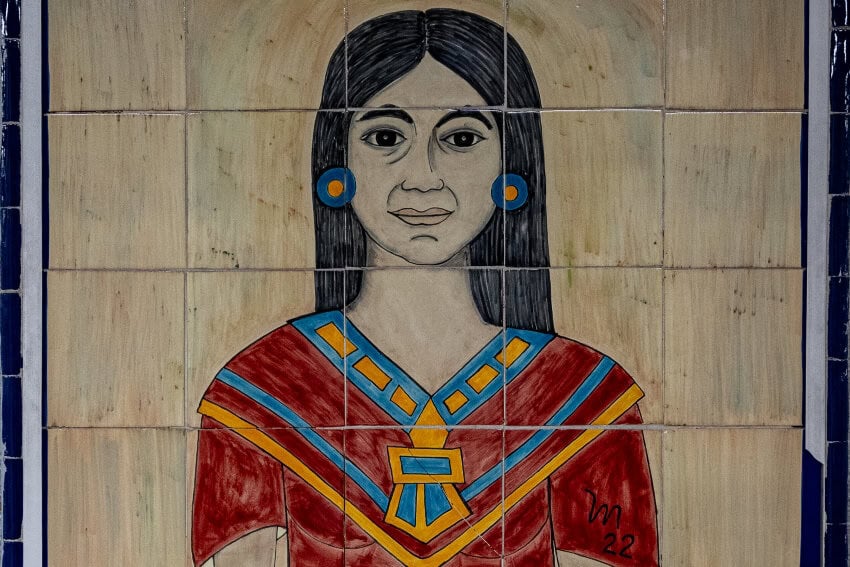
She was born amongst the royalty. In her blood, she bore the lineage of the highest kin in Mexico-Tenochtitlán, the imperial capital of the Mexica Empire. When the invaders from abroad took the city, however, her noble title meant nothing. Nor did her political career as a Tenochca leader: with the arrival of the Spanish colonizers, she lost everything. Not even her name survived.
Recent historiographical research by the Royal Academy of History, in Spain, has traced her profile back to the archives of Conquest documents, in which she is referred to as Isabel Moctezuma: the last Mexica princess who, despite having direct noble blood, was stripped of her power, her land and her identity upon being baptized in the Christian rite.
Doña Isabel Moctezuma Tecuichpo Ixquixóchitl: the empire’s ‘Cotton Flower’
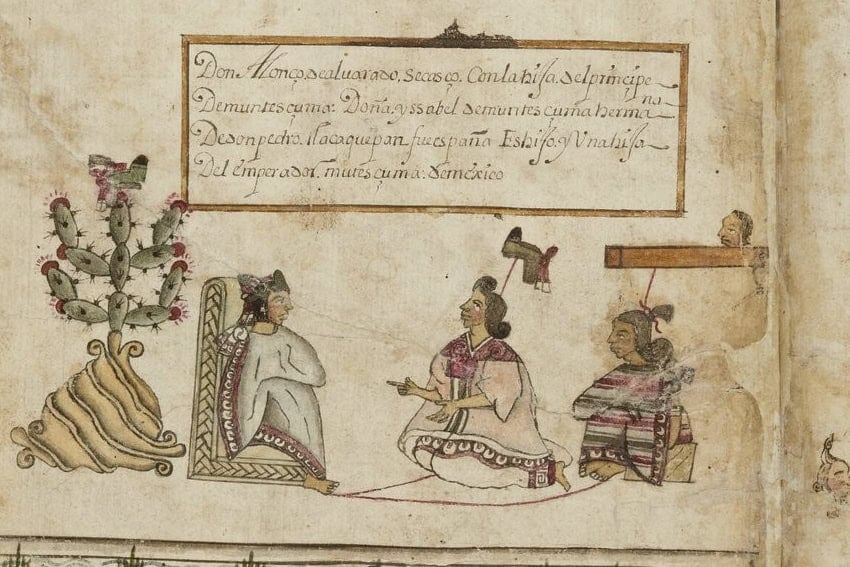
Tecuichpo Ixcaxochitzin was her original name. According to the UNAM’s Institute of Historical Research, the Náhuatl name translates to “Divine Lady” and “Cotton Flower,” respectively. The —tzin suffix was an extremely reverential way of referring to the royal family — and even goddesses and gods. However, as part of the scorching process of Conquest, this record lost its validity in the territory that was once under Mexica rule. Although her birth name was changed to Isabel Moctezuma, this political figure has been revisited in film, theater and various historical novels.
She was the daughter of Moctezuma II and Empress Consort Teotlacho. For this reason, she was a powerful and respected woman from birth, around 1509. Among her descendants, it is known that Moctezuma Xocoyotzin had a particular fondness for his daughter Tecuichpo. While the city-state was free, they built a strong father-daughter relationship. Given that she was born to such influential figures, in the highest rank of the Mexica royalty, some authors consider her the last empress of Mexico-Tenochtitlán.


A change of sides
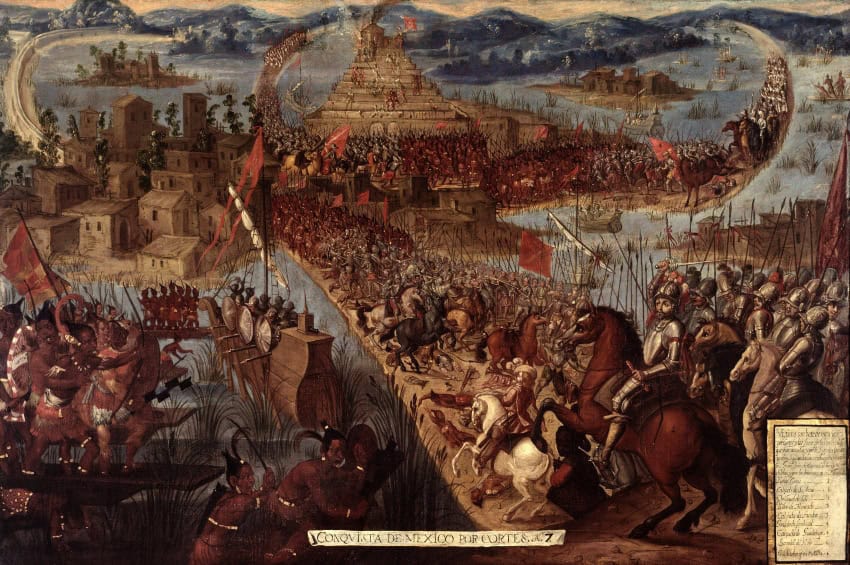
The imperial capital was under siege. When Moctezuma II was taken prisoner by the Spanish, Tecuichpo Ixcaxochitzin was the only one who visited him at Cortés’s headquarters.
After nights of torture, the emperor was very weak. He asked the Spanish general to take care of his three daughters, because the Mexica reign had come to an end. If he didn’t leave them in the care of the new rulers, a grim future awaited them. Cortés kept his word, and to protect them, he changed their names to Christian ones.
Now known as Isabel Moctezuma, she was a woman of many men. Ancient codices suggest she was married five times — twice to Mexica emperors and thrice to Spanish generals — and even had a bastard daughter with the invader Hernán Cortés, whom she refused to recognize as her own kin. So yes, harsh, but Doña Isabel Moctezuma knew what she wanted in life
Thus, a new chapter began in her life. Instead of being a lady among Mexica royalty, Tecuichpo assumed the identity of Isabel Moctezuma, in honor of her deceased father. She even took the name of the ruler of Castile across the sea. With the blessing of the colonizing priests, she completed the process of Catholic baptism and secured a few years of peace as a new member of the ruling group.
Her best man was Cortés himself. This was the first marriage recognized by the Spanish. However, before the invasion, she had already been married to Cuitláhuac, the lord of Iztapalapa. After the death of her first husband, the Spanish administrators cared little for her widowhood and arranged another political union with Cuauhtémoc, the last Mexica tlatoani (ruler).
Feathers and precious stones
Cuauhtémoc was accused of treason. Without further ado, the Spanish soldiers executed him in cold blood, after a night of torture. Thus, Isabel Moctezuma was widowed once again. A few months later, Cortés arranged her third marriage with one of his trusted representatives. By then, in 1528, Tecuichpo Ixquixóchitl had become pregnant with his daughter.
Although Cortés did recognize the child, for the former Mexica ruler, the birth of her first daughter always represented an inner conflict. They named her Leonor, and she adopted her biological father’s surname. Although they were in close contact, they lived in different places. While the general managed his conquests from his villa in Coyoacán, Leonor lived with her mother in the perpetual encomienda of Tlacopan.
Daughter of Cortés
Although she shared a home with her mother’s husband, the explorer Alonso de Grado, she never acknowledged him as her father. On the contrary, the young girl was very clear that she was Cortés’s daughter, and understood the social standing that this guaranteed her. At the same time, Tecuichpo Ixquixóchitl retained the respect of her former Mexica subjects, now subjugated by the Spanish armed forces.
Thus, until the end of her days, she earned the respect of the Spaniards for her skill in navigating their circles of power. Shortly after turning 40, however, the former Mexica leader died at her estate in Tlacopan. She was buried according to the traditions of her people, with precious stones and feathers crafted in Coyoacán. In her will, she granted freedom to the Mexica slaves who worked her land and allocated one-fifth of all her wealth to pay off the debts of her servants.
Andrea Fischer contributes to the features desk at Mexico News Daily. She has edited and written for National Geographic en Español and Muy Interesante México, and continues to be an advocate for anything that screams science. Or yoga. Or both.
Source: Mexico News Daily