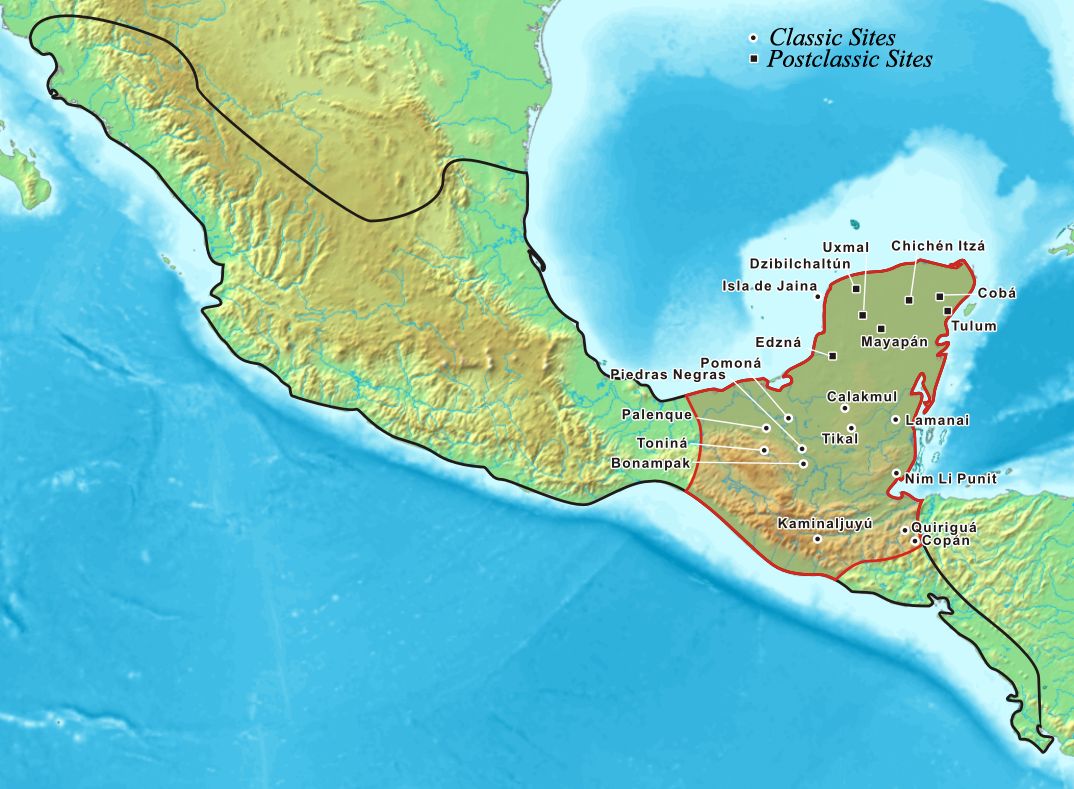
The Maya Civilization
The Maya civilization was an advanced Mesoamerican culture known for its achievements in writing, astronomy, mathematics, and monumental architecture, flourishing across present-day Mexico and Central America.
Its cities were abandoned centuries before European contact, for reasons still debated by archaeologists, yet the writing system and calendar this civilization developed remain some of the most sophisticated of the ancient Americas.
City-States, Not an Empire
Rather than a single unified empire, Maya civilization consisted of numerous independent city-states across the Yucatán Peninsula and surrounding regions, each with its own rulers, though sharing common religious beliefs, writing systems, and cultural practices.
The Classic Period
Maya civilization reached its cultural height during the Classic Period, roughly 250 to 900 CE, when major cities including Tikal and Chichen Itza flourished as significant political, religious, and economic centers.
A Sophisticated Writing System
The Maya developed one of the only fully developed writing systems in the pre-Columbian Americas, using hieroglyphic script to record history, astronomy, and religious ceremonies on stone monuments and folded bark-paper books.
Mastery of the Calendar
Maya astronomers developed a remarkably sophisticated understanding of celestial movements, creating an extraordinarily precise calendar system that tracked time across multiple interlocking cycles with an accuracy that rivaled or exceeded contemporary systems elsewhere in the world.
A Civilization That Endures
Although many major Maya cities were mysteriously abandoned by around 900 CE, for reasons still debated among historians and archaeologists, Maya culture and millions of descendant Indigenous people continue to exist today, preserving elements of their ancestral languages and traditions.