🔬 Science & Nature
Scientific concepts, discoveries, and the natural world

Genetic Engineering is the direct manipulation of an organism's genetic material to alter its characteristics, with applications spanning agriculture, medicine, and scientific research.

Genetics is the scientific study of genes, heredity, and genetic variation, developed significantly beginning in the 19th century and foundational to modern biology.

Giant pandas are large bear species native to central China, known for their distinctive black-and-white coloring and near-exclusive diet of bamboo, and long serving as a global symbol of wildlife conservation.

Gorillas are the largest living primates, native to equatorial Africa, known for their significant genetic similarity to humans and complex social structures.

Gravity is the fundamental force of attraction between objects with mass, responsible for holding planets in orbit and shaping the large-scale structure of the universe.
Gregor Mendel was an Austrian friar and scientist whose experiments with pea plants established the fundamental laws of heredity, earning him recognition as the founder of modern genetics.

Hibernation is a state of significantly reduced metabolic activity that certain animals enter to survive periods of cold temperatures and scarce food availability.

Homeostasis is the biological process by which organisms maintain stable internal conditions despite external environmental changes, fundamental to survival across all living species.

Honeybees are social insects renowned for their complex hive structures and critical role as pollinators, supporting a significant portion of global food crop production.

Hormones are chemical messengers produced by the endocrine system that regulate numerous bodily functions including growth, metabolism, and mood, traveling through the bloodstream to target organs.

Hummingbirds are small birds native to the Americas, known for their extraordinary hovering flight ability, rapid wing beats, and remarkably high metabolic rates.

Led the scientific team that developed the first atomic bomb during World War II's Manhattan Project, later becoming a prominent advocate for nuclear arms control

Formulated the classical theory of electromagnetic radiation, unifying electricity, magnetism, and light into a single framework

Jane Goodall is a British primatologist whose groundbreaking long-term study of wild chimpanzees in Tanzania transformed scientific understanding of primate behavior and human-animal relationships.

Jellyfish are simple marine invertebrates found in oceans worldwide, notable for their gelatinous bodies, ancient evolutionary history, and some species' significant longevity or venomous stings.

Jupiter is the largest planet in the solar system, a gas giant known for its Great Red Spot storm and extensive system of moons including four large Galilean satellites.

A NASA mathematician whose precise orbital calculations were critical to the success of early American crewed spaceflight missions

Lions are large cats native primarily to sub-Saharan Africa, known for their distinctive social structure living in prides and the male's iconic mane.

Louis Pasteur was a French chemist and microbiologist whose research confirmed the germ theory of disease and led to life-saving developments including pasteurization and early vaccines.

Magnetism is a physical phenomenon involving forces exerted by magnets and electric currents, studied scientifically since ancient times and foundational to numerous modern technologies.

Mars is the fourth planet from the Sun, known as the "Red Planet" for its distinctive coloring, and a significant focus of ongoing space exploration and potential future human missions.
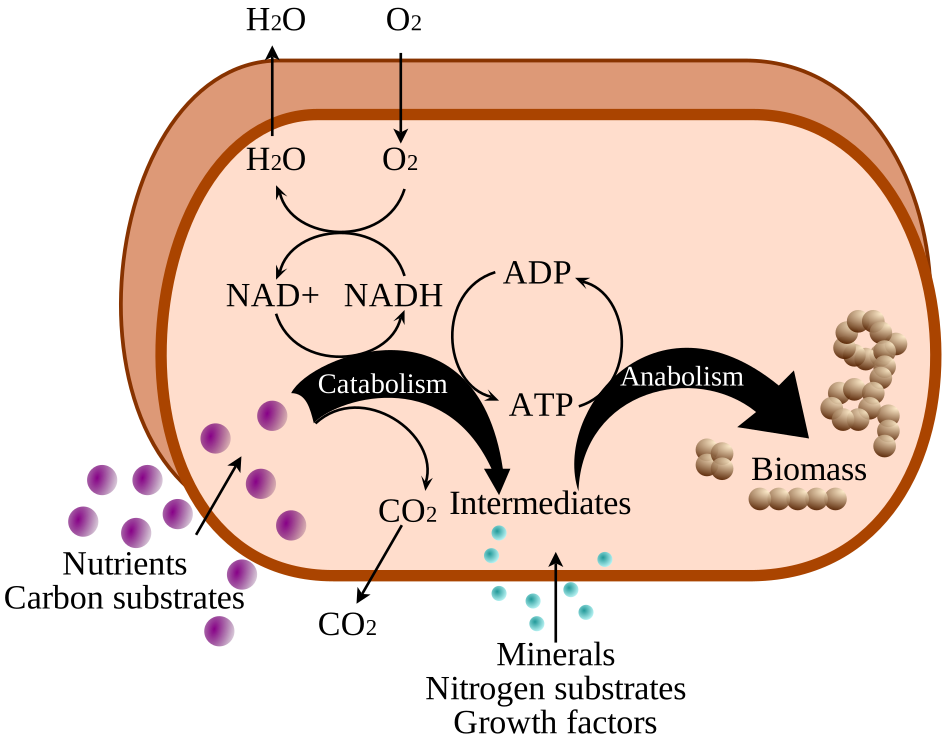
Metabolism refers to the complete set of chemical processes that occur within living organisms to maintain life, including converting food into energy and building necessary biological compounds.

Metamorphosis is a biological process in which an animal undergoes a dramatic physical transformation between distinct life stages, most famously observed in butterflies and frogs.

Groundbreaking discoveries in electromagnetism and electrochemistry, including the principle behind the electric motor